Shopping · Anime
What to buy in Akihabara: electronics, retro games, capsule toys, trading cards and where each shop is
Akihabara sells far more than anime goods: overseas-model electronics, PC parts, second-hand phones, retro games, capsule toys and trading cards, all around one station. This guide sorts the district by what you want to buy, names the shop and its floor, and gives hours and prices from each shop's own page. All of it was read from official pages on 12 October 2026.
Last checked · Sources

In short
The best things to buy in Akihabara are overseas-model electronics, retro video games, capsule toys, trading cards and anime figures. For electronics, start at Yodobashi Camera Multimedia Akiba, joined to the station and open from 9:30 to 22:00, or at Bic Camera AKIBA, open from 10:00 to 22:00. For retro games, go to Super Potato on floors three to five of its building. Capsule toys cost mostly 300 to 500 yen a turn, and Akihabara Gachapon Hall sells nothing else. Most shops open at 10:00 or 11:00 and close around 20:00.
What to buy in Akihabara
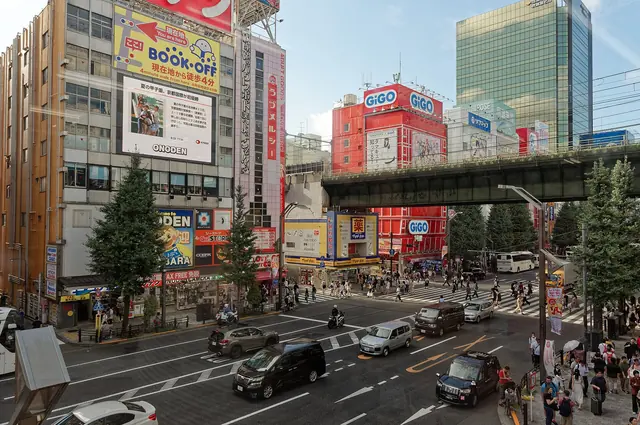
Akihabara is the part of Tokyo to buy electronics, PC parts, retro video games, capsule toys, trading cards and anime figures. The big stores sell new appliances over many floors; the small shops beside the railway tracks and on upper floors sell components, second-hand phones and old game cartridges. The furthest shop this guide gives a walking time for is seven minutes from the Electric Town exit of JR Akihabara Station.
Tokyo's official travel guide sums up how the district got here: "Once home to black-market sellers of electronics parts in postwar Japan, the streets of Akihabara are now densely packed with legitimate electronics retailers hawking everything with a current."
| What to buy | Where | Hours |
|---|---|---|
| New electronics | Yodobashi Camera Multimedia Akiba | 9:30–22:00 |
| New electronics | Bic Camera AKIBA | 10:00–22:00 |
| Overseas-model appliances | Onoden main store | 10:00–20:00 |
| PC parts | TSUKUMO eX. | 11:00–21:00 |
| Electronic components | Tokyo Radio Department Store | 10:00–19:00, varies by shop |
| Second-hand phones | Janpara Akihabara main store | 11:00–19:30 |
| Retro games | Super Potato Akihabara | 11:00–20:00 |
| Capsule toys | Akihabara Gachapon Hall | 11:00–20:00 on weekdays |
| Trading cards | Card shops in Akihabara Radio Kaikan | 10:00–20:00 |
| Handmade goods | 2k540 AKI-OKA ARTISAN | 11:00–19:00, closed Wednesdays |
Every shop named below is listed on an official page that was read for this guide: the shop's own website, its building's directory, the shop list of the Akihabara Electrical Town Organization (the district's own association of shops) or an official tourism guide. No official source ranks these shops by price, so this guide does not either.
Electronics in Akihabara: the big stores
For new electronics, two stores cover almost everything: Yodobashi Camera Multimedia Akiba, joined to the station, and Bic Camera AKIBA, with seven floors. Travellers who want an appliance built for use abroad should also look at Onoden and AKKY, which both stock overseas models.
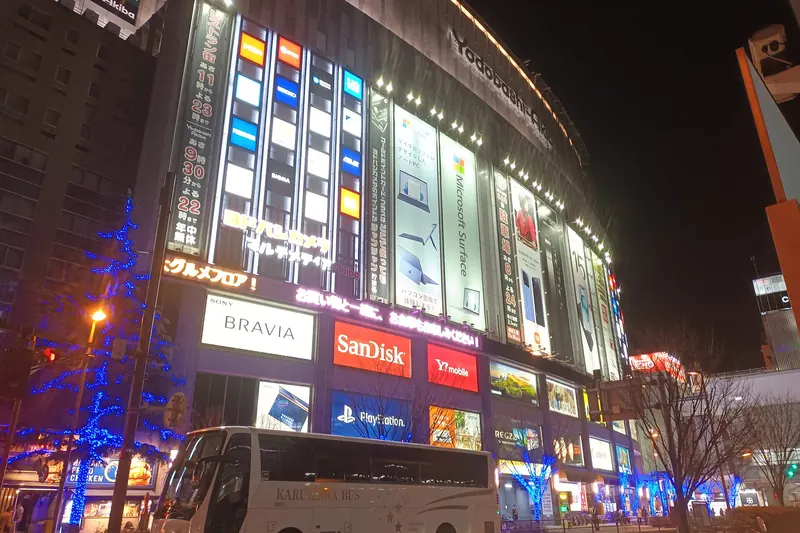
Tokyo's official guide gives the scale of the district: "Akihabara Electric Town began as a small 1 km2 area near JR Akihabara Station densely packed with 1,000 electronics stores."
| Store | Hours | Good for |
|---|---|---|
| Yodobashi Camera Multimedia Akiba | 9:30–22:00 | A whole building joined to the station, with restaurants and other shops inside |
| Bic Camera AKIBA | 10:00–22:00, every day | Seven floors, from computers on 1F to toys and games on 7F |
| Onoden main store | 10:00–20:00, every day | Overseas-model appliances and souvenirs on 1F |
| EDION AKIBA | 10:00–20:00, every day | Home appliances, imported appliances, TVs |
| AKKY main store | 9:30–20:00, every day | Electrical goods for use overseas, travel goods |
Yodobashi Camera Multimedia Akiba
Yodobashi's Akihabara store stands at 1-1 Kanda Hanaokacho, Chiyoda City. Its own access page says the building connects directly to Akihabara Station and its five lines, and that it has parking for 520 cars. Yodobashi Camera itself opens from 9:30 to 22:00. The same building also holds:
- 1F: a Travelex currency exchange counter and ATMs of Resona Bank and MUFG Bank. This site has not confirmed whether those ATMs accept cards issued abroad.
- 7F: speciality shops open from 9:30 to 22:00, among them DAISO (household goods), UNIQLO, the shoe chain ABC-MART and the glasses chain JINS.
- 8F: restaurants, open from 11:00 to 23:00.
The store's pages list those tenants, but this site could not read a floor guide for Yodobashi's own sales floors, so it does not say which floor sells what. Check the floor guide at the entrance.
Bic Camera AKIBA
Bic Camera AKIBA is at 4-1-1 Sotokanda and opens from 10:00 to 22:00 every day of the year. The Akihabara Electrical Town Organization's page for the store, updated in May 2026, lists the floors:
- 1F: computers, printers and an Apple Shop
- 2F: gaming PCs and PC peripherals
- 3F: mobile phones, SIM cards, audio, and service and support
- 4F: beauty appliances and cosmetics
- 5F: cameras, watches, suitcases and stationery
- 6F: fridges, washing machines, air conditioners, kitchen appliances, TVs, recorders and lighting
- 7F: toys and games
The third floor is the one most visitors need: a SIM card and a pair of headphones sit on the same level.
Onoden: overseas models two minutes from the station
Onoden's main store is at 1-2-7 Sotokanda, two minutes on foot from the Electric Town exit, and opens from 10:00 to 20:00 every day. It is the easiest place in the district to see appliances sold for use abroad, because the first floor is laid out for travellers:
- 1F: shavers, hair dryers and hair irons; overseas-model cooking appliances, air purifiers, irons, vacuum cleaners and electronic toilet seats; folk crafts and iron kettles as souvenirs; suitcases, instant cameras, binoculars, batteries, calculators, power strips, plastic models and T-shirts. A currency exchange machine stands on this floor.
- 2F: general home appliances and seasonal goods.
- 3F: audio-visual equipment, information equipment, bicycles and watches.
Onoden's online shop has a category for overseas models. On 12 October 2026 it held 75 items: 35 audio-visual products, 30 suitcases and travel goods, 5 beauty appliances, 3 kitchen appliances, 1 household appliance and 1 under transformers and plugs. Four of the Sony overseas models give an idea of prices:
| Overseas model on Onoden's online shop | Price with tax |
|---|---|
| Sony WH-CH730N | 22,000 yen |
| Sony IER-M500 | 19,800 yen |
| Sony WF-C510 | 9,900 yen |
| Sony WH-CH530 | 7,700 yen |
Suitcases in the same category ran from 17,600 to 25,080 yen with tax. Stock in the shop and stock online are not promised to match, so read the table as a price range, not a promise.
EDION AKIBA and AKKY
EDION AKIBA is at 1-2-9 Sotokanda, in the same numbered block as Onoden, and opens from 10:00 to 20:00 every day. Its listing with the town organisation, last updated in October 2019, covers home appliances, beauty appliances, lighting, imported appliances and TVs.
AKKY's main store is at 1-12-1 Sotokanda. The town organisation's page for it, also last updated in October 2019, gives hours of 9:30 to 20:00 every day and says the whole building, from the basement to the third floor, stocks electrical goods for use overseas and travel goods, along with folk-craft souvenirs. Its product list includes Windows desktop and notebook computers described as world-standard models. This site could not read AKKY's own website, so confirm the hours at the door.
Will it work at home? Voltage and warranty
JNTO's page on electricity says the mains supply is 100 volts everywhere in Japan, at 50 hertz in the east of the country and 60 hertz in the west. An appliance built only for the Japanese market expects exactly that. JNTO adds that transformers are sold in electronics districts such as Akihabara and at the big chains, Yodobashi Camera and Bic Camera among them. The what to buy in Japan page on this site quotes JNTO's own wording.
Shops answer the problem with overseas models, appliances made for use outside Japan. Neither Onoden's page nor AKKY's gives the voltage of each item, so read the rating label before you pay. You want it to show your own country's voltage, or a range such as 100–240V.
Tokyo's official walking guide to the district lists this among its general tips: "Before buying electronics, check that the store offers an international warranty". Ask at the counter before you pay, and ask whether the menus and the manual come in English.
Is Akihabara cheap for electronics?
No official source compares Akihabara's prices with prices abroad, or one Akihabara shop with another, so this site does not quote a saving. Two things an official page does confirm can lower what you pay:
- Tax-free shopping. Bic Camera AKIBA, Onoden, EDION AKIBA and AKKY are all on the town organisation's list of tax-free shops. The rules are in the tax-free section below.
- Second-hand shops. Used phones, PCs and games are sold a few streets from the big stores. They come next.
PC parts, components and second-hand electronics in Akihabara
For PC parts, go to TSUKUMO eX. on Chuo-dori. For loose electronic components, go to Tokyo Radio Department Store, two minutes from the Electric Town exit, or to the fifth floor of Radio Kaikan. For a second-hand phone, go to Janpara's main store.
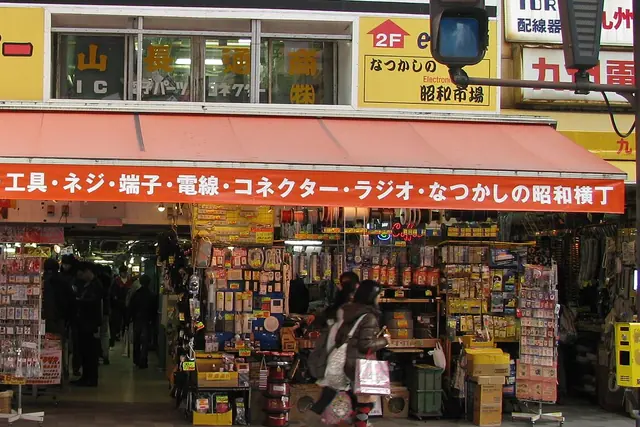
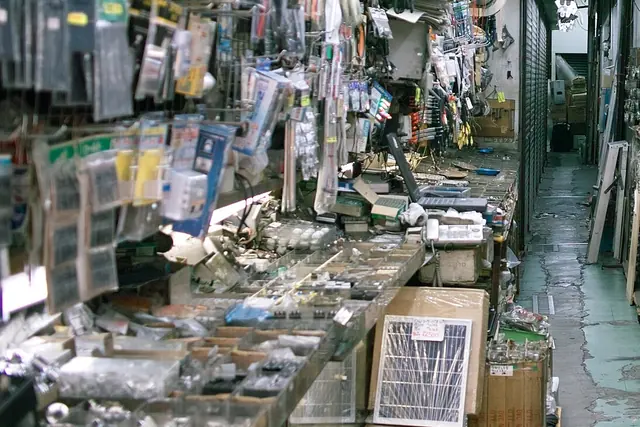
JNTO traces the district's nickname to the years after the war: "Akihabara got its nickname Electric Town from the black market that sprouted there after WWII." It goes on: "Common items being sold at the time included wires, cables, light bulbs and other electrical items." Shops selling exactly those things are still open.
Electronic components: three buildings by the station
Tokyo Radio Department Store (Tokyo Rajio Depato) is at 1-10-11 Sotokanda, beside the elevated tracks. Its own site calls it Japan's first department store for electronic components, with about 70 years of history, and says about 36 shops fill four levels of its six-storey building, the first basement up to the third floor. They sell vacuum tubes (valves), resistors, capacitors, switches, junk parts and kits. Hours are 10:00 to 19:00 and vary by shop.
Akihabara Radio Centre is the one Tokyo's official guide names: "Akihabara Radio Kaikan offers anime and character-related goods, while Akihabara Radio Centre sells amateur radio and electronic equipment." Its own site lists shops for volume controls, capacitors and switches; for transformers and power supplies; for wire and wiring fittings; for three-band radios and vacuum tubes; for tools; and for amateur radio. This site did not find opening hours on the pages it read, so it gives none.
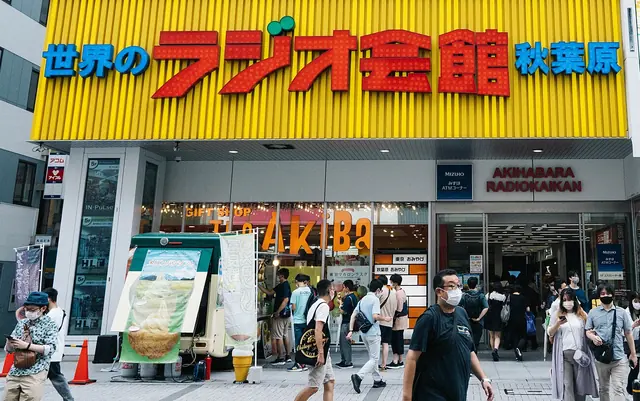
Akihabara Radio Kaikan is better known for figures, but two of its shops belong in this section:
- Wakamatsu Tsusho (5F). An electronic components shop with more than 80,000 items: transistors, ICs, diodes, resistors, capacitors, vacuum tubes, transformers and kits. Open 10:00 to 19:00, and 10:00 to 18:30 on Tuesdays, Saturdays and Sundays.
- TOMOCA Proshop (2F). Professional broadcast equipment and pro audio: speakers, mixers, amplifiers, microphones, cables and connectors. Open 10:00 to 20:00.
PC parts: TSUKUMO eX.
JNTO describes how the district moved on from fridges and televisions: "But as these appliances became commonplace, Akihabara shifted towards calculators and watches, toys and games, and from the 1990s, computers and other technology."
TSUKUMO eX. is the clearest example. The town organisation's page describes it as the black building that stands out on Chuo-dori, with PC parts on every level between the first basement and the sixth floor: CPUs, memory, SSDs, motherboards and graphics cards. It is at 4-4-1 Sotokanda, opens from 11:00 to 21:00 and closes only on New Year's Day. The page was last updated in August 2020.
For a finished computer instead of parts, Bic Camera AKIBA sells computers on its first floor and gaming PCs on its second.
Second-hand phones, PCs and games
- Janpara Akihabara main store. On the first floor at 4-4-9 Sotokanda, open 11:00 to 19:30 every day. The town organisation's page, last updated in July 2022, calls it the only Janpara in Akihabara that specialises in second-hand mobile phones, with smartphones, tablets and handsets from overseas.
- Sofmap AKIBA Amusement Building. At 1-10-8 Sotokanda, open 10:00 to 20:00 every day. Its listing, last updated in May 2021, covers second-hand game software and second-hand music and video software, and says the shop buys as well as sells.
Before you buy a used phone, ask the shop whether the handset will work on your network at home. This site has found no official page that answers that question, and it is the one that decides whether the phone is a bargain.
Retro games in Akihabara
For retro games in Akihabara, go to Super Potato first, then to BEEP Akihabara for arcade boards and old computers, and to Sofmap's Amusement Building for second-hand games on newer consoles.
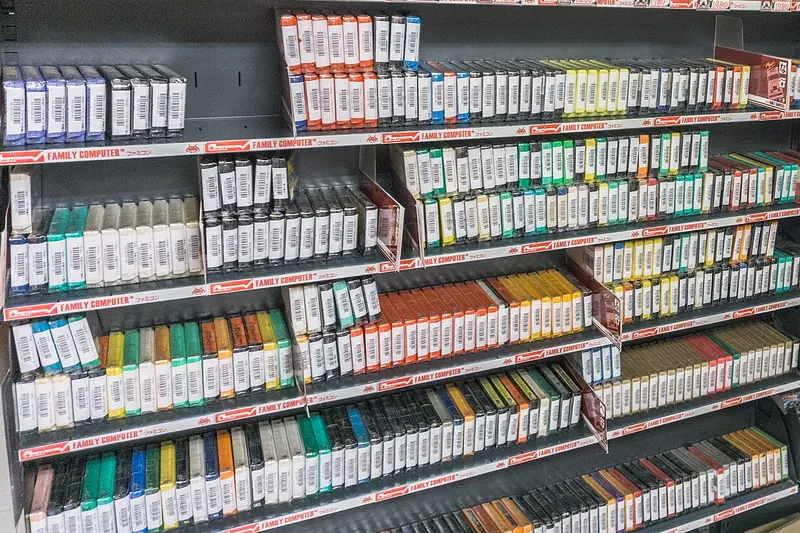
JNTO singles one shop out: "Super Potato is a famous video game store that epitomizes the otaku lifestyle." Tokyo's official guide explains where shops of this kind hide: "Plus, the alleyway just off the main road is full of niche specialty shops for dedicated fans, selling retro games, computer parts, and more."
Super Potato Akihabara
JNTO describes the inside: "Decked out with retro games over three floors, relive your childhood by wandering through aisles of original Nintendo (Famicon) and game consoles including Nintendo 64, PlayStation, Sega Saturn, and the original Game Boy." And the top floor: "It is also home to a game arcade that features, of course, games from the 1980s and 1990s."
The shop's own page fills in the details:
- Where: floors 3, 4 and 5 of a building at 1-11-2 Sotokanda.
- Hours: 11:00 to 20:00, on weekdays, weekends and public holidays alike, every day of the year.
- What it sells: games and consoles from the Famicom and the Mega Drive to far rarer machines, plus dagashi (old-fashioned cheap sweets) and character goods.
- 5F: a game centre lined with old arcade cabinets. The page says you are welcome to come up just for a rest.
The same page claims the largest stock of retro games in Japan. That is the shop's own claim, not a ranking this site can check.
BEEP Akihabara
BEEP buys and sells retro games, retro PCs, and arcade circuit boards and cabinets. It is inside SEEKBASE at 15-1 Kanda Neribeicho, seven minutes on foot from the Electric Town exit and three minutes from Suehirocho Station on the Ginza Line. Hours are 12:00 to 20:00 on weekdays and 11:00 to 20:00 on Saturdays, Sundays and public holidays. It is closed on Wednesdays.
Sofmap AKIBA Amusement Building
The town organisation's page describes this as a specialist game shop: consoles, video games and PC games, music and video software, figures and plastic models, both new and second-hand. It is the place to look for a used game on a current console. For new releases, the seventh floor of Bic Camera AKIBA is toys and games.
Will a Japanese game work on your console?
This site has found no official page it can quote on which Japanese games and consoles work with machines sold in other countries, so it gives no rule. Look up your own console on its maker's support pages before you buy, and ask the shop whether the game has an English language option.
Neither Super Potato's page nor BEEP's gives a price list, so for retro game prices this site does not quote one.
Anime goods and figures in Akihabara
For anime goods, start at Akihabara Radio Kaikan and at animate Akihabara. Tokyo's official guide names two buildings full of anime, manga and game shops: the Akiba Cultures Zone and Radio Kaikan.
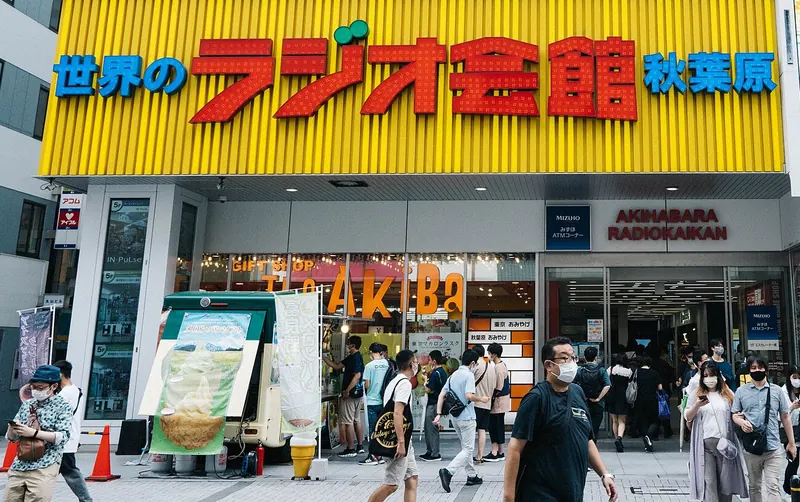
animate Akihabara is at 4-3-1 Sotokanda and reopened after a refit on 8 August 2026. Building 1 sells character goods on floors 1 to 6, and both it and Building 2 keep hours of 10:00 to 21:00 all week.
Figures need a guide of their own, and this site has one. The shop-by-shop list for Radio Kaikan, price examples, second-hand shops, how to spot a bootleg and how to get a figure home are in where to buy anime figures in Japan. For museums, cafes, arcades and the other anime districts, see Japan for anime fans.
Two shops already covered above also sell hobby goods: Onoden's first floor has plastic models and T-shirts, and Sofmap's Amusement Building has figures and plastic models.
Capsule toys in Akihabara: Gachapon Hall and what a turn costs
Akihabara Gachapon Hall is a shop of nothing but capsule-toy machines, two minutes on foot from Suehirocho Station. Most capsule toys cost 300 to 500 yen a turn, which makes them the cheapest souvenir in the district.
Tokyo's official guide lists it among the district's sights: "Akihabara Gachapon Hall, a popular capsule toy specialty store, offers capsule toys of beloved movie and anime characters and more." The city's walking guide explains how it works: "Just off the main street, this shop is completely given over to capsule machines; put in your coins, turn the dial and get your prize inside a plastic ball." And why people bother: "The toys are often bizarre and finely detailed, making them a perfect, cheap Tokyo souvenir."
Akihabara Gachapon Hall: where and when
- Where: the first floor at 3-15-5 Sotokanda.
- Station: two minutes on foot from Suehirocho on the Ginza Line, or seven minutes from the Electric Town exit of JR Akihabara Station.
- Hours: the shop's page gives 11:00 to 20:00 on weekdays and 11:00 to 19:00 on Sundays and public holidays. It has no separate line for Saturdays, and it asks visitors to check the latest hours on the shop's X account.
The Hall publishes a schedule of the month's new arrivals. The October 2026 schedule, updated on 1 October, includes toys from Pokémon, Chiikawa, Fate/stay night and Jurassic World. You cannot choose which toy in a series drops out: that is the game.
How much do capsule toys cost?
The Hall's own pages give no price list. Bandai's official Gashapon site is the closest thing to one. On 12 October 2026, almost all the toys shown on its front page were priced at 300, 400 or 500 yen, with a few at 800 yen.
The machines take coins, so arrive with change. Which coins each machine accepts is something this site has not confirmed.
More capsule toys nearby
The animate Akihabara Annex gives its first basement and first floor to capsule toys. Annex hours are 10:00 to 21:00 on weekdays, with a 20:00 close on weekends and public holidays.
Pokémon cards and trading cards in Akihabara
Akihabara has no Pokémon Center, but Akihabara Radio Kaikan has five trading-card shops that this site has confirmed, and three of them name the Pokémon Trading Card Game on their pages. All five open from 10:00 to 20:00.
| Shop | Floor | What its page lists |
|---|---|---|
| Hobby Station Akihabara Radio Kaikan | 1F | Magic: The Gathering, Vanguard, Duel Masters, Pokémon Trading Card Game |
| Treca Park AKIBA Radio Kaikan | 7F | New and second-hand cards, card supplies, a free play space |
| Card Labo Akihabara Radio Kaikan main store | 9F | Booster packs, starter decks and single cards; Yu-Gi-Oh!, Pokémon, Magic, Duel Masters |
| BIG MAGIC Akihabara | 9F | Trading cards in general, a play space |
| Fullcomp Akihabara Radio Kaikan | 9F | Second-hand single cards, booster packs, pre-built decks; Yu-Gi-Oh!, Duel Masters, Pokémon |
Card Labo's page claims one of the largest play spaces in Akihabara, with 100 seats, and its buying counter takes cards from 12:00 to 18:45. With three card shops on one floor, the ninth floor is the place to compare.
Is there a Pokémon Center in Akihabara?
No. The Pokémon Company's official shop list, read on 12 October 2026, has no shop in Akihabara. Its Tokyo shops are:
- Pokémon Center Tokyo DX: 5F, Nihombashi Takashimaya S.C. East Building, 2-11-2 Nihonbashi, Chuo City
- Pokémon Center Mega Tokyo: 3-1-2 Higashi-Ikebukuro, Toshima City
- Pokémon Center Shibuya: 15-1 Udagawacho, Shibuya City
- Pokémon Center Skytree Town: 1-1-2 Oshiage, Sumida City
- Pokémon Store Tokyo Station: 1F, First Avenue Tokyo Station, 1-9-1 Marunouchi, Chiyoda City
The Tokyo Station shop is the simplest to add to an Akihabara day: Tokyo Station is four minutes from Akihabara on the JR Yamanote Line.
What the card shops' pages do not say
- Language. None of the five pages says which languages its cards are printed in. Check the card before you pay if you need English.
- Prices. None gives a price list, and single-card prices move daily, so this site does not quote one.
- Stock. None promises that a given set is on the shelf. A page that lists a game is saying the shop deals in it, not that today's release is in stock.
Cheap and unusual things to buy in Akihabara
The cheapest thing worth carrying home is a capsule toy. The most unusual is an amulet for your computer. Between them sit handmade goods, regional food and the small souvenirs that the electronics shops keep by the door.

Under 1,000 yen
- Capsule toys. Mostly 300 to 500 yen a turn, as above.
- Dagashi. Super Potato sells these old-fashioned cheap sweets beside its retro games.
- Household goods. DAISO has a shop on floor 7 of the Yodobashi building, the same floor as UNIQLO.
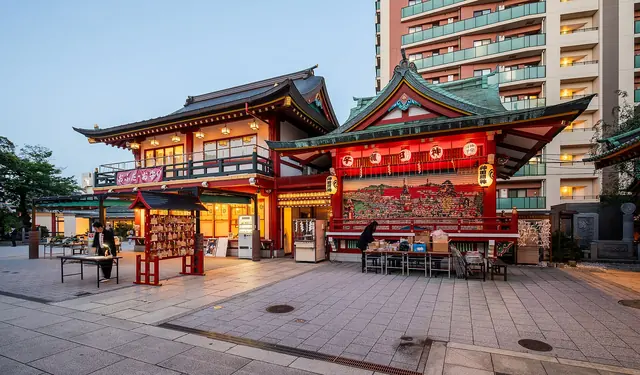
An IT amulet from Kanda Myojin
Kanda Myojin is a shrine seven minutes on foot from the Electric Town exit and five minutes from Suehirocho Station. Its own English history page dates it: "It was moved to Kanda-dai at the beginning of the Edo period in 1603 due to an expansion program of the Edo castle, and further changed its location to the current site in 1616."
Among its amulets is one that suits the district, an IT amulet (IT shugo). The shrine's English label for it reads: "Preventing information leakage." The offering is 1,000 yen. The shrine's Japanese description says it is a prayer for the safe working of a computer. The shrine's page on sending amulets by post forbids selling them on behalf of others, using them as prizes or using them for profit, so buy one for yourself or as a gift.
The shrine is at 2-16-2 Sotokanda.
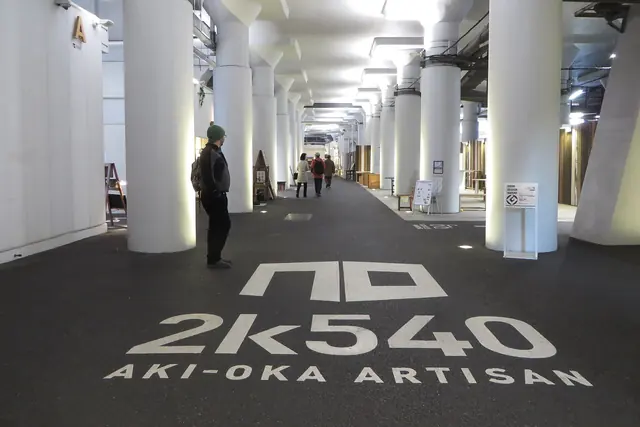
Handmade goods at 2k540 AKI-OKA ARTISAN
JNTO puts it this way: "The 2k540 Aki-Oka Artisan is another world altogether in Akiba, beneath the JR Yamanote Line tracks running between Akihabara and Okachimachi stations." It lists what the workshops make: "These products include textiles, pottery, furniture, stationery, clothing and even hats."
JR's own English page adds leather goods, jewellery, umbrellas, glasses and shoes, and two useful lines. One is "At some of the shops, you can try your own hand at product making." The other is "2k540 is within walking distance of Akihabara."
- Where: 5-9 Ueno, Taito City, under the tracks.
- Walk: six minutes from the Electric Town exit, four minutes from the south exit of JR Okachimachi Station, three minutes from Suehirocho Station.
- Hours: 11:00 to 19:00.
- Closed: Wednesdays. It opens when a Wednesday is a public holiday, and some shops keep different days.
Regional food at CHABARA
CHABARA is a food market run by the same JR company. Its Japanese page says it opened under the tracks in 2013 as the follow-up to 2k540. Its English page describes it: "This market gathers and sells in one location fine food products carefully selected from across Japan." The page counts more than 6,000 items, among them soy sauce, regional condiments and honey, and places it simply: "Chabara is next to JR Akihabara Station."
This site did not find opening hours on the pages it read, so it gives none.
Souvenirs in the electronics shops
Onoden's first floor sells folk crafts and iron kettles beside the shavers, and AKKY's listing includes folk-craft souvenirs. Both shops are on the town organisation's tax-free list, which matters more for a kettle than for a capsule toy.
Tax-free shopping in Akihabara
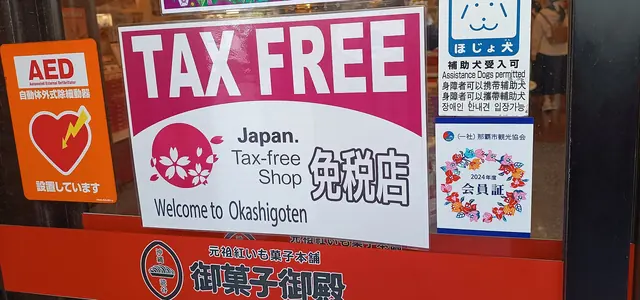
Many Akihabara shops are tax-free shops. To qualify, what you buy in one of them on one day must add up to 5,000 yen or more with the tax left out, and the shop needs to see your passport. Anything bought on 1 November 2026 or later is sold with the tax in the price; the tax is returned afterwards, once customs has checked on your way out of Japan that you are taking the goods with you.
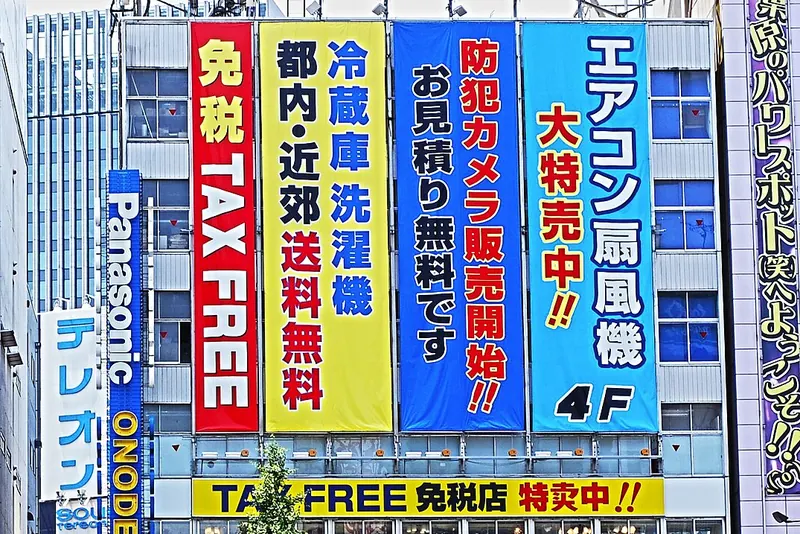
The rules below come from the Japan Tourism Agency's page for travellers. The scheme is for foreign travellers visiting Japan, and the 5,000-yen line is counted per shop and per day, so small purchases in three different shops do not add up.
Which Akihabara shops are tax-free
The Akihabara Electrical Town Organization's shop guide has a tax-free category. On 12 October 2026 it included, among others:
- Big electronics stores: Bic Camera AKIBA, Onoden's main store, EDION AKIBA, AKKY's main store and AKKY II.
- PC shops: TSUKUMO eX., Tsukumo's PC main store and its reuse building for second-hand machines, and Sofmap AKIBA's PC and Digital Building.
- Second-hand phones and games: Janpara's main store and five more Janpara shops in the district, and Sofmap AKIBA Amusement Building.
- Components: Wakamatsu Tsusho, upstairs in Radio Kaikan on 5F.
Each entry in that category carries the month it was last updated, and several date from October 2019. Look for the tax-free sign at the entrance, or ask before you queue.
Two more notes on who is in and who is not:
- animate. The chain's English tax-free page names its Akihabara shop, Buildings 1 and 2.
- Shops whose pages are silent. The pages this site read for Yodobashi Camera Multimedia Akiba, Super Potato, BEEP, Akihabara Gachapon Hall and the trading-card shops in Radio Kaikan do not mention tax-free shopping either way. Ask at the till.
Before 1 November 2026
The refund method applies to purchases made on or after 1 November 2026. The official pages this guide draws on explain the new system and not the steps for earlier purchases, so this site does not set those out. If you shop before that date, ask at the shop's tax-free counter how the tax is handled and what you need to keep.
From 1 November 2026
The agency calls the new system the refund method (rifando hoshiki). It works in three stages:
- In the shop. You pay the price with tax included.
- When you leave Japan. Inside 90 days from the day you bought, you take your passport to a terminal for tax-free procedures at the airport or seaport, either a kiosk or an electronic terminal, and customs checks that your purchases are going abroad with you.
- After that confirmation. The shop, or a refund company working on its behalf, pays the tax back.
How the money reaches you depends on the shop. The agency's FAQ gives examples: a bank transfer, a transfer to a credit card, a transfer through an app, or cash inside the airport or seaport after the customs check. That is the question to ask at the till before you pay, because the answer differs from one shop to the next.
The same pages set conditions that are easy to miss:
- Keep it all with you. Everything you bought must be ready to show to customs when you leave.
- Buy what you can carry. The quantity is limited to what you can take out of Japan yourself.
- Do not use up consumables. Food, cosmetics and other consumables that are used inside Japan get no refund.
- Leave time. Reach the airport early. An inspection you cut short, for example because you would miss check-in, does not count as customs confirmation.
- Changing planes inside Japan. With a domestic flight before the international one, the procedure waits for the airport your international flight leaves from.
What the 5,000-yen line means here
A capsule toy, a bag of sweets or a single trading card comes nowhere near the 5,000-yen line. Each of the four Sony overseas models priced earlier in this guide clears it alone. For several small things, the way to reach it is one tax-free shop on one day.
The tax-free calculator on this site does the sum for any total. The airport steps are set out one by one in this site's guide to buying anime figures, which also lists the airports that have the terminals.
Opening hours, Sundays and getting to Akihabara
Most Akihabara shops open at 10:00 or 11:00 and close around 20:00, and the two largest electronics stores stay open until 22:00. On Sunday afternoons the main street, Chuo-dori, is closed to cars. Arrive just after 11:00 on any day except Wednesday and nearly every shop in this guide is open.
| Opens at | Shops |
|---|---|
| 9:30 | Yodobashi Camera Multimedia Akiba, AKKY main store |
| 10:00 | Bic Camera AKIBA, Onoden, EDION AKIBA, Tokyo Radio Department Store, the Radio Kaikan shops in this guide, Sofmap AKIBA Amusement Building, animate Akihabara |
| 11:00 | TSUKUMO eX., Janpara main store, Super Potato, Akihabara Gachapon Hall, 2k540; BEEP on Saturdays, Sundays and public holidays |
| 12:00 | BEEP on weekdays |
| Closes at | Shops |
|---|---|
| 18:30 | Wakamatsu Tsusho on Tuesdays, Saturdays and Sundays |
| 19:00 | Tokyo Radio Department Store, 2k540, Wakamatsu Tsusho on other days, Gachapon Hall on Sundays and public holidays |
| 19:30 | Janpara main store |
| 20:00 | Onoden, EDION AKIBA, AKKY, Super Potato, BEEP, Sofmap AKIBA Amusement Building, the card shops and TOMOCA in Radio Kaikan, Gachapon Hall on weekdays, the animate Annex on weekends and public holidays |
| 21:00 | TSUKUMO eX., animate Akihabara Buildings 1 and 2, the animate Annex on weekdays |
| 22:00 | Yodobashi Camera Multimedia Akiba, Bic Camera AKIBA |
Closed days are few. BEEP and 2k540 close on Wednesdays, though 2k540 opens when the Wednesday is a public holiday. TSUKUMO eX. closes only on New Year's Day. The pages for Bic Camera AKIBA, Onoden, EDION AKIBA, AKKY, Janpara, Sofmap's Amusement Building and Super Potato all say they open every day.
Sundays: the pedestrian zone on Chuo-dori
Each Sunday afternoon, Chuo-dori is handed to people on foot. Tokyo's official guide gives the hours: "It is open to pedestrians from 13:00 to 18:00 from April to September, and from 13:00 to 17:00 from October to March." The town organisation's English page gives the stretch: "Chuo-dori (between Sotokanda 5-chome intersection and Manseibashi intersection) 570 meters".
That page adds two things worth knowing. The zone is cancelled in rain, storms, strong winds or other bad weather. And inside it you may not sell goods, give a performance, play live music or ride a bicycle.
Two shops in this guide close earlier on Sundays: Akihabara Gachapon Hall at 19:00 and Wakamatsu Tsusho at 18:30.
Which exit of Akihabara Station
The city's walking guide sorts the station out: "There are two main exits from the station; the Central Gate on the east side leads to the Yodobashi Camera store, restaurants and hotels." For almost everything else here, you want the other one: "The Akihabara Electric Town Gate leads to the main shopping areas and electronics stores." Shops' own pages call it the Electric Town exit, and so does this guide.
Suehirocho Station on the Tokyo Metro Ginza Line is nearer for the far end of the district. It is two minutes from Akihabara Gachapon Hall, three from BEEP, three from 2k540 and five from Kanda Myojin.
Getting to Akihabara
Tokyo's official guide gives these train times to Akihabara:
- Haneda Airport: 45 minutes.
- Narita Airport: roughly 90 minutes.
- Shinjuku Station: 18 minutes; take the JR Sobu Line.
- Tokyo Station: 4 minutes; take the JR Yamanote Line.
Yodobashi's access page counts five lines at Akihabara Station: the Tsukuba Express, the JR Yamanote, Sobu and Keihin-Tohoku lines, and the Tokyo Metro Hibiya Line. This site's Suica card guide covers paying for those trains.
Money and bags
- Cash. The first floor of the Yodobashi building has a Travelex counter and two bank ATMs, and Onoden's first floor has a currency exchange machine. For the machines that are known to take cards from abroad, see ATMs in Japan.
- Bags. Bic Camera AKIBA sells suitcases on its fifth floor and Onoden on its first. If you end the day with more than you can carry, luggage in Japan covers coin lockers and sending bags ahead.
A route that follows the opening hours
- From 9:30, at the station. Yodobashi Camera Multimedia Akiba, on the Central Gate side.
- From 10:00, by the Electric Town exit. Onoden and Tokyo Radio Department Store, both two minutes from the exit, then Akihabara Radio Kaikan for trading cards and components.
- From 11:00, Sotokanda 1-chome and 4-chome. Super Potato is at 1-11-2. Bic Camera AKIBA (4-1-1), animate Akihabara (4-3-1), TSUKUMO eX. (4-4-1) and Janpara's main store (4-4-9) share one numbered district.
- Towards Suehirocho Station. Akihabara Gachapon Hall, BEEP and 2k540, each two or three minutes from that station.
- Kanda Myojin. Seven minutes from the Electric Town exit. This site has not confirmed the hours of the shrine's amulet counter, so do not leave it until evening.
No official page gives walking times from one shop to the next, so this guide gives only the times from the stations. Tokyo's official walking guide allows half a day or a full day for the district.
Frequently asked questions
What are the best things to buy in Akihabara?
Electronics made for use overseas, PC parts, retro video games, capsule toys, trading cards and anime figures. Onoden and Tokyo Radio Department Store are two minutes from the Electric Town exit of JR Akihabara Station, and the furthest shops in this guide are seven minutes away on foot.
What are cheap things to buy in Akihabara?
Capsule toys, at mostly 300 to 500 yen a turn on Bandai's official Gashapon site. Super Potato sells dagashi, old-fashioned cheap sweets, and DAISO has a shop on floor 7 of the Yodobashi building. An IT amulet from Kanda Myojin shrine is a 1,000-yen offering.
What are unique things to buy in Akihabara?
An IT amulet from Kanda Myojin, the shrine seven minutes from the station, which describes it as a prayer for the safe working of a computer. Other choices are handmade goods from the workshops at 2k540 AKI-OKA ARTISAN, vacuum tubes from Tokyo Radio Department Store and old game cartridges from Super Potato.
Is Akihabara cheap for electronics?
No official source compares its prices with prices abroad, so this site does not claim a saving. Official pages do confirm that Bic Camera AKIBA, Onoden, EDION AKIBA and AKKY are in the district's tax-free category, and that Janpara and Sofmap sell second-hand phones and games.
Which is the best electronics store in Akihabara?
It depends on what you want. Yodobashi Camera Multimedia Akiba is joined to the station and opens from 9:30 to 22:00. Bic Camera AKIBA has seven floors and opens from 10:00 to 22:00. Onoden and AKKY stock overseas models for use outside Japan. No official source ranks them.
Will electronics bought in Akihabara work in my country?
Not always. JNTO says mains power in Japan is 100 volts, at 50 hertz in the east and 60 hertz in the west. Choose an overseas model, read the rating label for your own voltage or a range such as 100–240V, and ask the shop about an international warranty before you pay.
Where are the second-hand phone and PC parts shops in Akihabara?
Janpara's main store at 4-4-9 Sotokanda specialises in second-hand mobile phones and opens from 11:00 to 19:30. TSUKUMO eX. at 4-4-1 Sotokanda sells PC parts from its first basement to its sixth floor and opens from 11:00 to 21:00. Ask whether a used phone will work on your network at home.
Where can I buy retro games in Akihabara?
Super Potato, on floors 3 to 5 at 1-11-2 Sotokanda, opens from 11:00 to 20:00 every day. BEEP Akihabara sells retro games, old PCs and arcade boards and is closed on Wednesdays. Sofmap's Amusement Building sells second-hand games for newer consoles.
Where is Akihabara Gachapon Hall and how much are capsule toys?
It is on the first floor at 3-15-5 Sotokanda, two minutes from Suehirocho Station and seven from the Electric Town exit of JR Akihabara Station. Its page gives 11:00 to 20:00 on weekdays and 11:00 to 19:00 on Sundays and public holidays. Most toys on Bandai's Gashapon site cost 300 to 500 yen.
Where can I buy Pokémon cards in Akihabara?
In Akihabara Radio Kaikan. Hobby Station on the first floor, and Card Labo and Fullcomp on the ninth, all name Pokémon cards on their pages and open from 10:00 to 20:00. None of the pages says which languages the cards are printed in, so check before you pay.
Is there a Pokémon Center in Akihabara?
No. The Pokémon Company's shop list had none in Akihabara on 12 October 2026. The simplest one to reach is the Pokémon Store at Tokyo Station, which is four minutes from Akihabara on the JR Yamanote Line.
Is shopping in Akihabara tax-free?
In many shops, yes, for foreign travellers. One day's shopping in one tax-free shop has to come to 5,000 yen or more before tax. On anything bought from 1 November 2026 the till price includes the tax, and the refund follows a customs check when you leave Japan, which has to happen inside 90 days. Before that date, ask at the shop's tax-free counter how it works.
What time do shops in Akihabara open and close?
Most open at 10:00 or 11:00 and close around 20:00. Yodobashi Camera opens at 9:30, and Yodobashi and Bic Camera AKIBA close at 22:00. BEEP and 2k540 are closed on Wednesdays.
What happens in Akihabara on Sundays?
Cars are kept off Chuo-dori, the main street, on Sunday afternoons, starting at 13:00 and ending at 18:00 in April to September or 17:00 in October to March. The closure is cancelled in bad weather. Akihabara Gachapon Hall closes at 19:00 on Sundays, an hour earlier than on weekdays.
Sources
Official and primary sources used for this page. Checked October 12, 2026.
- GO TOKYO: A guide to Akihabara - Japan's pop culture paradise — the district's post-war history, Radio Kaikan and the Akiba Cultures Zone, Gachapon Hall, and travel times from the airports, Shinjuku and Tokyo Station
- GO TOKYO: Akihabara Electric Town — the size of the district, Akihabara Radio Centre, the alley of specialist shops and the Sunday pedestrian hours
- GO TOKYO: Explore around Akihabara — the two station exits, how capsule machines work, the warranty tip and how long to allow
- JNTO: Akihabara — the Electric Town nickname, the shift to computers, Super Potato and 2k540
- JNTO: Plugs & Electricity — voltage, frequency and where transformers are sold
Show all 50 sources
- JNTO: Japan's Tax Exemption — the change to a refund system for purchases from 1 November 2026
- Japan Tourism Agency: Tax-free refund system, page for travellers (in Japanese) — the 5,000-yen line, the 90 days, the terminals, consumables and who pays the refund
- Japan Tourism Agency: Refund system FAQ for travellers (in Japanese) — showing the goods to customs and the examples of how refunds are paid
- Akihabara Electrical Town Organization: Tax-free shops (in Japanese) — which shops are in the tax-free category and when each entry was last updated
- Akihabara Electrical Town Organization: Pedestrian zone — the stretch of Chuo-dori, cancellations and what is not allowed
- Akihabara Electrical Town Organization: Bic Camera AKIBA (in Japanese) — address, hours and the floor list
- Akihabara Electrical Town Organization: Onoden main store (in Japanese) — the three floors and the currency exchange machine
- Akihabara Electrical Town Organization: EDION AKIBA (in Japanese) — address, hours and product range
- Akihabara Electrical Town Organization: AKKY main store (in Japanese) — address, hours and overseas-use goods
- Akihabara Electrical Town Organization: TSUKUMO eX. (in Japanese) — address, hours, closed day and PC parts by floor
- Akihabara Electrical Town Organization: Janpara Akihabara main store (in Japanese) — address, hours and second-hand phones
- Akihabara Electrical Town Organization: Sofmap AKIBA Amusement Building (in Japanese) — address, hours and second-hand games
- Akihabara Electrical Town Organization: Wakamatsu Tsusho Akihabara station shop (in Japanese) — its address on the fifth floor of Radio Kaikan
- Yodobashi Akiba: Access guide (in Japanese) — the five lines and the opening hours of each part of the building
- Yodobashi Akiba: Facility information (in Japanese) — address and parking
- Yodobashi Akiba: Floor guide, B1 and 1F (in Japanese) — the Travelex counter and bank ATMs
- Yodobashi Akiba: Floor guide, 7F (in Japanese) — DAISO, UNIQLO, ABC-MART and JINS
- Onoden: Company and shop information (in Japanese) — address, hours and the walk from the station
- Onoden: Overseas models (in Japanese) — the 75 items and the prices in the table
- Tokyo Radio Department Store (in Japanese) — history, number of shops, hours and the walk from the station
- Akihabara Radio Centre (in Japanese) — the kinds of shop inside
- Akihabara Radio Kaikan: Floor guide (in Japanese) — which shop is on which floor
- Akihabara Radio Kaikan: Wakamatsu Tsusho (in Japanese) — components and hours
- Akihabara Radio Kaikan: TOMOCA Proshop (in Japanese) — pro audio and hours
- Akihabara Radio Kaikan: Hobby Station (in Japanese) — the card games it lists
- Akihabara Radio Kaikan: Treca Park (in Japanese) — new and second-hand cards and the play space
- Akihabara Radio Kaikan: Card Labo (in Japanese) — the card games it lists, the 100 seats and the buying counter
- Akihabara Radio Kaikan: BIG MAGIC (in Japanese) — trading cards and the play space
- Akihabara Radio Kaikan: Fullcomp (in Japanese) — second-hand single cards and the games it lists
- Super Potato: Akihabara shop (in Japanese) — address, floors, hours and what it sells
- BEEP Akihabara (in Japanese) — address, hours, closed day and walking times
- Akihabara Gachapon Hall (in Japanese) — address, hours and walking times
- Akihabara Gachapon Hall: This month's schedule (in Japanese) — the October 2026 arrivals
- Bandai: Gashapon official site (in Japanese) — capsule toy prices on 12 October 2026
- The Pokémon Company: Pokémon Center shop list (in Japanese) — the Tokyo shops and their addresses
- animate: animate Akihabara (in Japanese) — address, the August 2026 reopening, hours and the Annex's capsule-toy floors
- animate: Japan. Tax-free Shop — animate Akihabara as a tax-free shop
- Kanda Myojin: What's Kandamyoujin? — the shrine's history
- Kanda Myojin: Access (in Japanese) — address and walking times
- Kanda Myojin: Amulets (in Japanese) — the IT amulet and its offering
- Kanda Myojin: Amulets by post (in Japanese) — the ban on resale and use for profit
- JR East Urban Development Corporation: English page — 2k540 and CHABARA in English
- JR East Urban Development Corporation: 2k540 AKI-OKA ARTISAN, access (in Japanese) — address and walking times
- JR East Urban Development Corporation: 2k540 AKI-OKA ARTISAN, outline (in Japanese) — hours and closed day
- JR East Urban Development Corporation: CHABARA AKI-OKA MARCHE (in Japanese) — the 2013 opening
Related guides
To cite or link to this page: What to buy in Akihabara: electronics, retro games, capsule toys, trading cards and where each shop is — Japan Pocket Guide, https://japanpocketguide.com/shopping/what-to-buy-in-akihabara/