Culture · Zen
Zazen meditation in Japan: what it is, how to sit step by step, manners in the zendo, and where to join a sitting in Kamakura, Tokyo, Yokohama, Kyoto and Fukui
Zazen is the seated meditation at the centre of Zen Buddhism, and in Japan you can sit with monks and lay people at a working temple, often for a few hundred yen or a small donation. Below you will find the meaning of the word, the Soto and Rinzai approaches, every step from the cushion to the walking meditation, the manners of the hall, and the places to join a session in Kamakura, Tokyo, Yokohama, Kyoto and Fukui, with the times and fees the temples list for winter 2026 and 2027.
Last checked · Sources

In short
Zazen means seated meditation: za is to sit and zen is meditation. You sit on a round cushion with your legs crossed, your back straight, your hands folded in front of the navel and your eyes half open, breathing quietly through the nose. In Kamakura, Engaku-ji holds a dawn sitting at 6:00 on most mornings for a donation, and Kencho-ji sits every Friday and Saturday at 15:30 for the price of admission. In Tokyo, the Soto school runs a free English class once a month, and Sojiji in Yokohama holds a monthly English session for 500 yen with no booking.
What zazen is, and how Soto and Rinzai differ
Zazen is the Zen name for meditation done sitting down. The joint English website of the Rinzai and Obaku schools splits the word in two: za means to sit, and zen means meditation. Zen is the Japanese reading of the Chinese chan, a shortened form of a word that goes back to the Sanskrit dhyana. Both schools trace the practice to Shakyamuni, the historical Buddha, who is said to have reached full enlightenment while seated beneath the Bodhi Tree in Bodhgaya more than 2,500 years ago.
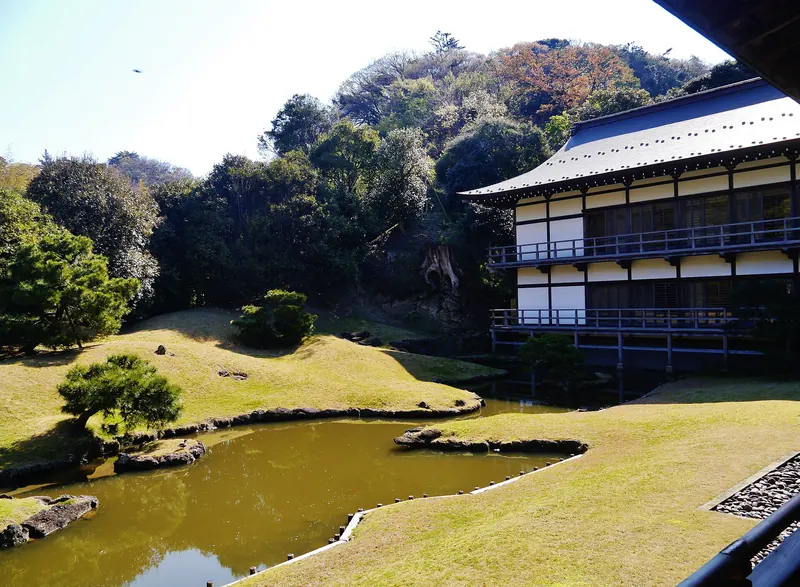
According to JNTO, Buddhism came to Japan in the 6th century by way of China and Korea, and Zen later left its mark on gardens, the tea ceremony and the martial arts. If you have walked round a dry garden or drunk a bowl of matcha in Kyoto, you have already met its influence; the Japanese gardens and tea ceremony pages cover those two arts.
Today there are three main Zen lines in Japan: Rinzai, Obaku and Soto. The monk Myoan Eisai (1141–1215) first brought the Rinzai teaching to Japan. Rinzai is now divided into fourteen branches, each under its own head temple, and Obaku has a single head temple of its own. Soto looks back to Zen Master Dogen, whose teachings monks have been carrying out at Eihei-ji, in Fukui, since 1244.
Words you will hear in a zendo
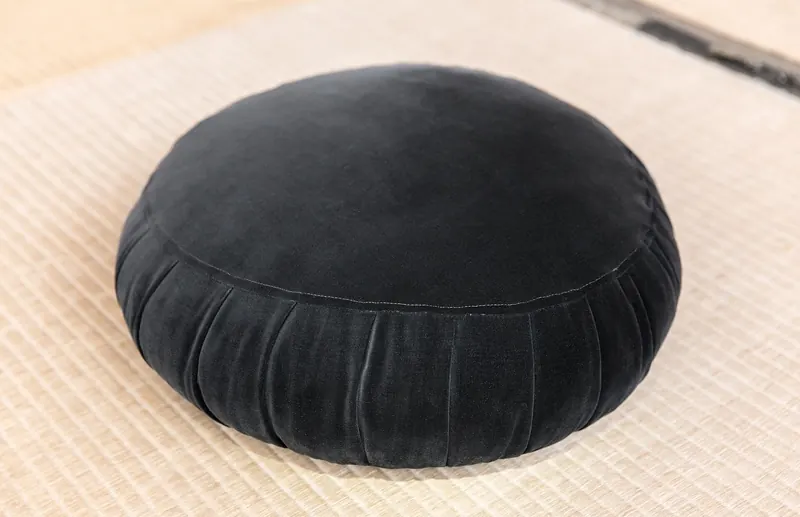
- Zafu: the round cushion you sit on.
- Zabuton: the flat square mat under the cushion, which takes your knees.
- Zendo: a hall set aside for zazen and nothing else.
- Kinhin: slow walking meditation between two periods of sitting.
- Kyosaku: the flat wooden stick used to rouse a sleepy sitter.
- Gassho: palms pressed together, the gesture used for every bow.
Soto and Rinzai: two ways to sit
The Soto school calls its zazen shikantaza, which it renders as sitting single-mindedly. Its official English site insists that zazen is not a means of reaching some other goal, and that, in Dogen's teaching, all the activities of everyday life carry the same value as sitting when they are done as practice. The Rinzai and Obaku schools pair zazen with koan training and samu, or physical work, and they name the aim of practice kensho, which their site translates as seeing self-nature.
The difference matters more to monks than to a first-time visitor. JNTO describes the usual shape of a session for beginners: an explanation of the basics, then guided zazen, often followed by a walk round the temple grounds. The Rinzai site describes the seated body as still and free of tension, with the breath relaxed and regulated.
Soto and Rinzai side by side
- Soto practice: shikantaza, sitting with nothing to achieve; daily chores count as practice too.
- Rinzai practice: zazen together with koan training and samu, work done as training.
- Founding figures in Japan: Dogen for Soto; Myoan Eisai for Rinzai.
- Soto head temples: Eihei-ji in Fukui and Sojiji in Yokohama.
- Rinzai head temples with public sittings: Engaku-ji and Kencho-ji in Kamakura; Myoshin-ji, Shokoku-ji, Kennin-ji, Tofuku-ji and Tenryu-ji in Kyoto.
How to do zazen, step by step
The steps below follow the Soto school's English guide, "How to do Zazen", published by its head office in Tokyo. A teacher at a temple will take you through the same points in person, and each hall has small habits of its own, so treat this as a first map rather than a set of rules.
Before you sit
The Soto guide begins well before the cushion, with the room, your body and your clothes. It advises against sitting when you are short of sleep or worn out, and asks you to leave heavy, soiled or expensive clothes at home.
Ready to sit
- A quiet, tidy room with gentle light and a comfortable temperature
- A moderate meal beforehand, not a large one
- Face and feet washed first
- Loose but neat clothing that lets you cross your legs
- Bare feet in a monastery zendo, where socks are not worn
Taking your seat
Place the zafu on the zabuton, facing the wall, and sit on its front half so that the back half is behind you and both knees rest firmly on the mat. Then work up the body, from the legs to the eyes.
Taking your seat
- Cross your legs: in full lotus, half lotus or one of the easier positions below.
- Straighten the lower back: push the buttocks back and the hips forward, so the spine stands upright.
- Lengthen the neck: draw the chin in as though the top of your head were reaching for the ceiling.
- Line up: ears level with the shoulders, nose in line with the navel, shoulders relaxed, no leaning.
- Fold the hands: in the hokkaijoin, the Cosmic Mudra, just in front of the navel.
- Close the mouth: rest the tongue against the roof of the mouth, behind the teeth.
- Lower the eyes: keep them a little open, with the gaze falling at about 45 degrees.
- Breathe out deeply: once, through a slightly open mouth, then breathe in through the nose.
- Sway and settle: rock left and right, in large then smaller arcs, until you come to rest at the centre.
The Cosmic Mudra is simpler than it sounds. The right hand lies palm up on the left foot, the left hand rests palm up on top of it, and the tips of the two thumbs touch lightly. The deep breath at the start has a name, kanki-issoku: you empty the lungs slowly from the abdomen, then return to breathing through the nose.
Leg positions for every kind of knee
Full lotus is the classic pose, but nobody at a temple will expect a beginner to manage it. The Soto guide offers five positions, from the most demanding to a chair.
Five ways to sit
- Full lotus (kekkahuza): the right foot on the left thigh, then the left foot on the right thigh.
- Half lotus (hankahuza): only the left foot goes on the right thigh; the two knees and the base of the spine form a triangle, and the sides can be swapped.
- Burmese position: both legs rest on the floor, one folded in front of the other.
- Seiza on a bench: kneeling with a low bench under you, which puts your centre of gravity a little higher.
- On a chair: sit upright without leaning on the backrest, add a cushion if you need one, and keep the hands in the same mudra.
Breathing and the mind
Breathing in zazen is left alone. You breathe quietly through the nose without trying to control it: when a breath is long, it is long, and when it is short, it is short. The eyes stay slightly open because closing them tends to bring on drowsiness.
What to do with the mind is where the two schools sound most different. The Soto guide gives zazen no object at all: thoughts will come, and you neither follow them nor try to escape them, but simply return, moment by moment, to the posture. The guide calls this waking up from distraction and dullness kakusoku. The Rinzai site, by contrast, describes the mind gathered on one point of focus.
Getting up, and kinhin
Do not jump up when the bell rings. Bow with your palms together, rest the hands palm up on your thighs, sway from side to side in small arcs that grow larger, take a deep breath, and unfold your legs. Move slowly, above all if your legs have gone to sleep, and never stand up abruptly.
Between periods of sitting, many halls hold kinhin, walking meditation. From the waist up you keep the zazen posture; only the legs move, and very slowly.
Kinhin, walking meditation
- Hold the hands: in shashu, in front of the chest.
- Start with the right foot: and walk clockwise round the hall.
- Keep the pace: half a step for every full breath, in and out.
- Turn to the right: at each corner.
- Finish with a bow: when the bell ends the walking.
Manners in the zendo, the bells and the kyosaku
Temple halls run on quiet signals rather than spoken instructions, so a little knowledge of the manners makes a first sitting far less confusing. The Soto school's page on zendo manners covers the basics and adds a line every visitor should keep in mind: "Receive and follow the instructions given at each place." The forms below are a starting point, and the monk in charge has the last word.
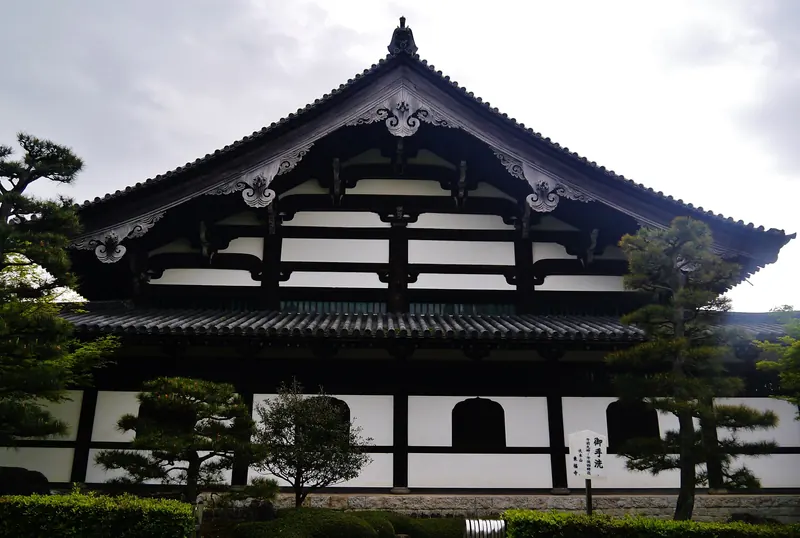
In a traditional monastery the monks sleep, eat and sit in one building, the sodo or monks' hall. Along its sides runs a platform, the tan, about two feet high, and each monk has the space of one tatami mat on it. Manjushri, the bodhisattva who stands for wisdom, is enshrined in the middle of the hall. A zendo is used for sitting only, but the same manners apply.
Entering and taking your place
Hold your hands in shashu and step in with your left foot, keeping to the left of the doorway; the middle of the doorway is kept for the abbot. Bow in gassho towards the altar, then go to your seat, passing behind the statue of Manjushri rather than in front of it. On leaving, step out with the right foot, on the same side.
At your seat
- Bow to your seat: in gassho, facing it; this greets the people on either side, and they bow back.
- Turn to the right: so that you face away from your seat, and bow once more towards those sitting opposite.
- Sit down: on the zafu.
- Turn to face the wall: by turning to the right.
The first bow is called rini-monjin and the second taiza-monjin. In a sodo, the edge of the platform carries a wooden board, the joen, where bowls stand at mealtimes: never put your feet or buttocks on it.
The two hand positions
- Gassho: palms and fingers together, fingertips at about the height of the nose, elbows out to the sides.
- Shashu: the left thumb tucked inside a fist held in front of the chest, with the right hand covering it.
What the bells mean
Nobody announces the start or end of a period; a bell does. The pattern below is the Soto one, and once you know it you can follow a session without understanding a word of Japanese.
Bells in a Soto zendo
- Three rings: zazen begins (shijosho).
- Two rings: time for kinhin, the walking meditation (kinhinsho).
- One ring after walking: kinhin is over (chukaisho).
- One ring after sitting: zazen is over (hozensho).
When the sitting ends, get down from the platform, face your seat, plump the zafu back into shape and bow to it, then turn right and bow to the people opposite. During kinhin, keep an even gap to the people in front and behind. The break after the walking is the moment to slip out to the toilet if you need to.
The kyosaku, the wake-up stick
The kyosaku is a flat wooden stick carried by the jikido, the monk who looks after the hall. Its purpose is to wake sitters who are nodding off or whose minds are racing, and in the Soto hall you ask for it yourself rather than wait to be picked out.
Asking for the kyosaku
- Signal: put your palms together in gassho and wait.
- Lean: when the stick is laid on your right shoulder, tilt your head to the left, keeping your hands in gassho.
- Receive the strike: on the shoulder muscle, which is why the head moves out of the way.
- Bow: straighten your head and bow; the jikido bows back from behind you, holding the stick in both hands.
Zazen in Kamakura: Engaku-ji and Kencho-ji
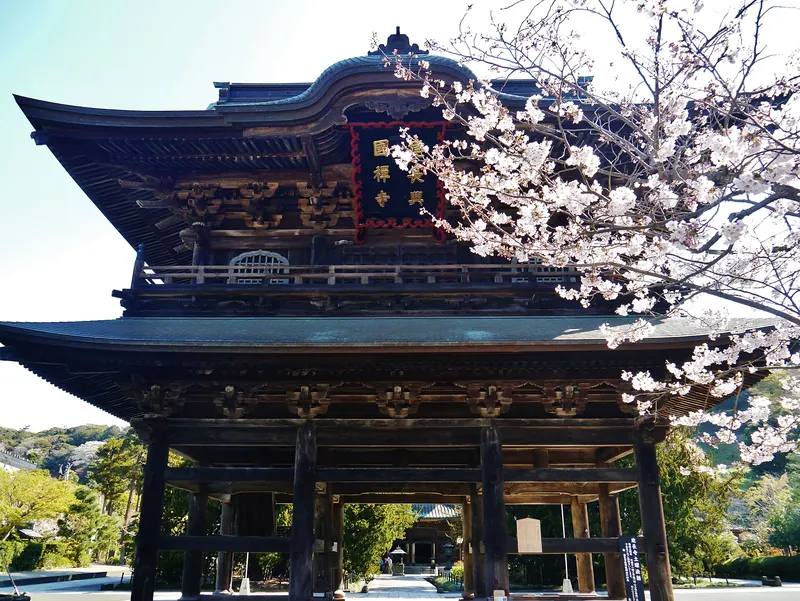
Kamakura has two of the great Rinzai head temples, both reached from JR Kita-Kamakura Station and both open to lay people who want to sit. The Rinzai and Obaku joint site gives their story.
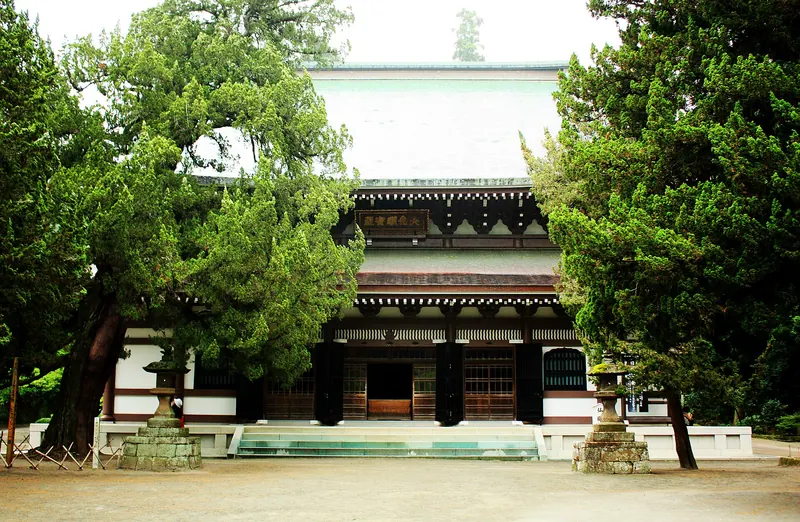
Kamakura's two Zen head temples
- Engaku-ji: founded in 1282 by the regent Hojo Tokimune, with the Chinese master Wuxue Zuyuan as first abbot; second of the Kamakura Five Mountains.
- Kencho-ji: founded in 1253 by the regent Hojo Tokiyori, with the Chinese master Lanxi Daolong as first abbot; first of the Kamakura Five Mountains.
Kencho-ji was Japan's first monastery set aside purely for Rinzai practice, and under its early abbots it had more than a thousand monks in training. Tokimune founded Engaku-ji partly to console the souls of those who died on both sides, Japanese and Mongol, in the invasions of 1274 and 1281. Engaku-ji has kept teaching Zen to monks and lay people alike into modern times.
Dawn zazen at Engaku-ji
Engaku-ji's gyoten zazen is held in the Butsuden, the Buddha Hall, at 6:00 on most mornings of the year, before the temple opens to sightseers. Because it is before opening hours, there is no admission charge and nothing to book.
The rules are strict. The toilets in the grounds are locked at that hour, so use the ones at the station first. You may not wander the grounds before or after the sitting; to sightsee, come back in through the gate after 8:30. Do not drive in: cars must go to a paid car park outside the gate. The temple also states that anyone who ignores its rules or the instructions of the monk in charge cannot take part.
Weekend and evening sittings at Engaku-ji
More sittings at Engaku-ji
- Koji-rin afternoons: Saturdays, plus the 1st and 3rd Sundays, 14:30–16:00, in the lay training hall; 1,000 yen plus temple admission; beginners welcome, no booking, no groups.
- Sunday sermon and zazen: 2nd and 4th Sundays in the Daihojo; sermon 9:30–10:30, zazen 11:00–12:00.
- Night zazen for beginners: 2nd Wednesday, 19:00–20:30 at the Koji-rin; booking required.
- Online: a Zoom sitting led from the Koji-rin, and an introductory video on YouTube.
You can attend a Sunday sermon on its own, but the sitting after it is only for those who heard the sermon first. At the 2nd Sunday talk, numbered tickets for the zazen go to the first 80 people as they enter the Daihojo, the large abbot's hall. The next 2nd Sunday sermon, on 13 December 2026, is by Yokota Nanrei, who heads the Engaku-ji branch, and is also streamed live on YouTube.
The night session is the gentlest way in, and chairs are allowed.
Kencho-ji's Friday and Saturday sittings
Kencho-ji holds a public zazen every Friday and Saturday from 15:30 to 16:30, normally in the Hojo, the abbot's quarters, which is also called the Ryuo-den. You do not apply in advance; the sitting is free, but you pay the temple's admission at the gate.
Inside the hall there is no private talk and no wandering about, and people who do not follow the instructor are asked to leave. Loose clothes are recommended. Sittings are sometimes cancelled at short notice for temple events; in 2026 they were called off on 23 and 24 October and 30 and 31 October, resuming on 6 November, so look at the temple's news page before you go.
Twice a year Kencho-ji also runs a two-day sitting with a night at the temple, combining zazen, sutra chanting, work and formal meals. The Minazuki sitting falls in June and the Rogetsu sitting in December, in principle on the first Saturday and Sunday of the month; they cost a fee and need an application, and the details go up about a month ahead. Applications for the December 2026 Rogetsu sitting were announced on 7 November. The temple's news page also carries a notice on zazen in English for 2026 and 2027, posted on 10 April 2026.
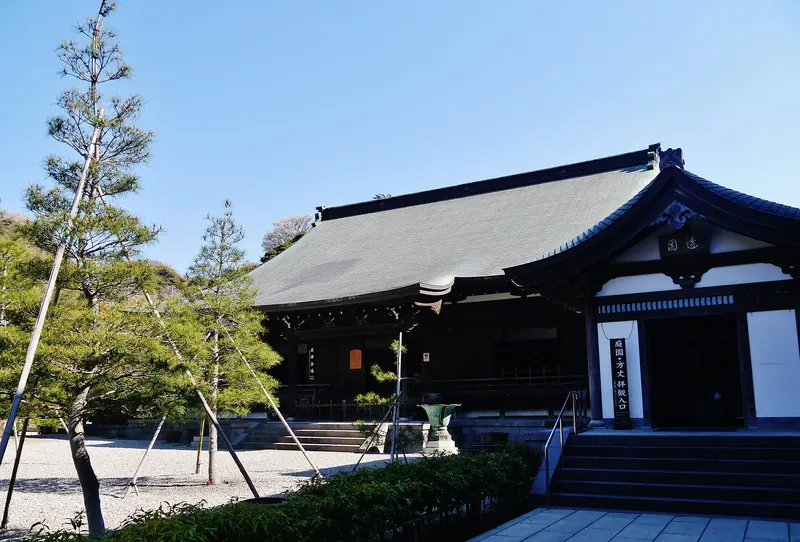
Zazen in Tokyo and Yokohama
Sitting is possible without leaving the capital. The Soto school runs an English class in central Tokyo, a temple in Setagaya opens its hall twice a week, and Sojiji, a Soto head temple, is a short train ride away in Yokohama.
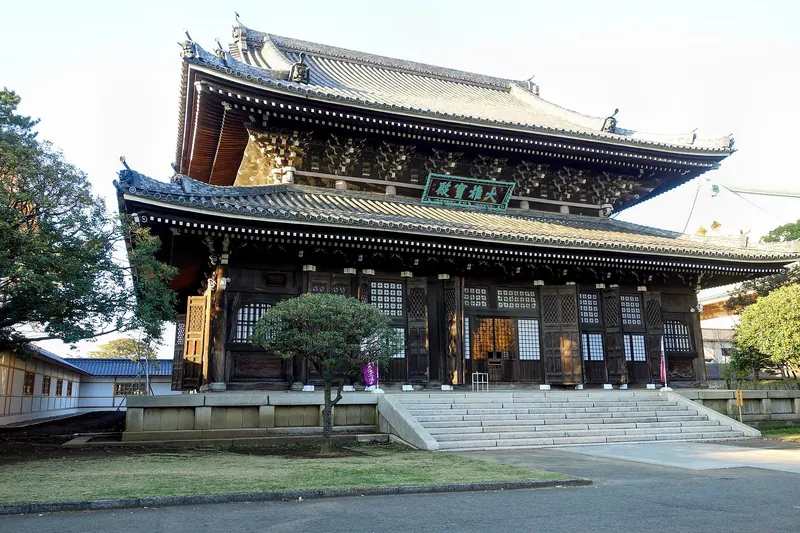
Zazen in English near Tokyo, at a glance
- Soto ZEN class, Minato: once a month, 18:00–19:00; free; register online in advance.
- Sojiji, Yokohama: once a month from 10:00, about two hours with a temple tour; 500 yen; no booking.
- Kouunji, Setagaya: Saturdays 19:00–21:00 with no booking, Sundays 6:30–9:00 by phone the day before; 400 yen.
The Soto ZEN class in Minato
ZEN class is the Soto school's own introduction to zazen in English, run by its Administrative Headquarters on the 5th floor of the Tokyo Grand Hotel in Shiba 2-chome, Minato. It is free, held in person, and capped at 30 people a session, so you register online beforehand. Beginners are the intended audience.
The teacher is the Rev. Hojun Szpunar, a Soto priest from Poland who has practised in Europe and Japan and leads a Zen group in Poland. Come in loose clothes, or change on arrival.
One evening at ZEN class
- Reception, from 17:30: on the 5th floor of the Tokyo Grand Hotel, where staff can show you to a changing room.
- Dharma talk, 15 minutes: on the thinking and background behind zazen.
- Zazen, 40 minutes: the main sitting.
- Kinhin, 5 minutes: slow walking meditation.
- Tea, from 19:00: optional, for anyone who wants to stay and talk.
The remaining dates in the current series run into March 2027. Each session is also streamed live on YouTube, with no registration needed to watch, and past sessions stay online.
ZEN class dates, winter 2026 to spring 2027
- 26 November 2026: Thursday, 18:00–19:00.
- 17 December 2026: Thursday, 18:00–19:00.
- 14 January 2027: Thursday, 18:00–19:00.
- 2 February 2027: Tuesday, 18:00–19:00.
- 25 March 2027: Thursday, 18:00–19:00.
Sojiji in Yokohama
Sojiji is a head temple of Soto Zen, with more than 13,000 related temples across Japan. It was founded about 700 years ago on the Noto Peninsula by Keizan Zenji and moved to Tsurumi in Yokohama in 1911, after a fire in 1898 destroyed most of the original buildings.
Every month Sojiji holds a guided zazen course in English on a set date, which it publishes on its zazen page as a PDF for that month. It suits complete beginners, costs 500 yen, and needs no booking.
A morning of English zazen at Sojiji
- 10:00–10:30: meet at the reception desk.
- 10:30–11:15: zazen with instruction in English.
- 11:15–12:00: a guided tour of Sojiji in English.
Groups of 10 to 40 people can book longer courses on weekdays: a three-hour programme with a dharma talk for 2,500 yen, or a six-hour day with a dharma talk and a vegetarian shojin ryori lunch for 7,000 yen, a little less for high school students and younger. Loose clothing is asked for, with no hair cream or perfume, and the temple may ask for a medical certificate.
Kouunji and a museum of Zen in Setagaya
GO TOKYO, Tokyo's official travel website, lists a zazen experience at Kouunji, a temple in Kinuta, Setagaya, seven minutes on foot from Soshigaya-okura Station on the Odakyu Line, and describes a two-hour session. On Saturdays it runs from 19:00 to 21:00 and you can simply turn up; the Sunday sitting, from 6:30 to 9:00, has to be booked by phone at the latest the day before. Either costs 400 yen.
Not far away, on the campus of Komazawa University, the Museum of Zen Culture and History is housed in the Kounkan, a building registered as a Tangible Cultural Property, with an exterior shaped like a folding screen. The museum covers the history of Zen and its musical instruments, and it has a reconstruction of the living space of trainee monks, which gives a picture of the monks' hall described above.
Zazen in Kyoto and at Eihei-ji in Fukui
Seven of the fifteen Rinzai and Obaku head temples stand in the city of Kyoto, and several of them, or their sub-temples, open their halls to the public on a fixed schedule. The Kyoto Tourist Information Center, Kyo Navi, keeps a bilingual sheet of these sittings; the version below is from June 2026, and the centre notes that details can change without notice and that groups must always book.
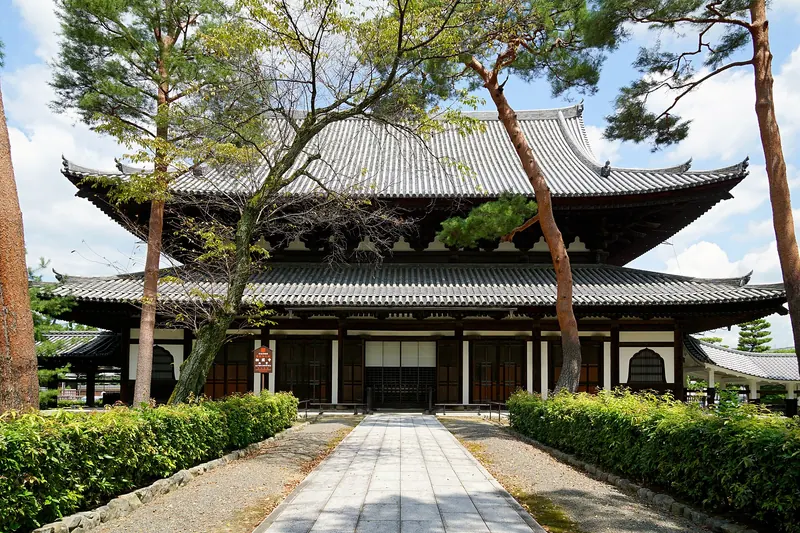
Regular sittings in Kyoto
Zazen sessions on the Kyo Navi list, June 2026
- Myoshin-ji, Daihojo: 8th of each month, 6:00–7:30; no booking; JR Hanazono Station.
- Shokoku-ji: 2nd and 4th Sundays, 9:00–10:00; no booking; Imadegawa Station, Karasuma subway line.
- Kennin-ji: 2nd Sunday except August, 7:30–9:30; no booking; bus to Gion.
- Tenryu-ji, Yuun-an: 2nd Sunday, 9:00–10:00; no booking; JR Saga-Arashiyama Station.
- Tofuku-ji, zendo: some Sundays, 6:30–7:30, dates on the temple's website; no booking; JR Tofukuji Station.
- Nanzen-ji Zen Center, Kounji: every Saturday, 20:00–21:00; no booking; Keage Station, Tozai subway line.
- Daisen-in, Daitoku-ji: every Saturday and Sunday and the 24th of each month, 16:30–17:45; book on the website; bus to Daitokuji-mae.
- Nishijin Koshoji: every day, 6:00–6:30; no booking, but phone the day before your first visit; Kuramaguchi Station, Karasuma line.
Private sessions at Shunkoin
Shunkoin, one of the sub-temples within Myoshin-ji, teaches meditation along with Buddhist history and philosophy, in Japanese and English, by day or by night. Its shared programme pairs 20 minutes of zazen with cold-brewed tea and 20 minutes of nanso, a meditation from the teaching of the priest Hakuin Ekaku. Shunkoin also takes overnight guests; see the temple stay page for that side of it, along with the meditation nights at Koyasan.
Two ways to sit at Shunkoin
- The Way of Zen: private, at least two hours, up to five people, one group a day; fees on request.
- Kissako Zen and Tea: shared; the sitting and tea end with a dharma talk and a tour of the garden and prayer hall, for 8 to 10 people.
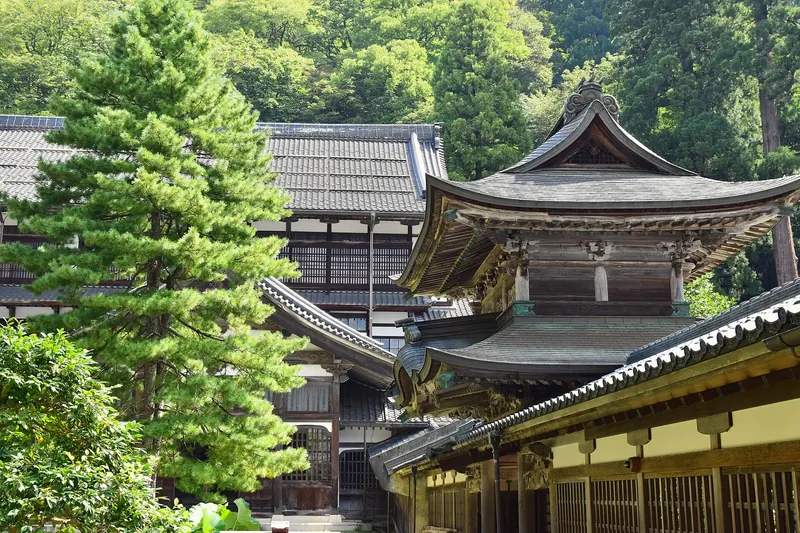
Eihei-ji in Fukui
Eihei-ji, in Eiheiji Town in Fukui Prefecture, has been a training monastery since 1244, and its English site describes the monks' life plainly: meals, cleaning, chanting, sleep and zazen, each given full attention and done by the monastic standard. The temple offers a one-night stay with zazen, the Sanzen programme, on limited dates.
In 2026, though, the programme was closed to visitors from abroad. A notice on Eihei-ji's practice page, dated spring 2026, says that because of circumstances in the monastery it cannot offer Sanzen to international visitors from that spring through the autumn, and that an update will appear on the same page when it can take participants again.
Booking, fees and what to wear
JNTO's advice is that most zazen lessons need a reservation and that sessions in English can be found in many parts of Japan; some temples sit every day, others once a week. In practice the sessions above fall into three groups.
Three ways to join a sitting
- Turn up: Engaku-ji at dawn and at the Koji-rin, Kencho-ji, Sojiji's English course, Kouunji on Saturdays, and most of the Kyoto list.
- Book ahead: the Soto ZEN class, Engaku-ji's night zazen, Kouunji on Sundays, Daisen-in and Shunkoin.
- Stay the night: Kencho-ji's two-day sittings in June and December, and the temple stays at Shunkoin and Koyasan.
None of the regular sittings costs more than 1,000 yen, and several are free apart from a donation or the temple's admission.
What a sitting costs
- Soto ZEN class, Tokyo: free.
- Engaku-ji dawn zazen: a donation; no admission fee before opening.
- Kencho-ji zazen: free, but admission is 500 yen for adults.
- Kouunji: 400 yen.
- Sojiji English zazen: 500 yen.
- Engaku-ji Koji-rin or night zazen: 1,000 yen for adults, plus admission for the afternoon sittings.
Before your first sitting
- Wear loose, plain clothes; Sojiji also asks for no hair cream or perfume.
- Arrive early: Kencho-ji turns away latecomers, and Engaku-ji asks first-timers to come 10 minutes before the others.
- Come on your own or in a small party: Engaku-ji's sittings do not take groups, and the Kyoto list says groups must book.
- Use the toilet beforehand; at Engaku-ji the grounds' toilets are locked at dawn.
If you can only spare one day, Kamakura on a Friday or Saturday lets you sit twice. Catch the early train for the dawn zazen at Engaku-ji, see the temples once the gates open, and finish at Kencho-ji in the afternoon.
A Saturday of zazen in Kamakura
- 6:00, Engaku-ji: dawn zazen in the Buddha Hall.
- From 8:30: come back in as a sightseer and walk round the temple.
- By 15:15, Kencho-ji: pay admission and be seated in time.
- 15:30–16:30: the Friday and Saturday sitting.
Frequently asked questions
What is zazen meditation?
Zazen is seated meditation as practised in Zen Buddhism; za means to sit and zen means meditation. You sit still with your legs crossed and your back upright, eyes half open, breathing naturally through the nose. In the Soto school it is called shikantaza, sitting single-mindedly with no goal beyond the sitting itself.
How do you do zazen as a beginner?
Sit on the front half of a round cushion with your knees on a flat mat, in half lotus or one of the easier positions. Straighten the lower back, draw in the chin, fold the hands in front of the navel with the thumbs lightly touching, and cast your eyes down at about 45 degrees. Breathe quietly through the nose and, when thoughts come, return to the posture.
Do you keep your eyes open during zazen?
Yes, slightly. The Soto guide asks you to keep the eyes a little open and lowered at about 45 degrees, without focusing on anything, because closed eyes tend to lead to drowsiness or daydreaming.
How long is a zazen session in Japan?
Usually between one and two hours. Kencho-ji in Kamakura sits for an hour on Friday and Saturday afternoons, the Soto school's Tokyo class has 40 minutes of zazen within an hour, and Sojiji's English course gives 45 minutes of zazen inside a two-hour morning that ends with a tour.
Can I join zazen in Japan without speaking Japanese?
Yes. The Soto school runs a free monthly ZEN class in English in Minato, Tokyo, and Sojiji in Yokohama has a monthly English course for 500 yen with no booking.
Do I need to book a zazen session?
It depends on the temple. Engaku-ji's dawn sitting, Kencho-ji's Friday and Saturday sitting and Sojiji's English course need no booking, while the Soto ZEN class and Engaku-ji's night session for beginners must be booked in advance. Groups usually have to book, and some sittings do not accept them at all.
What is the stick used in zazen?
It is the kyosaku, a flat wooden stick carried by the monk in charge of the hall. In a Soto zendo you ask for it by putting your palms together; the monk strikes your shoulder, and both of you bow afterwards. Its purpose is to wake sitters who are drowsy or whose minds are busy.
Can I do zazen on a chair?
Yes. The Soto guide includes sitting upright on a chair without leaning back, with a cushion on the seat or under the feet if needed, and the hands held in the same mudra. Engaku-ji's night session for beginners also allows chairs.
Sources
Official and primary sources used for this page. Checked November 24, 2026.
- Soto Zen Buddhism: How to do Zazen — the room, clothing, leg positions, posture, breathing and kinhin
- Soto Zen Buddhism: Manners in the Zendo — the monks' hall, bows, bells and the kyosaku
- Soto Zen Buddhism: The Soto Zen School's Zazen — shikantaza and Dogen's view of daily activity
- Soto Zen Buddhism: ZEN class — venue, dates to March 2027, programme and live stream
- Rinzai-Obaku Zen: Zazen — the meaning of the word and the Rinzai view of the mind
Show all 25 sources
- Rinzai-Obaku Zen: What is Zen? — the three Zen lines, Myoan Eisai, koan training and samu
- Rinzai-Obaku Zen: Head Temples — fourteen Rinzai branches and one Obaku head temple
- Rinzai-Obaku Zen: Kencho-ji Temple — founding in 1253, Lanxi Daolong, the Hojo, more than a thousand monks
- Rinzai-Obaku Zen: Engaku-ji Temple — founding in 1282, Wuxue Zuyuan, teaching lay people
- JNTO: Meditation — Buddhism's arrival, the shape of a session and reservations
- Engaku-ji: Sermons, zazen and sutra copying (in Japanese) — dawn zazen, Koji-rin sittings, sermons and night zazen
- Engaku-ji: Sunday sermon times from September 2026 (in Japanese) — the time change for the sermon and zazen
- Engaku-ji: Numbered tickets for the Sunday zazen (in Japanese) — tickets for the first 80 at the Daihojo
- Engaku-ji: Night zazen for beginners on 9 December (in Japanese) — programme, capacity, fees and how to apply
- Kencho-ji: Zazen (in Japanese) — weekly zazen, admission, rules and the two-day sittings
- Kencho-ji: News (in Japanese) — cancelled sittings in October 2026, the December 2026 sitting, zazen in English 2026 to 2027
- Sojiji: Zazen — the monthly English course, its schedule and fee, group courses
- Sojiji: Soto Zen Buddhism Sojiji Head Monastery — founding by Keizan, the fire of 1898, the move to Tsurumi in 1911
- GO TOKYO: Zazen Experience at Kouunji — times, booking and fee in Setagaya
- GO TOKYO: The Museum of Zen Culture and History — the Kounkan, exhibits, hours and access
- Kyoto Tourist Information Center: Zazen Sessions, Seated Meditation (PDF) — the June 2026 list of Kyoto sittings, days, times and booking
- Shunkoin: Zen Meditation — The Way of Zen and Kissako Zen and Tea
- Daihonzan Eiheiji: Practice — the Sanzen stay and the 2026 notice for international visitors
- Daihonzan Eiheiji: Zen Village — Hakujukan, morning service and zazen for guests
- Fukui Prefectural Tourism Federation: Eiheiji Temple — opening hours, admission and buses from Fukui Station
Related guides
To cite or link to this page: Zazen meditation in Japan: what it is, how to sit step by step, manners in the zendo, and where to join a sitting in Kamakura, Tokyo, Yokohama, Kyoto and Fukui — Japan Pocket Guide, https://japanpocketguide.com/culture/zazen-meditation-japan/