Things to do · Ponds and waterfalls
Blue Pond in Biei: the parking fee, bus times, the winter light-up and when to go
The Blue Pond is a pool of blue water, with dead larch trees standing in it, that collected behind an erosion-control dam about 17 km from Biei Station in central Hokkaido. This guide covers what a visit costs, which is a parking charge and not a ticket; every bus from Biei Station and Asahikawa; the map code, car park hours and distances for drivers; how the colour changes through the year; the winter light-up for 2026–27; and Shirahige Falls, a little further up the same road. Charges, hours and timetables are those published by the Town of Biei, the Biei Tourism Association and Dohoku Bus, checked on 12 October 2026; a dated note on Mount Tokachi's volcanic alert is near the end.
Last checked · Sources

In short
None of the official pages lists an admission charge for the pond itself. What they list is the car park, which since 1 July 2026 has cost 1,000 yen for a car, 300 yen for a motorcycle and 6,000 yen for a vehicle 6 metres or longer, per visit. Without a car, the Dohoku Bus from Biei Station takes 22 minutes and costs 800 yen each way, ten times a day. The pond is open all year, and from 22 October 2026 to 21 April 2027 it is lit after dark until 21:00.
Is there an entrance fee for the Blue Pond in Biei?
None is listed. The Town of Biei, the Biei Tourism Association and the Japan National Tourism Organization (JNTO) each have pages about the pond, and not one of them mentions an admission charge or a ticket. What they do list is a charge for the car park beside the pond, and the town raised it on 1 July 2026.
| Vehicle | Until 30 June 2026 | From 1 July 2026 |
|---|---|---|
| Motorcycle | 100 yen | 300 yen |
| Ordinary, small or light car | 500 yen | 1,000 yen |
| Large vehicle of 6 m or more, such as a coach | 2,000 yen | 6,000 yen |
The town's notice sets out how the charge works.
- It is charged per vehicle and per visit. Four people in one car pay 1,000 yen between them, not 1,000 yen each.
- Six metres is the dividing line. A vehicle shorter than 6 m counts as an ordinary car, and one of 6 m or more as a large vehicle. A car pulling a trailer is measured together with the trailer, so a combination that reaches 6 m pays the large-vehicle rate. Anyone renting a long campervan should look up its length first.
- Payment is at a machine. The car park has had automatic gates since 21 March 2024. You take a parking ticket at the entry gate, and the town asks drivers to settle at the pre-payment machine before they walk back to the car, so that the queue at the exit keeps moving.
- Visitors are not on the exemption list. The exemptions are for the town itself: residents of Biei, lodging businesses in the town, local groups, and sightseeing buses and taxis based in the town. They prove it to the attendant at the exit with a driving licence or another document that shows an address.
Neither the town's notice nor the association's page says which payment methods the machines accept, so this page does not say either.
If you come by route bus, nothing is listed to pay at the pond. The bus fare from Biei Station is 800 yen each way, and the full timetable is further down this page.
Where the parking money goes
The town publishes a list of what the parking fees were put towards, year by year. For fiscal 2024, the Japanese fiscal year that ran from April 2024 to March 2025, the list adds up to 176,132 thousand yen, a little over 176 million yen. The three largest lines were 47,823 thousand yen set aside in a tourism promotion fund, 43,204 thousand yen for running and looking after the Blue Pond itself, and 30,116 thousand yen in subsidy to the tourism association. Smaller lines went to the campsite in the Shirogane district, the tourist centre, the Birke forest on the road to the pond, and a system that shows how crowded the town's sights are.
The totals for earlier years show how fast the sums have grown: 78,205 thousand yen for fiscal 2020, 73,534 thousand for 2021, 135,663 thousand for 2022 and 170,336 thousand for 2023. Every one of those figures is from before the 2026 increase.
Shirogane Blue Pond and Biei Blue Pond: one place, several names
They are the same pond. Shirogane is a district of the town of Biei, and the tourism association gives the pond's address as nothing more exact than Shirogane, Biei-cho. A page that says Shirogane Blue Pond and a page that says Biei Blue Pond are talking about one place, with one car park and one bus stop.
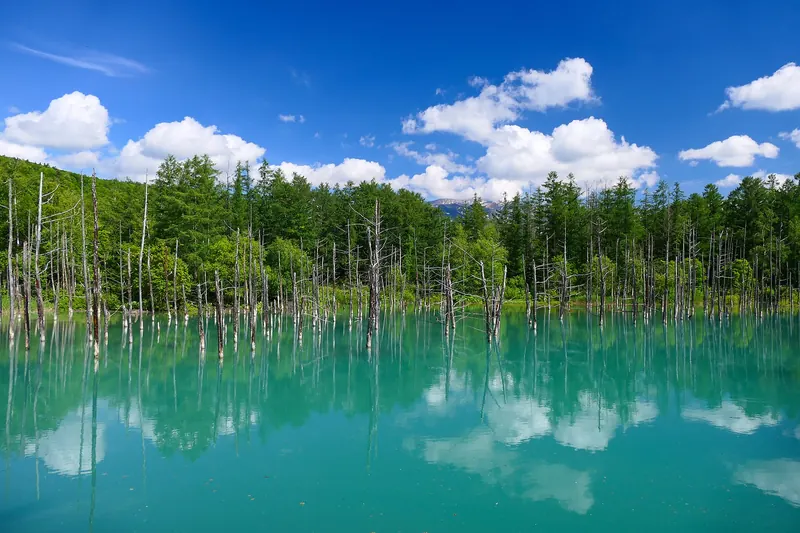
JNTO's page on the town places it for anyone looking at a map: "Chief among the attractions is the Blue Pond, just southeast of the town, a still body of vivid blue that alters its hue in tune with the seasons and weather."
These are the names you are likely to meet:
- Shirogane Blue Pond and Biei Shirogane Blue Pond: the two names the Biei Tourism Association uses on its English pages.
- Blue Pond: the name JNTO uses.
- Shirogane Aoi-ike, or Aoiike: the Japanese name, 白金青い池, in Roman letters. Aoi means blue and ike means pond.
- Shirokane: a second spelling of the district. The association's own news item for October 2026 has Shirokane in its heading and Shirogane in its text.
- Shirogane Blue Pond, as a bus stop: the English name the Dohoku Bus timetable prints beside the stop 白金青い池入口. JNTO spells the same stop out as Shirogane Aoiike Iriguchi; iriguchi means entrance.
Two names nearby belong to other places:
- Shirogane Onsen, printed as Shirogane Hot-Spring on the bus timetable, is the hot-spring village four minutes further along the bus route.
- Shirahige Falls is the waterfall at Shirogane Onsen. It has a section of its own below.
Why is the Blue Pond blue?
The short answer is aluminium in the water and the way it scatters sunlight. The pond is not a natural lake. It is water that collected behind a dam built to hold back mudflows from Mount Tokachi, and its colour was not planned. JNTO opens its page with one line: "The Blue Pond is a happy accident."
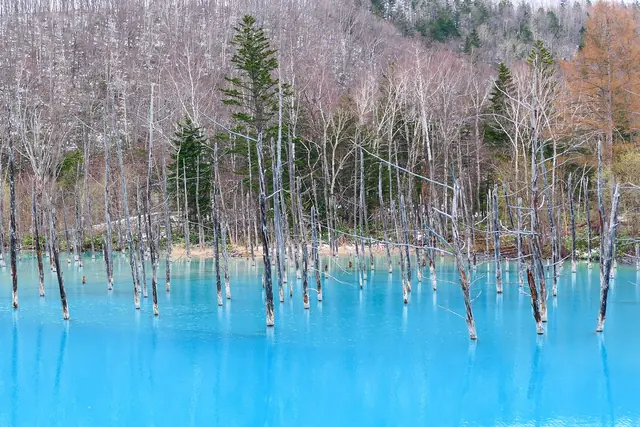
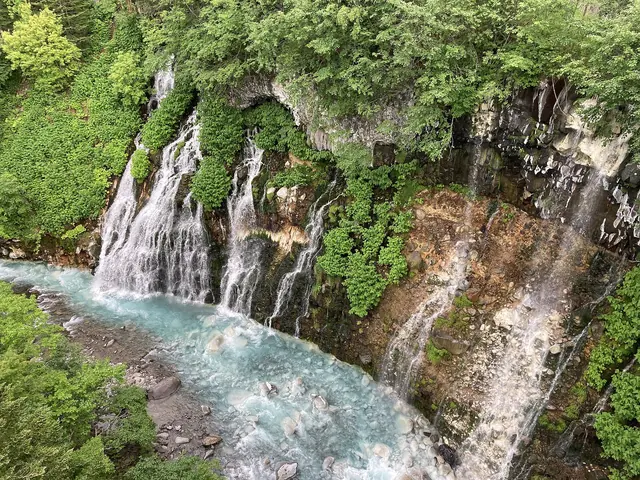
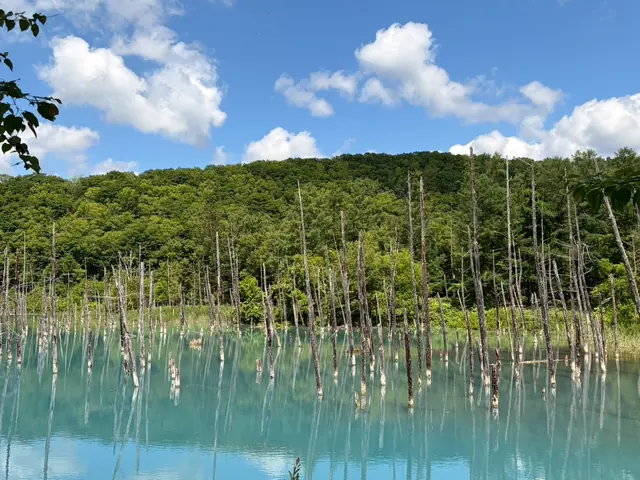
How the pond came to exist. JNTO dates the works: "Blue Pond was created as part of an erosion control system built in 1988 that was designed to stop mudflow damage to Biei from the nearby active volcano, Mt. Tokachi, in Daisetsuzan National Park." The Biei Tourism Association tells it from the town's side, calling the pond something made by accident, "as the by-product of attempts to control mudslides". Its older English page describes what people then saw: "During the disaster prevention work on Tokachi-dake, the water accumulated in the dam took on an unusually blue hue, creating a fantastic landscape when combined with the standing dead larch trees." The association's Japanese page adds that, in time, people simply came to call it the blue pond.
Where the colour comes from. The fullest explanation is on the association's Japanese page, which words it as what is said to be the reason and not as settled fact.
- Two kinds of water mix. The Biei River runs beneath Shirahige Falls at Shirogane Onsen. Upstream of it, streams that carry aluminium and other substances meet water of a different make-up. That mixture is what reaches the pond, which is why the river beside the pond is the same colour.
- Particles scatter the light. Sunlight strikes fine particles suspended in the water, known as colloids, and is scattered in every direction. Blue light has a short wavelength and scatters most easily, so blue is what reaches the eye.
- The bottom may help. One more theory on the same page is that pale soil on the floor of the pond reflects light and brings the blue out.
JNTO names the substance in its list of quick facts: "The bright blue color is thought to be caused by natural colloidal aluminum hydroxide in the water". It also ties the colour to the waterfall up the road: "The color of the pond ranges from a vibrant turquoise to emerald to cobalt blue, caused by impurities in the waters from the Shirahige Falls."
When it is not blue. The association warns that during the spring thaw and after heavy rain the minerals are diluted, and the water can turn cloudy or lose its blue. In the depths of winter the surface is frozen and lies under snow.
The trees. The bare trunks standing in the water are half of the picture. JNTO's note on them is short: "The trees in the water are larch and silver birch". The association describes them as larches that died where they stood.
The Apple wallpaper. The pond's fame outside Japan is usually traced to a computer wallpaper, and JNTO's own two pages do not agree on which one. Its main page says: "In July 2012, Apple released OS X Mountain Lion, which contained a photo of the Blue Pond. As this was included as one of the 15 wallpapers, it became even more famous." Its Local Treasures page says the pond "rose to fame after being selected for use as one of Apple's iOS wallpapers". This page cannot settle which is right. What the two share is that an Apple wallpaper carried the picture around the world.
Best time to visit the Blue Pond
The association's advice is specific: a clear morning with no wind. Its Japanese page recommends exactly that, and suggests staying a night in Biei to be there early. JNTO explains why no two visits look alike: "The seasons and the wind, clouds, and rain can all change its aspect."
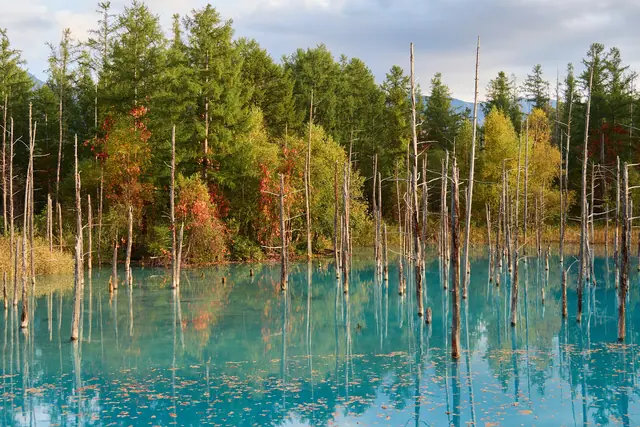
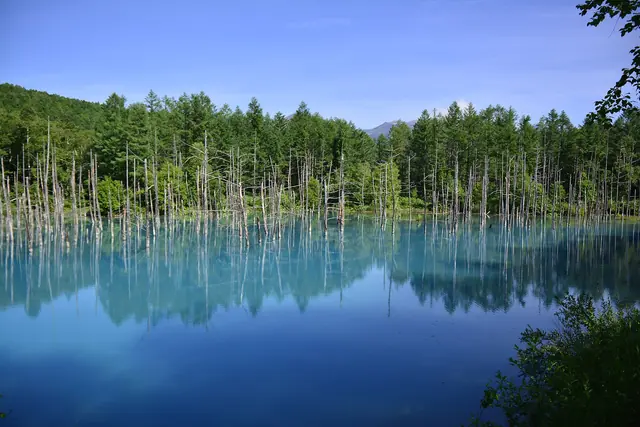
Time of day. On fine days the pond is at its most crowded between 13:00 and 15:00, according to the association, which recommends travelling in the morning to stay out of the afternoon traffic jams and allowing extra time at weekends. The first three buses of the day from Biei Station reach the pond at 07:17, 08:36 and 09:22.
Season. The official pages describe a pond that changes colour through the year.
| Time of year | Official description |
|---|---|
| Spring, while snowmelt pours in | Slightly green-blue; can be cloudy or not blue at all |
| Early summer | Light blue on many days |
| When the new leaves are out | Fresh green against the blue of the water |
| Autumn | The surface coloured by the autumn leaves |
| Midwinter | Frozen over and white |
JNTO's Local Treasures page puts dates on the first of those stages: "In spring, from May to early June, the water is mixed with freshly melted snow from the Daisetsu Mountains and appears a light greenish-blue."
For autumn there is a dated report. On 7 October 2026 the association posted a short note on how the pond looked that week: "Fallen leaves float on the blue water, while the changing colors of the trees add to the autumn scenery."
So the months for blue water are the ones between the thaw and the freeze, with the lightest blue reported for early summer, and the months for a white pond under lights are the winter ones. None of the pages read gives a date for when the pond freezes or when the ice goes, and this page does not guess one.
The photograph of the Blue Pond at the top of this page was taken by this site in July 2026.
Blue Pond in winter and the 2026–27 light-up
In winter you come for snow and light, not for blue water. The town says so directly on its light-up page: during the winter months the blue surface cannot be seen, because snow covers it. A visit in December, January or February means a white pond with dark trunks standing in it, and coloured light after dark.
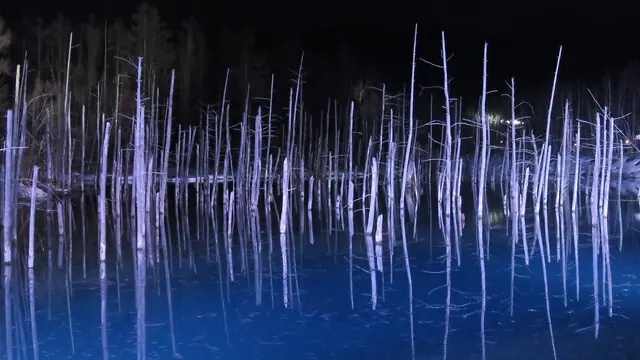
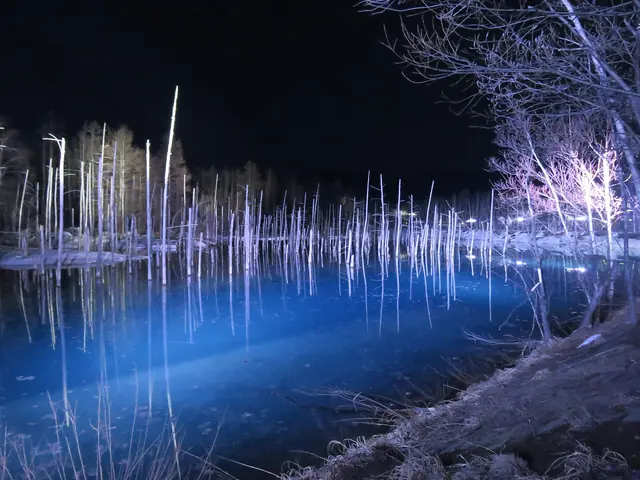
The pond has not always been open at this time of year. Among JNTO's quick facts is this one: "Until 2014, Blue Pond was closed during winter but is now open all year".
Light-up dates and times
The Town of Biei lights the pond every evening from 22 October 2026 to 21 April 2027. The lights come on at a set time that changes by the month, and go off at 21:00.
| Month | Lights on | Lights off |
|---|---|---|
| October, from the 22nd | 17:00 | 21:00 |
| November | 17:00 | 21:00 |
| December | 16:30 | 21:00 |
| January | 17:00 | 21:00 |
| February | 17:30 | 21:00 |
| March | 18:00 | 21:00 |
| April, until the 21st | 18:30 | 21:00 |
- What you see. The town describes a set of lighting patterns that together tell one story in about 15 minutes. Once the surface has frozen and snow lies on it, the programme is changed: more gradation in the lighting, more depth, and sharper shadows, so that the stars, falling snow and the shadows of the larches stand out against the pond.
- Bad weather. The lighting is called off in bad weather, and the town posts the cancellation on its website.
- Stay in the viewing area. The town asks visitors to keep to it and never to step onto the pond.
- New Year. Last winter's notice on the association's page said the lights would stay on until 2:00 the next morning from 31 December to 3 January. The town's page for this winter does not mention any such extension, so do not count on it.
- Parking. The car park beside the pond is the one to use, at the ordinary charge. It stays open until 21:30 from 23 October. By the town's own two tables, the very first evening of lights, 22 October, still falls under the summer hours that end at 19:00; if that is your date, check the town's page before driving out.
Other places lit on the same evenings
The same town page covers three more sets of lights along the road from Biei.
- The Birke forest, 1.8 km before the pond, is lit on the same dates and at the same times. The place to park is the public car park in front of the roadside station there.
- Shirahige Falls, 2.5 km beyond the pond, is lit all year round, from sunset until 21:00. The place to park is the public car park in front of the Shirogane tourist centre.
- In the town centre there are lights in front of Biei Station, the town hall and the library.
Can you see the light-up by bus?
Only in part, and not in every month. The last Dohoku Bus back to Biei Station leaves the pond at 18:05. The two afternoon buses that fit leave Biei Station at 15:34 and 17:15 and reach the pond at 15:56 and 17:37.
| Month | Lights on | Time under lights before the 18:05 bus |
|---|---|---|
| October, from the 22nd, and November | 17:00 | 1 hour 5 minutes |
| December | 16:30 | 1 hour 35 minutes |
| January | 17:00 | 1 hour 5 minutes |
| February | 17:30 | 35 minutes |
| March | 18:00 | 5 minutes |
| April | 18:30 | None; the lights come on after the bus has gone |
From late October to January a bus visitor gets a good hour of lights. In February it is tight, and in March and April the timetable does not work at all. For those months the choices are a car, a taxi or a night at Shirogane Onsen.
Two things from last winter are worth knowing about, with the warning that neither had been announced for 2026–27 on the pages read for this guide.
- A light-up bus tour. The association ran a winter course of its Biei View Bus from 14 November 2025 on Fridays and Saturdays, leaving at 16:35 and returning at 19:30, with a guide. It called at the lit pond, Shirahige Falls and the Birke forest, and it ran even with a single passenger.
- A shuttle for hotel guests. The same notice mentioned a free light-up shuttle for people staying at the Shirogane Onsen lodgings, with the details left to each lodging's own website.
Opening hours and parking
The pond is listed as open all year. The hours the official pages publish are those of the car park, and the town's version is the precise one:
| Period | Car park hours |
|---|---|
| May to 22 October | 7:00 to 19:00 |
| 23 October to April | 8:00 to 21:30 |
The association's pages round the same hours to whole months, with the change at the start of November.
The pond is a short walk from where you park. JNTO puts it this way: "There is a parking lot next to the road, and the pond is about a 2-minute walk away." The association, in the notes for its own bus tour, allows about 5 minutes on foot from the car park.
The town asks drivers to follow its map of the two entrances, so that the queue for the car park does not back up onto the road to Shirogane Onsen.
For visitors who need assistance, the association's Japanese page describes two trials: an online service for arranging help along the whole journey in one request, and a barrier-free map with walking-route guidance for the area around the pond. Both are labelled as trials, and the pages read for this guide do not describe the surface or the slope of the path itself.
How to get to the Blue Pond from Biei Station
Take the Dohoku Bus on its Biei–Shirogane Line. It runs every day, ten times in each direction, reaches the pond in 22 minutes and costs 800 yen one way. The stop to get off at is printed on the timetable as Shirogane Blue Pond.
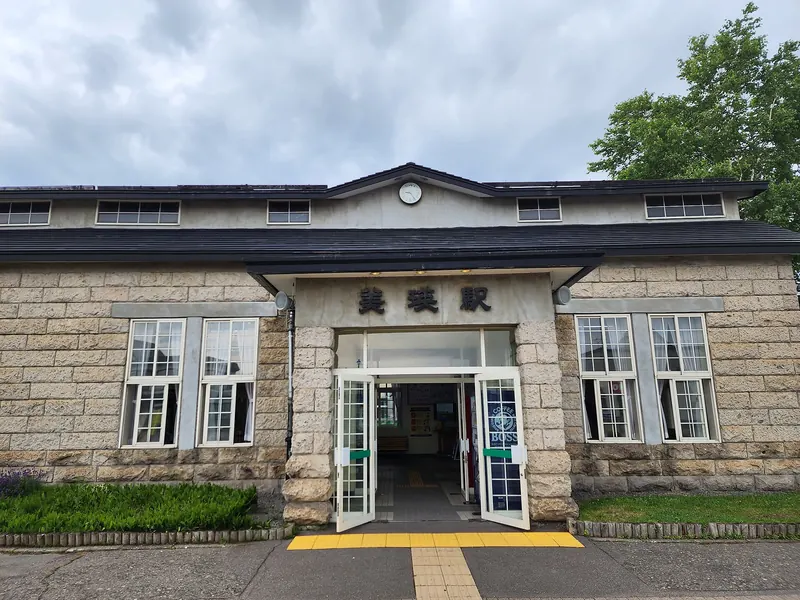
Finding the stop in Biei. The association adds a warning to its page about buses: "Please note the bus stop from JR Biei Station to Shirogane area is in front of the Asahikawa Bank which is on the main street." The timetable labels the stop Biei STN, and the association's Japanese page about the pond links to a guide to the walk from the station.
Buses to the Blue Pond
The times in this section are from the Dohoku Bus timetable marked as revised on 1 October 2026, read on 12 October 2026. A dash means that the bus starts at Biei Station and does not come from Asahikawa.
| Asahikawa Station, stop 9 | Biei Station | Blue Pond | Shirogane Hot-Spring |
|---|---|---|---|
| — | 06:55 | 07:17 | 07:21 |
| 07:20 | 08:14 | 08:36 | 08:40 |
| — | 09:00 | 09:22 | 09:26 |
| 09:40 | 10:34 | 10:56 | 11:00 |
| — | 11:05 | 11:27 | 11:31 |
| 11:00 | 11:54 | 12:16 | 12:20 |
| — | 13:45 | 14:07 | 14:11 |
| — | 14:45 | 15:07 | 15:11 |
| 14:40 | 15:34 | 15:56 | 16:00 |
| — | 17:15 | 17:37 | 17:41 |
Every bus carries on past the hot spring to the end of the line, the National Taisetsu Youth Friendship Center, six minutes later.
Buses back from the Blue Pond
Here a dash means that the bus ends its run at Biei Station.
| Shirogane Hot-Spring | Blue Pond | Biei Station | Asahikawa Station |
|---|---|---|---|
| 07:37 | 07:40 | 08:05 | 09:02 |
| 09:16 | 09:19 | 09:44 | — |
| 10:02 | 10:05 | 10:30 | 11:27 |
| 11:46 | 11:49 | 12:14 | — |
| 12:02 | 12:05 | 12:30 | 13:27 |
| 13:16 | 13:19 | 13:44 | — |
| 14:42 | 14:45 | 15:10 | 16:07 |
| 15:46 | 15:49 | 16:14 | — |
| 16:32 | 16:35 | 17:00 | — |
| 18:02 | 18:05 | 18:30 | — |
The ride back to Biei Station takes 25 minutes. The 18:05 is the last bus of the day, and there is nothing after it.
Fares and how to pay
| Journey, one way | Fare |
|---|---|
| Biei Station to the Blue Pond | 800 yen |
| Biei Station to Shirogane Hot-Spring | 900 yen |
| Asahikawa Station to Biei Station | 580 yen |
| Asahikawa Station to the Blue Pond | 1,600 yen |
| Asahikawa Station to Shirogane Hot-Spring | 1,630 yen |
- What the timetable leaves out. It prints no fare for the short hop between the pond and Shirogane Hot-Spring and no child fare, so this page gives neither.
- Payment. The payment line on the timetable names cash. A second method is shown only as a picture that could not be read for this guide, so this page says no more than that cash is accepted.
- Boarding. The buses work the way most local buses in Japan do. Dohoku Bus spells it out on the page for its day pass: "Please board from the rear door and take a numbered ticket." You press the button before your stop and put the numbered ticket in the fare box beside the driver as you get off. The steps are explained in full under How to ride a city bus in Japan on the Japan bus guide.
How long each bus gives you at the pond
The table pairs each bus from Biei Station with the next bus back. The times at the pond are this site's arithmetic from the timetable, counted from the bus stop.
| Leave Biei Station | Reach the pond | Next bus back | Time at the pond | Back at Biei Station |
|---|---|---|---|---|
| 06:55 | 07:17 | 07:40 | 23 minutes | 08:05 |
| 08:14 | 08:36 | 09:19 | 43 minutes | 09:44 |
| 09:00 | 09:22 | 10:05 | 43 minutes | 10:30 |
| 10:34 | 10:56 | 11:49 | 53 minutes | 12:14 |
| 11:05 | 11:27 | 11:49 or 12:05 | 22 or 38 minutes | 12:14 or 12:30 |
| 11:54 | 12:16 | 13:19 | 1 hour 3 minutes | 13:44 |
| 13:45 | 14:07 | 14:45 | 38 minutes | 15:10 |
| 14:45 | 15:07 | 15:49 | 42 minutes | 16:14 |
| 15:34 | 15:56 | 16:35 | 39 minutes | 17:00 |
| 17:15 | 17:37 | 18:05 | 28 minutes | 18:30 |
The 08:14 and 09:00 buses put you at the pond in the morning hours the association recommends, with 43 minutes before the bus back. The 11:54 arrives shortly before the busiest part of the day.
The one-day bus pass
Dohoku Bus sells a mobile pass for this line, the Biei and Shirogane Area 1-Day Free Pass.
Dohoku Bus is plain about the one limit that matters most to visitors from Asahikawa: "This pass is NOT valid between Biei Station and Asahikawa Station."
Whether the pass saves money is simple arithmetic on the printed fares.
- Pond only. A plain return from Biei Station costs 1,600 yen. The pass costs 400 yen more.
- Shirogane Onsen and Shirahige Falls only. A plain return costs 1,800 yen. The pass costs 200 yen more.
- Pond and falls. Biei Station to the pond is 800 yen and Shirogane Hot-Spring back to Biei Station is 900 yen, 1,700 yen in all, plus the unprinted fare for the four-minute hop between the two. The pass comes out ahead only if that hop costs more than 300 yen.
- More rides than that. Anyone who gets on and off more often, for example by going back to the pond for the evening lights, is the visitor the pass suits.
Taxis and bicycles
JNTO notes that sightseeing taxis are available in Biei and that bicycles, ordinary and electric, can be rented from shops in the town. No taxi fare to the pond and no bicycle rental price was found on an official page, and this site does not quote one. The town's own distances put the pond about 17 km from the station, and none of the pages read gives a cycling time.
From Asahikawa, the airport, Furano and Sapporo
Everything by public transport funnels through Biei Station or Asahikawa Station. The pond has no railway station of its own.
From Asahikawa Station
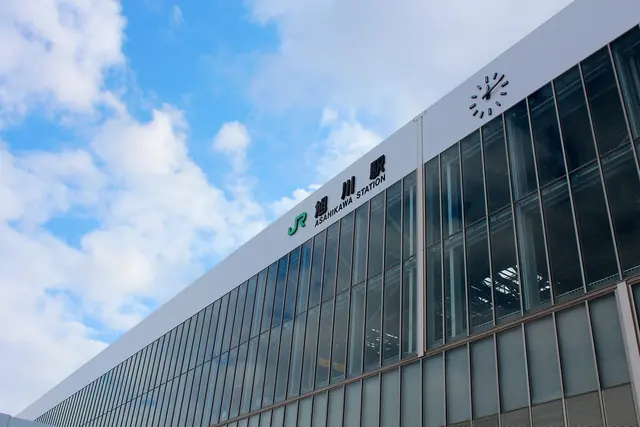
The direct bus. Four of the ten Dohoku buses start at stop 9 in front of Asahikawa Station, and four go back there. The ride to the pond takes 1 hour 16 minutes and costs 1,600 yen.
| Leave Asahikawa | Reach the pond | Direct bus back | Time at the pond | Back at Asahikawa |
|---|---|---|---|---|
| 07:20 | 08:36 | 10:05 | 1 hour 29 minutes | 11:27 |
| 09:40 | 10:56 | 12:05 | 1 hour 9 minutes | 13:27 |
| 11:00 | 12:16 | 14:45 | 2 hours 29 minutes | 16:07 |
| 14:40 | 15:56 | None |
The 14:40 from Asahikawa has no direct bus home. From the pond you take the 16:35 or the 18:05 as far as Biei Station and go on to Asahikawa by train.
Train and bus. The JR Furano Line runs from Asahikawa to Biei for 680 yen. The association gives about 32 minutes for the ride and JNTO around 40. With the 800-yen bus from Biei Station the total is 1,480 yen, 120 yen less than the direct bus. It also opens up the six buses a day that start at Biei. Train times are not listed on the pages read for this guide, so check them against the bus table above.
From Asahikawa Airport
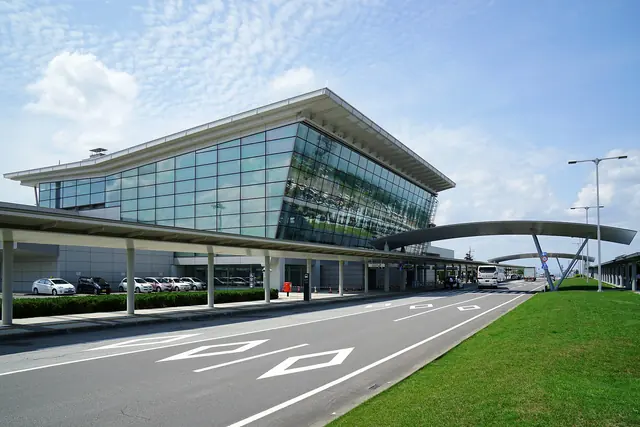
One bus links the airport with Biei, the Lavender-go run by Furano Bus. The association says so in as many words: "This is the only bus to go between Biei and Asahikawa Airport." The ride takes 15 minutes on the timetable revised on 1 April 2026. Reservations are not taken, and the fare table on the Furano Bus page is an image, so this site does not quote a fare.
| Lavender-go leaves the airport | Reaches Biei Station | Next Dohoku bus to the pond |
|---|---|---|
| 10:37 | 10:52 | 11:05 or 11:54 |
| 12:07 | 12:22 | 13:45 |
| 13:12 | 13:27 | 13:45 |
| 14:37 | 14:52 | 15:34 |
| 16:27 | 16:42 | 17:15 |
| 17:27 | 17:42 | None that day |
| 20:02 | 20:17 | None that day |
The pages read do not say whether the two companies stop at the same place in Biei, so the 13-minute connection off the first bus of the day is one to treat with caution.
Going the other way, the Lavender-go leaves Biei Station for the airport at 7:34, 9:04, 10:09, 11:34, 13:24, 14:24 and 16:59 and arrives 19 minutes later.
JNTO's Local Treasures page gives the flight from Tokyo's Haneda Airport to Asahikawa as roughly 1 hour 35 minutes. Fares and baggage rules for flights inside Japan are on the domestic flights page.
From Furano and the lavender towns
The lavender fields are on the same railway line, south of Biei. The association gives about 36 minutes for the train from Furano Station to Biei.
| From | Train fare to Biei, one way |
|---|---|
| Furano | 800 yen |
| Nakafurano | 680 yen |
| Lavender-Batake, the summer-only station | 580 yen |
| Kamifurano | 470 yen |
From Biei Station you change to the Dohoku Bus as above. The fields themselves, their flowering dates and the rail pass that JR Hokkaido sells for this area are covered in the Furano lavender guide.
From Sapporo
By train. JNTO describes the first leg: "The closest major train station, Asahikawa Station, is an hour and 20 minutes from Sapporo on the JR Hakodate Line." The association allows about 90 minutes for the same express. From Asahikawa you either change to the Furano Line for Biei or walk out to stop 9 for the direct bus.
A day trip that fits the timetable. The association's leaflet for summer 2026 listed the limited express Lilac No. 3, leaving Sapporo at 7:13, with a connection that left Asahikawa at 8:44 and reached Biei at 9:17. That is in time for the 10:34 bus from Biei Station, which is the same bus as the 9:40 from Asahikawa, and it puts you at the pond at 10:56. The direct buses back to Asahikawa leave the pond at 12:05 and 14:45. Those train times were printed for the summer and should be checked before you rely on them; trains back to Sapporo are not listed on the pages read for this guide.
By highway bus. The association gives 120 minutes for the highway bus from Sapporo to Asahikawa. It does not name the operator or the fare.
By car. The association gives about 166 km and about 2 hours 30 minutes from the Sapporo interchange to Biei, by the Hokkaido Expressway as far as the Asahikawa-Takasu interchange and then ordinary roads. From New Chitose Airport it allows about 3 hours by rental car on the expressway. The pond is about 20 minutes beyond Biei Station.
By tour. JNTO mentions one more way: "Bus tours go from Sapporo Station and are easily arranged through tour companies." It names no company and no price, and this site does not quote one.
Rail passes, and whether one pays for a trip like this, are discussed on the Japan Rail Pass page.
Driving to the Blue Pond: map code and distances
The map code for the pond's car park is 349 568 888. Typing it into the satnav of a Japanese rental car is what the association's page tells drivers to do; the only address it gives is the name of the district.
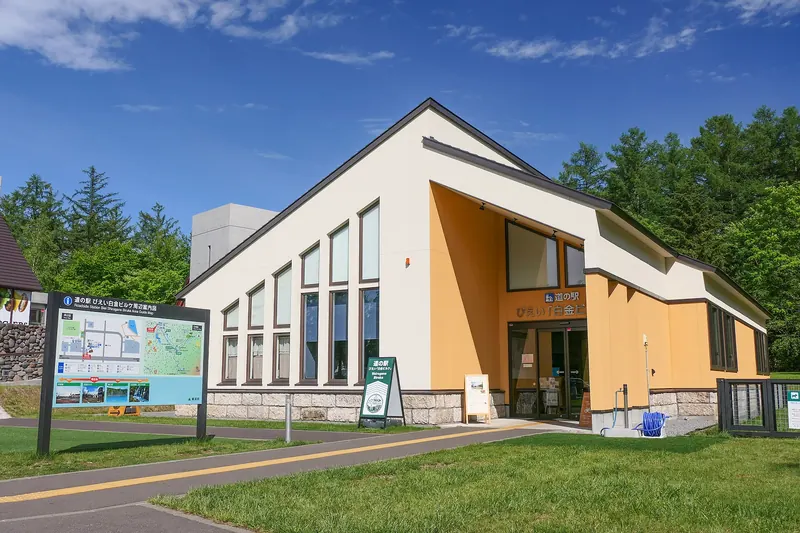
JNTO places the pond on the road network: "Blue Pond is located along prefectural road number 966, which connects central Biei to the Tokachidake Onsen via Shirogane Onsen." The town calls the same road the Tokachidake Onsen Biei Line.
The town's light-up page gives the distances along that road.
| Stretch | Distance |
|---|---|
| Biei Station to the Birke forest and its roadside station | about 15.3 km |
| Birke forest to the Blue Pond | about 1.8 km |
| Blue Pond to Shirahige Falls | about 2.5 km |
That makes about 17 km from the station to the pond, which the association gives as about 20 minutes by car.
The association's access page has figures for reaching Biei in the first place.
| From | Distance to Biei | Time |
|---|---|---|
| Asahikawa | about 26 km on Route 237 | about 40 minutes |
| Furano | about 34 km on Route 237 | about 40 minutes |
| Sapporo interchange | about 166 km | about 2 hours 30 minutes |
| New Chitose Airport | not given | about 3 hours by expressway |
Four points for drivers:
- Arrive in the morning. The association names 13:00 to 15:00 on fine days as the most crowded hours and warns of traffic jams in the afternoon.
- Know your vehicle's length. The car park has one entrance for vehicles of 6 m or more and another for shorter ones, and the charge is six times higher above that line.
- In winter, plan for snow. The pond is open and lit from late October to April, and the car park stays open until 21:30. The section on winter driving in the driving guide covers the conditions.
- The road is closed higher up. Since the volcanic alert for Mount Tokachi was raised in September 2026, a stretch of road 966 beyond the pond and the hot spring has been shut. The pond itself is not inside the restricted area; the details are near the end of this page.
The licence a visitor needs, and what a rental car costs, are on the car rental page.
Bus tours that stop at the Blue Pond
Two operators ran sightseeing buses to the pond in 2026. Both have finished for the year, so what follows is a record of how they worked, to help with planning for 2027. No dates for 2027 had been published on the pages read for this guide.
Biei View Bus
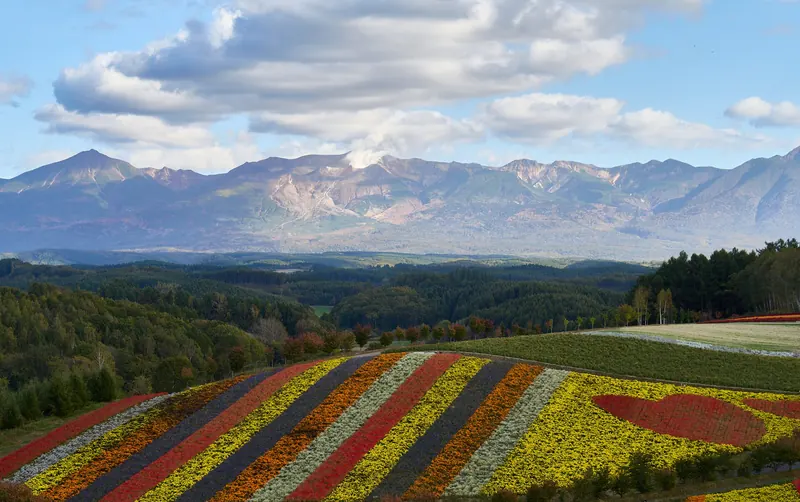
This is a half-day guided tour planned by the Biei Tourism Association and driven by a local bus company.
| Course A, morning | Course B, afternoon | |
|---|---|---|
| Leaves and returns | 9:40 to 12:45 | 14:10 to 17:10 |
| First stop | Blue Pond, about 35 minutes | Shikisai-no-Oka, about 40 minutes |
| Second stop | Shirahige Falls, about 20 minutes | Blue Pond, about 30 minutes |
| Third stop | Shikisai-no-Oka, about 45 minutes | Shirahige Falls, about 15 minutes |
- Dates in 2026: 6 June, then every day from 15 June to 30 September, then 1 to 3 and 9 to 12 October.
- Price in 2026: from 4,500 yen for an adult and 2,250 yen for a child in June and October, and from 5,000 yen and 2,500 yen from July to September. An adult was anyone aged 12 or over. The association noted that prices could vary.
- What it covered: the bus, a guide and insurance, plus admission to the flower garden Shikisai-no-Oka from July to September.
- Booking: online, from 90 days until 17:00 Japan time four days before the tour. Unsold seats could still be bought, first come first served, at the association's office on the day before or the day itself.
- Check-in: at the bus tour counter on the ground floor of the association's building, a minute's walk from Biei Station, at least 15 minutes before departure, with the QR code from the booking.
- On board: seats were reserved and luggage went in the hold at no charge. The association's notes also say: "There is no restroom on the bus."
- Bad weather: the tour was cancelled, with a full refund, when a weather warning was in force.
Furano Bus loop buses
Furano Bus ran three sightseeing loop courses in summer 2026, from Furano Station and Asahikawa Station, and its list of stops included the Shirogane Blue Pond. The two long courses cost 9,000 yen for an adult. The course details are published as image files, so this page cannot say which course stopped at the pond. Prices, dates and departure times for all three are in the Furano lavender guide linked above.
In winter
The association's winter light-up course, described in the section on the light-up, ran on Friday and Saturday evenings last winter. Nothing had been announced for the winter of 2026–27 on the pages read for this guide.
How long to spend at the Blue Pond
None of the official pages suggests a length of visit. Two things give a measure.
- What the association's own tour allows. Its morning course gave about 35 minutes at the pond and its afternoon course about 30. At Shirahige Falls the figures were about 20 and 15 minutes.
- What the bus timetable allows. The gap between arriving from Biei Station and the next bus back runs from 22 minutes to 1 hour 3 minutes, and for most buses it is about 40.
The walk has to come out of that time. JNTO's Local Treasures page says of the bus stop: "The pond is about a 5-minute walk away." On the two tightest turnarounds, 22 and 23 minutes, ten minutes of walking leaves little more than ten at the water, so it is safer to take the bus after.
Put together, half an hour to an hour at the pond is what both the tour and the timetable are built around. Adding Shirahige Falls by route bus turns the outing into about two to two and a half hours from Biei Station; three ways to fit the buses together are set out in the next section.
Shirahige Falls and Shirogane Onsen
Shirahige Falls is the natural second stop. It is about 2.5 km further up the same road, at the hot-spring village of Shirogane Onsen, and the water that runs beneath it is the water that later fills the pond. JNTO lists "The rare groundwater waterfalls of Shirahige" among the things not to miss in Biei, and on its page about the pond it adds "Visiting nearby Shirogane Onsen" to the same kind of list.
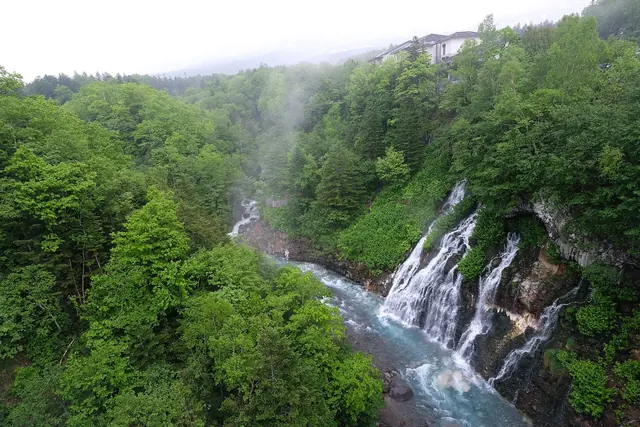
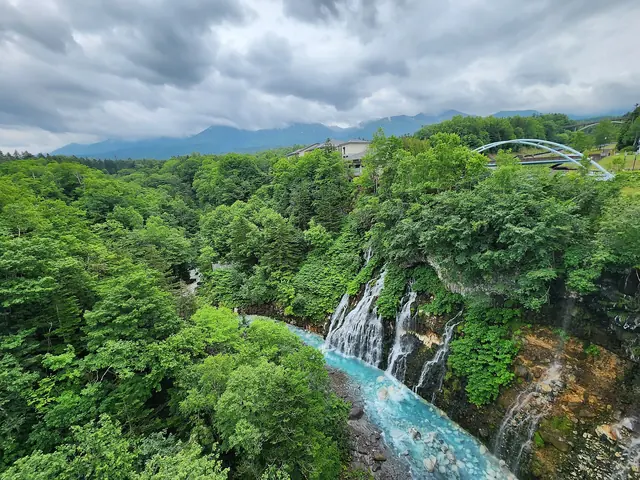
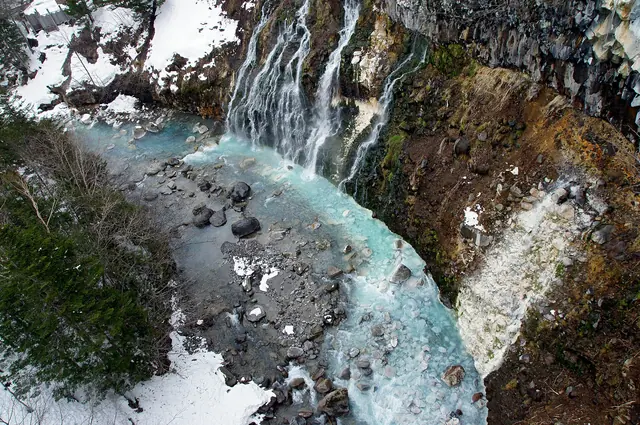
What you see. The association's Japanese page explains the name: the falls look like a white beard, which is what shirahige means. The drop is about 30 m. Groundwater seeps out from between the rocks of the cliff and pours into the Biei River, which the page describes as cobalt blue. The association classes the falls as a type that is rare in Japan, fed by water that has run underground. The view it recommends is from the bridge over the river, known as the Blue River Bridge.
In winter. The same page says the white lines of water and snow stand out against the rock, and that spray and steam from the falls leave rime on the trees. The falls are lit every evening of the year, from sunset until 21:00.
The Shirogane tourist centre. This is the information office for the hot-spring village, and the place the association tells visitors to the falls to park. It is open all year from 9:00 to 16:00, with a possible break between 11:30 and 12:30, and closes over the New Year holidays and in bad weather. It has free Wi-Fi.
Shirogane Onsen. This page does not review the baths or the lodgings. What can be said from the official pages is that the village is where the bus stops for the falls, that the town describes it as operating normally under the current volcanic alert, and that its lodgings offered guests a free shuttle to the lit pond last winter.
The pond and the falls by route bus
Because every bus to the pond goes on to Shirogane Hot-Spring, the two can be joined without a car. These three combinations are this site's arithmetic from the timetable.
| Leave Biei Station | At the Blue Pond stop | At the Shirogane Hot-Spring stop | Back at Biei Station | Whole outing |
|---|---|---|---|---|
| 08:14 | 08:36 to 09:22, 46 minutes | 09:26 to 10:02, 36 minutes | 10:30 | 2 hours 16 minutes |
| 10:34 | 10:56 to 11:27, 31 minutes | 11:31 to 12:02, 31 minutes | 12:30 | 1 hour 56 minutes |
| 13:45 | 14:07 to 15:07, 1 hour | 15:11 to 15:46, 35 minutes | 16:14 | 2 hours 29 minutes |
The order can be turned round. The 09:00 from Biei Station reaches Shirogane Hot-Spring at 09:26; the 10:02 from there drops you at the pond at 10:05; and the 11:49 from the pond is back at Biei Station at 12:14. That gives 36 minutes for the falls and 1 hour 44 minutes at the pond.
The fare for the hop between the two stops is not printed on the timetable. This is the kind of day the one-day pass was made for, though by the arithmetic earlier on this page it saves money only if that hop costs more than 300 yen.
The town gives the road distance between the pond and the falls, about 2.5 km, and nothing more. None of the pages read describes a footpath or gives a walking time, so this page does not suggest walking it.
Rules at the Blue Pond
The rules are few, and they are the same whichever official page you read.
- Stay behind the fence. The association's Japanese page tells visitors never to climb over the fence into the pond, and warns that doing so can cost a life.
- Keep off the ice. The association's list of requests to visitors is blunt about winter: "Do not walk on the frozen blue pond. The ice may break and fall off. It is very dangerous."
- Put nothing in the water. The same list asks people not to throw stones or rubbish into the pond.
- No drones without approval. Flying a drone at the pond needs an application to the town and its approval; the contact is the same section of the town office that handles the car park. For the town as a whole the association states the rule this way: "In principle, drone flights and aerial photography are prohibited in Biei Town." The exception is for people who have obtained permission in advance.
- At the light-up, keep to the viewing area. This is the town's request, and it comes with a reminder never to step onto the pond.
The drive to the pond crosses farming country, and the association's requests cover that as well.
- Fields are private. Do not walk into farmland. The association explains that soil carried on shoes can harm the crops.
- Snowfields are fields too. The white hills of winter are private land, with wheat and other crops growing beneath the snow. Visitors are asked to stay on public roads that have been ploughed.
- Stay on paved roads. Gravel tracks and farm roads are not for visitors' cars.
- Do not block the road. Stopping where it holds up traffic is on the list of things not to do, and so is leaving rubbish behind.
Blue Pond soft serve and souvenirs
The association's Japanese page has a list headed Blue Pond goods. It describes each item and stops there: it gives no price and no opening hours, and it does not name the shop. No price for any of these was found on an official page, and this site does not quote one.
- Blue Pond soft serve, summer only. A soft-serve ice cream topped with a biscuit in the shape of a character. There are three kinds: the Blue Pond soft serve, flavoured like ramune, a Japanese fizzy drink; the Biei milk soft serve, made with raw milk from the town; and a mixed one.
- Blue Pond soda. Three drinks: a lemonade-flavoured soda made in the image of the pond, a soda named after the snow-covered pond with soft jelly in it, and a cream soda topped with the Biei milk soft serve.
- Jersey milk and drinking yoghurt. Sold in bottles designed for the pond and described as new. The milk comes from a farm in Biei.
- A miniature bottle. A keepsake of a pond that, as the page puts it, cannot be taken home.
- Mascots. A Biei version of the Mokeke character and a blue fox.
One practical note for anyone who joins the association's bus tour with an ice cream in hand. Its rules for the bus read: "Food and drinks are allowed on board, but soft-serve ice cream is strictly prohibited."
Mount Tokachi: the volcanic alert in autumn 2026
The pond exists because of Mount Tokachi, and in autumn 2026 the volcano is active enough to affect travel plans. This is where things stood on 12 October 2026.
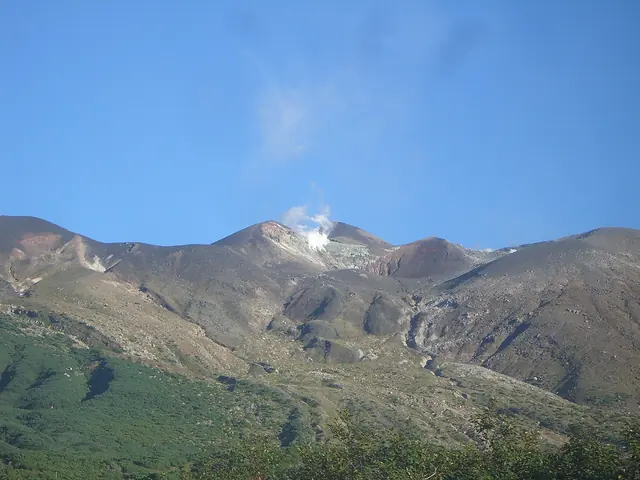
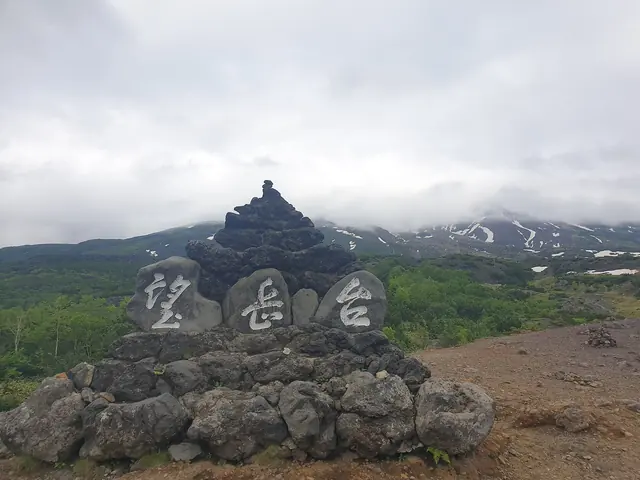
- The level. At 09:30 on 12 September 2026 the Japan Meteorological Agency (JMA) raised its alert for the volcano. The tourism association's English notice of that day reads: "The volcanic alert level for Mount Tokachi has been raised from Level 2 to Level 3." JMA labels Level 3 as a restriction on entering the mountain.
- The reason. JMA said that volcanic earthquakes of large amplitude had been increasing since 17 August.
- What the warning covers. Large rocks hurled out by an eruption anywhere within about 3 km of the crater. Downwind, ash and small stones may be carried further. Biei is one of five municipalities the warning names.
- What it does not cover. The Town of Biei states that the restriction is around the crater only, and that it is not a restriction on the Shirogane district or on the areas where people live. It describes the Shirogane Onsen district as open for business as usual.
- The road. Prefectural road 966 is closed between the gate at the Tokachidake Bogakudai lookout and Tokachidake Onsen. The town says the lookout itself can still be reached.
- Tours. In a statement dated 15 September 2026 the association said its Biei View Bus was running normally, because the Blue Pond, Shirahige Falls and Shikisai-no-Oka all lie short of the restricted area. If one of the stops ever fell inside it, the tour would be cancelled outright and refunded in full.
- The latest commentary. JMA's commentary issued at 16:00 on 9 October said Level 3 was continuing. It reported no large-amplitude volcanic earthquakes since 13 September, a volcanic tremor lasting about 20 minutes on 7 October, and a continuing possibility of an eruption that would affect the area within about 3 km of the crater.
- Earlier in the year. The town's page also records very small eruptions on 22 July and 6 August 2026.
None of the pages read gives the pond's distance from the crater, and this page does not estimate it. What the town and the association do say is that the pond, the falls and the hot spring are outside the restricted area.
The town notes that JMA publishes new information on Mount Tokachi every Monday and Friday at 16:00. Both the JMA page and the town's page are in the list of sources below, and they are the pages to read on the morning you go.
Frequently asked questions
Is the Blue Pond in Biei free?
No admission charge is listed on any of the official pages. The charge is for the car park: 1,000 yen for a car, 300 yen for a motorcycle and 6,000 yen for a vehicle of 6 m or more, per visit, since 1 July 2026. Visitors who arrive by bus have nothing listed to pay at the pond.
Are the Shirogane Blue Pond and the Biei Blue Pond the same place?
Yes. Shirogane is the district of Biei where the pond lies, so the two names describe a single pond. The Japanese name is Shirogane Aoi-ike.
How do I get to the Blue Pond from Biei Station?
Take the Dohoku Bus on the Biei–Shirogane Line from the stop in front of the Asahikawa Bank on the main street. There are ten buses a day; the ride takes 22 minutes and costs 800 yen each way. The first leaves Biei Station at 06:55, and the last one back leaves the pond at 18:05. By car it is about 17 km, or about 20 minutes.
How do I get from Asahikawa to the Blue Pond?
Four Dohoku buses a day run direct from stop 9 at Asahikawa Station, at 07:20, 09:40, 11:00 and 14:40. They take 1 hour 16 minutes and cost 1,600 yen. The alternative is the JR Furano Line to Biei for 680 yen and then the bus from Biei Station for 800 yen. From Asahikawa Airport, the Lavender-go bus reaches Biei Station in 15 minutes.
Can I visit the Blue Pond from Sapporo in a day?
On paper, yes. The express to Asahikawa takes about an hour and a half, and from Asahikawa the pond can be reached by direct bus or by train to Biei and the bus from there. In summer 2026 a train leaving Sapporo at 7:13 connected with the bus that reaches the pond at 10:56, and direct buses back to Asahikawa leave the pond at 12:05 and 14:45. This site has not timed the whole day, so check current train times first.
What is the map code for the Blue Pond?
It is 349 568 888, the code the Biei Tourism Association gives for the pond. For Shirahige Falls the association gives 796 182 604.
What are the Blue Pond's opening hours?
The pond is listed as open all year. The published hours are those of the car park: 7:00 to 19:00 from May to 22 October, and 8:00 to 21:30 from 23 October to April.
What is the Blue Pond like in December and the rest of winter?
White, not blue. The town says the blue surface cannot be seen in the winter months because snow lies over it. What visitors come for in December, January and February is the lighting after dark, with the bare trees standing in the snow.
When is the Blue Pond lit up?
Every evening from 22 October 2026 to 21 April 2027, unless bad weather cancels it. The lights come on at 17:00 in October, November and January, 16:30 in December, 17:30 in February, 18:00 in March and 18:30 in April. They go off at 21:00.
Can I see the Blue Pond light-up by bus?
From late October to January, yes: the lights are on for an hour or more before the last bus leaves the pond at 18:05. In February that shrinks to 35 minutes and in March to 5 minutes, and in April the lights come on after the last bus has gone. For those months you need a car, a taxi or a night at Shirogane Onsen.
Why is the Blue Pond blue?
The Biei Tourism Association's explanation is that water carrying aluminium mixes with other water upstream and forms fine suspended particles, and that those particles scatter sunlight. Blue light scatters most easily, so the water looks blue. The association presents this as what is said to be the cause, not as proven fact.
What is the best time of day to visit the Blue Pond?
The morning. The association recommends a clear morning without wind, and says that fine days are most crowded between 13:00 and 15:00. The 08:14 and 09:00 buses from Biei Station both arrive well before that.
Which month is best for the Blue Pond?
For blue water, the months between the spring thaw and the winter freeze. The official pages describe a greenish and sometimes cloudy pond while snowmelt runs in, light blue on many days in early summer, and autumn leaves on the water in October. For snow and lights, the winter months.
How long do I need at the Blue Pond?
Half an hour to an hour is what the official tour and the bus timetable are built around. The association's half-day tour allowed about 30 to 35 minutes at the pond, and the gap between a route bus arriving and the next one back runs from 22 minutes to 1 hour 3 minutes.
How far is Shirahige Falls from the Blue Pond?
About 2.5 km further up the same road, by the town's figures. By Dohoku Bus it is four minutes from the Blue Pond stop to Shirogane Hot-Spring, and the falls are about three minutes' walk from that stop.
Is there a live camera at the Blue Pond?
No live camera was found on the official pages read for this guide. The nearest thing to a current report is the news section of the Biei Tourism Association, which posted a note on how the pond looked on 7 October 2026.
Is there ice cream at the Blue Pond?
The association's Japanese page lists a Blue Pond soft serve, sold in summer only, in three kinds: one flavoured like ramune, one made with milk from Biei, and a mixed one. It gives no price and does not name the shop.
Can I fly a drone at the Blue Pond?
Not without permission. Flying a drone at the pond needs an application to the town and its approval, and across Biei, flying drones and filming from the air are banned in principle.
Can I walk on the frozen Blue Pond?
No. The association warns that the ice may break, and the town asks visitors to the winter light-up to stay inside the viewing area. Climbing over the fence is forbidden in every season.
Is the Blue Pond affected by the Mount Tokachi volcanic alert?
On 12 October 2026 the pond was outside the restricted area. Mount Tokachi has been at Level 3 since 12 September 2026, but the town says the restriction applies around the crater and not to the Shirogane district. A stretch of road 966 higher up is closed. Read the Japan Meteorological Agency's latest commentary before you travel.
Is the one-day bus pass worth it for the Blue Pond?
Not for the pond alone. The pass costs 2,000 yen, and a plain return from Biei Station costs 1,600 yen. It starts to pay only if you also ride to Shirogane Onsen and make extra journeys, and it is not valid between Biei and Asahikawa.
Can I see the Blue Pond and the Furano lavender fields in one day?
The transport allows it, though this site has not tried the timing. Biei is 680 yen by train from Nakafurano and 800 yen from Furano, and the bus from Biei Station to the pond adds 22 minutes. By car the association gives about 40 minutes between Furano and Biei, with about 20 more to the pond. The lavender flowers in summer, so it is a plan for that season.
Is the Blue Pond the Apple wallpaper?
A photograph of it was. JNTO's main page says a picture of the pond was among the wallpapers in OS X Mountain Lion, released in July 2012, while another JNTO page calls it an iOS wallpaper. Both credit an Apple wallpaper with making the pond famous.
Is there a toilet at the Blue Pond?
Yes. The association lists toilets at the pond that are open all year, including a wheelchair-accessible one. At Shirahige Falls the public toilets are in the Shirogane tourist centre and are open 24 hours.
Sources
Official and primary sources used for this page. Checked October 12, 2026.
- Town of Biei: 青い池駐車場のご利用について (in Japanese) — parking charges from 1 July 2026, the six-metre rule, the automatic gates, exemptions, car park hours, the two entrances and how the fees were spent
- Biei Tourism Association: 青い池駐車場の利用料金が令和8年7月1日(水)から変更となります (in Japanese) — the old and new parking charges
- Town of Biei: 青い池・白ひげの滝ライトアップ (in Japanese) — light-up dates and times for 2026–27, the lighting programme, the lights at the Birke forest and Shirahige Falls, and distances along the road
- Biei Tourism Association: Shirogane Blue Pond — map code, parking spaces, facilities, access and the one-day pass
- Biei Tourism Association: 白金青い池 (in Japanese) — why the water is blue, the seasons, the crowded hours, the goods on sale and the accessibility trials
- Biei Tourism Association: 白金青い池, facility page (in Japanese) — the warning about the fence and the drone rule at the pond
- Biei Tourism Association: Biei Shirogane Blue Pond — its account of how the pond formed
- Biei Tourism Association: The Blue Pond in Shirokane in October, 7 October 2026 — how the pond looked in early October 2026
- Biei Tourism Association: 「白金青い池」ライトアップ今年も始まります☆ (in Japanese) — last winter's light-up notice
- Biei Tourism Association: 「美遊バス」冬のライトアップコース運行決定!, 15 October 2025 (in Japanese) — last winter's light-up bus course and the shuttle for hotel guests
- Biei Tourism Association: Biei Half Day Bus Tour 'Biei View Bus' 2026 — courses, dates, prices, booking and rules of the 2026 tour, and its train connections
- Biei Tourism Association: 美遊バス運行状況, 15 September 2026 (in Japanese) — the tour's status under the volcanic alert
- Biei Tourism Association: Travel by sightseeing bus — where the bus stop in Biei is, and the airport bus
- Biei Tourism Association: Access — distances and times to Biei by road and rail
- Biei Tourism Association: A request to all visitors — rules about the ice, drones, farmland and roads
- Biei Tourism Association: The alert level for Mount Tokachi has been elevated due to volcanic activity, 12 September 2026 — notice of the rise to Level 3
- Biei Tourism Association: Shirahige-no-Taki Falls — the walk from the bus stop and access to the falls
- Biei Tourism Association: 白ひげの滝 (in Japanese) — the name, the drop, the bridge, parking, map code and toilets
- Biei Tourism Association: 白金観光センター (in Japanese) — opening hours, parking and toilets of the tourist centre
- Town of Biei: 十勝岳について (in Japanese) — the scope of the restriction, the road closure and the small eruptions of 2026
- Japan Meteorological Agency: 火山活動の状況(十勝岳) (in Japanese) — the Level 3 warning and the commentary of 9 October 2026
- Dohoku Bus: Biei–Shirogane Line timetable and fares (PDF, in Japanese) — every bus time and fare on this page
- Dohoku Bus: 美瑛・白金エリア1日フリーパス (in Japanese and English) — price, validity and conditions of the one-day pass, and how to board
- Japan National Tourism Organization: Blue Pond — the pond's origin, colour, trees, wallpaper, winter opening, road and tours
- Japan National Tourism Organization: Biei — the pond's place in the town, the train from Sapporo, taxis and rental bicycles
- Japan National Tourism Organization: Shirogane Blue Pond in Biei, Japan's Local Treasures — spring colour, the walk from the bus stop and the flight time from Tokyo
- Furano Bus: 路線バス (in Japanese) — times of the Lavender-go bus between Asahikawa Airport and Biei Station
- Furano Bus: 富良野・美瑛・旭川 観光周遊バス2026 (in Japanese) — the 2026 sightseeing loop buses
- JR Hokkaido: 富良野線「臨時快速列車」を運転します, 24 August 2026 (PDF, in Japanese) — train fares between Biei and the other stations on the Furano Line
- JR Hokkaido: 「JRで行く 富良野・美瑛 2026」キャンペーン, 25 March 2026 (PDF, in Japanese) — the temporary Lavender-Batake Station
Related guides
To cite or link to this page: Blue Pond in Biei: the parking fee, bus times, the winter light-up and when to go — Japan Pocket Guide, https://japanpocketguide.com/things-to-do/blue-pond-biei/