Culture · Calligraphy
Japanese calligraphy: what shodo is, how it came from China, the 2026 UNESCO decision, the brush, ink stick, inkstone and paper, the styles and kana, classes in Tokyo and Kyoto, museums to visit, Kumano brushes and Nara ink to take home, and New Year writing
Japanese calligraphy, shodo, is the art of writing characters with a brush and ink, and it reached Japan from China some 1,500 years ago before growing styles of its own. This guide explains what it is, where it parts ways with Chinese calligraphy, the four tools at its heart, the styles you will see in a museum, where a visitor can take a class in Tokyo or Kyoto, the museums that hold the great works, and where the best brushes, ink sticks and inkstones are made.
Last checked · Sources

In short
Japanese calligraphy, called shodo, is the art of writing kanji and kana with a brush and ink on paper. It came from China with Buddhism in the 6th century and grew its own Japanese styles, above all kana writing from the Heian period. Its tools are the brush, the ink stick, the inkstone and paper. In Tokyo, a class in Yushima costs ¥5,000 and the Taito City Calligraphy Museum charges ¥500. On 5 November 2026 a UNESCO body recommended listing shodo as intangible cultural heritage, with the final decision due between 1 and 3 December.
What Japanese calligraphy is
Japanese calligraphy is called shodo, and at its simplest it means writing characters on paper with a brush and ink. Keiko Fukumitsu, who founded and runs a calligraphy school in Osaka, explains in an interview with JNTO, Japan's national tourism organisation, that the word means the way of writing. For centuries, she says, it was seen as a key to classical literature and Buddhist thought and as a way to train the mind. Today you meet it all over the country: in shows at galleries, schools and public spaces, in lessons after school and at weekends, and in the huge characters that children paint for fun.
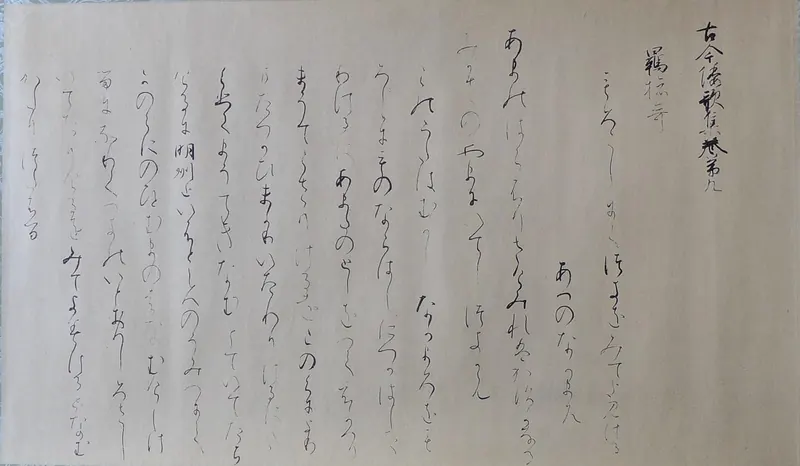
The Agency for Cultural Affairs goes into more detail. When Japan added calligraphy to its register of intangible cultural properties in 2021, the agency described shodo as putting language into writing with a brush, in kanji, in kana or in both, and counted seal carving, tenkoku, as part of the art. Students learn its techniques, shoho, by copying fine models, then adapt them to make their own work.
Where it came from: China and the 6th century
Calligraphy began in China, and JNTO's interview puts the next step plainly: "Calligraphy arrived in Japan from China in the 6th century, along with Buddhism." Japan had no written language of its own at the time. Chinese characters, kanji, were fitted to spoken Japanese, and a simpler script, kana, was made from them to write the parts of the language that characters could not show.
From China to Japan
- About 3,500 years ago: in China, simple pictures of things appear as inscriptions on bones and tortoiseshells used for divination.
- Before the 4th century ends: five basic forms of script are in place, from block styles with clearly separated strokes to joined-up cursive ones.
- 6th century: calligraphy reaches Japan along with Buddhism.
- Mid-Heian period: the wayo manner and kana writing develop at court.
- Edo period: tenarai, learning from printed models, becomes common.
Is calligraphy Japanese or Chinese?
The honest answer is a mix of the two. A JNTO itinerary for Tokyo describes Japanese calligraphy as "a form of artistic writing adopted and reinterpreted from ancient Chinese culture", and says it later grew into an art of its own. The Agency for Cultural Affairs traces how that happened. Japan first took in brush methods from the finest Chinese writing, then reworked them. From the middle of the Heian period a manner of writing that China did not have, known as wayo, appeared. Its full, generous lines and rounded characters can be seen in the hand of Fujiwara no Yukinari, one of three great masters of the age remembered as the sanseki.
In the same years, kana writing came into its own as poetry in the waka form flourished at court. Calligraphers scattered lines of verse across sheets of decorated paper and linked one character to the next in a single flowing movement, and the best of these pieces were later prized as models. So the short answer is that calligraphy came from China, while the kana writing and the wayo style are Japan's own.
Japanese calligraphy in six words
- Shodo: the Japanese name for the art, often explained as the way of writing.
- Kanji: the Chinese characters that reached Japan in the 6th century.
- Kana: the simpler script made from kanji to write Japanese sounds.
- Wayo: the Japanese manner of brush writing that grew from the mid-Heian period.
- Tenkoku: seal carving, which the Agency for Cultural Affairs counts as part of shodo.
- Tenarai: learning to write by copying a model, which spread widely in the Edo period.
From the Edo period to the gallery wall
In the Edo period one school of the wayo tradition, Oie-ryu, spread across the country. Simple printed books for learning characters began to circulate, and tenarai, practising from such a model, became common. Among the gifted priests and court nobles of the time, Shokado Shojo, Konoe Nobutada and Hon'ami Koetsu were later grouped together as the three great brushes of the Kan'ei era.
The modern way of showing calligraphy came with the Meiji period. At the first National Industrial Exhibition, held in Ueno Park in Tokyo in 1877, writing in hiragana and in kanji hung beside paintings and crafts, and as museums opened, works moved onto gallery walls. Calligraphy societies took on the job of holding exhibitions, and their open shows still keep traditional methods alive.
Shodo and UNESCO: the decision in December 2026
On 5 November 2026 the Agency for Cultural Affairs announced that the evaluation body for UNESCO's intangible heritage lists had recommended that shodo be added to UNESCO's Representative List of intangible cultural heritage. The body can make one of three recommendations: to inscribe, to refer a file back to the nominating country for more information, or not to inscribe. Shodo received the first.
From the national register to UNESCO
- October 2021: the Council for Cultural Affairs recommends registering shodo as a registered intangible cultural property, in a new field for the culture of daily life.
- The first nomination: Japan sends the file to UNESCO, but the examination is put off.
- March 2025: shodo is chosen again, and the file is to be resubmitted by the end of the month.
- 5 November 2026: the evaluation body recommends inscription.
- 1–3 December 2026: the committee in Xiamen is due to decide.
The recommendation is not the last word. The final decision belongs to the 21st session of the Intergovernmental Committee, meeting from 30 November to 5 December 2026 in Xiamen, China. The agency expects calligraphy's turn to come between Tuesday 1 and Thursday 3 December, and the committee picks from the same three outcomes as the evaluation body.
It is Japan's second attempt. The file was first sent to UNESCO a year before, but its examination was put off, because Japan currently has only one nomination examined every two years; in March 2025 shodo was chosen again as Japan's candidate.
The national register came first. A 2021 revision of Japan's law on cultural properties created a field for the culture of daily life, which the country's basic law on culture and the arts lists as tea ceremony, flower arrangement, calligraphy, food and the like. The Japan Calligraphy Culture Association, formed across the existing calligraphy societies, was recognised as the group that passes on the skills. Two other arts in that field, the way of tea and ikebana, have pages of their own on this site.
The four treasures: brush, ink stick, inkstone and paper
Calligraphy has its own set of tools, and they share a collective name, bunbo shiho, the four treasures of the writing desk: the brush, the ink, the inkstone and the paper. The Agency for Cultural Affairs names all four in its account of the art.
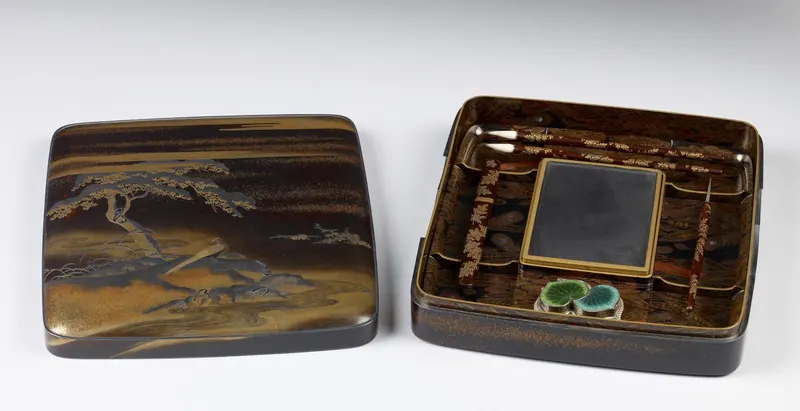
The tools of Japanese calligraphy
- Brush, fude: a Japanese brush blends 7 or 8 kinds of hair, such as goat, horse, raccoon dog and weasel.
- Ink stick, sumi: soot pressed together with glue into a solid stick, which is ground on the inkstone.
- Inkstone, suzuri: a slab of stone with a fine bite for grinding the stick; slate from Ogatsu was once the leading kind.
- Paper: the fourth treasure; workshops give you paper, a square shikishi board or a fan to write on.
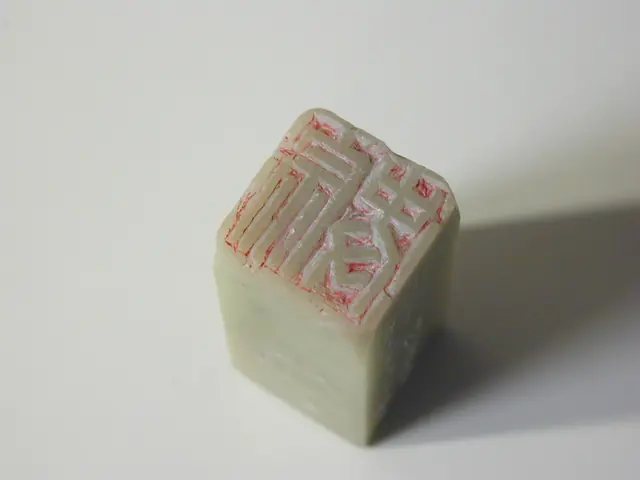
- Seal: a red stamp that stands for the artist's name; carving it is an art of its own.
- Model: a fine piece of writing to copy, the base of learning since the days of tenarai.
The brush
The brush matters more in calligraphy than in almost any other kind of writing, because blurring and broken, dry strokes are part of what a calligrapher sets out to show. The government magazine Highlighting Japan made the point in a 2016 feature on Kumano in Hiroshima Prefecture, the town that makes more brushes for writing, for painting and for make-up than anywhere else in Japan. Brushes made in other countries, the feature says, use one or two kinds of hair, while a Japanese brush blends seven or eight.
Making a brush is slow hand work, and a craftsman quoted in the feature reckons it takes at least ten years just to learn to judge the hair.
How a brush is made
- Prepare the hair: dust it with rice-husk ash, press it with a heated iron and knead it to work out oil; too much oil repels the ink, too little lets the hair snap.
- Sort: comb the hair and take out poor strands.
- Shape: cut it into five lengths and layer them into a cone.
- Finish: wrap the outside in soft fine hair and tie the base with hemp thread.
Hiroshima Prefecture adds one more feature of Kumano brushes: the tips are left as they are, not cut level, so the point is fine and has a good spring. Its guide to the brushes reminds learners that the stop, the flick and the sweep, tome, hane and harai, are the heart of writing with a brush.
The ink stick and Nara
Traditional Japanese calligraphy ink comes as a solid stick, sumi. A 2017 Highlighting Japan feature defines it as "a compressed mixture of vegetable soot and glue", and the stick is ground against the inkstone to make the ink. Nara is the name most linked with it, and Keiko Fukumitsu, who studied in Nara, rates its ink sticks as the best in Japan. A Nara City archive sets out the long history of the trade.
Nara ink through the centuries
- Muromachi period: ink making in Nara is said to have begun at Kofuku-ji temple.
- Edo period: Nara ink was presented to the shogunate every year, making the city one of the best-known places for ink.
- After 1868: the trade had to change with the Meiji Restoration; Nara makers won awards at exhibitions, including Chicago in 1893.
- 1920: seven old ink makers joined forces in a single company so that the trade could survive.
The inkstone and Ogatsu
The inkstone, suzuri, is a shaped slab of stone. Its surface needs a fine bite, the teeth that wear the ink stick down evenly as it is rubbed. At one time nine in ten of the inkstones made in Japan came from a single town, Ogatsu, on the Pacific coast of Miyagi Prefecture.
Paper and the finished piece
The fourth treasure is paper. In the workshops in this guide, the finished piece often goes on something sturdier: a square board called a shikishi, a folding fan, or a long sheet made into a hanging scroll. At Fude no Sato Kobo in Kumano, for example, visitors can write or paint on a 70 by 35 cm sheet that has been mounted as a scroll.
Styles, kana and how to look at a work
Ask what Japanese calligraphy styles are, and the answer starts in China, where five basic forms were in place before the close of the 4th century. Keiko Fukumitsu describes them as running from block styles, with each stroke clearly defined, to cursive styles that join up, and she says a serious student must learn all five main styles. The block style is called kaisho, which GO TOKYO, the city's official tourism site, glosses as the square style. On top of the Chinese forms, Japan added kana writing and the wayo manner described above.
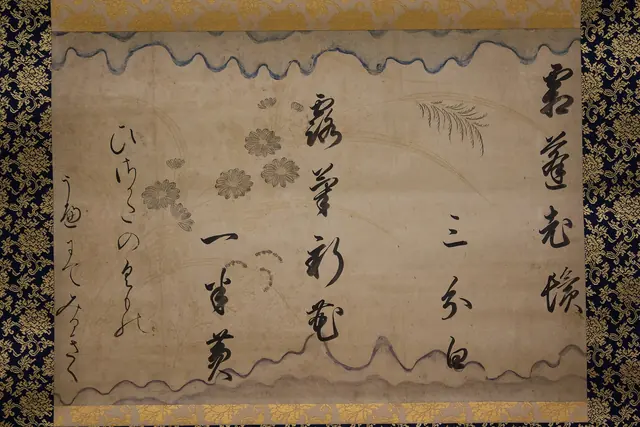
Reading a work without reading Japanese
You do not need to read Japanese to enjoy a piece of calligraphy. JNTO's guide to Kyoto says of the art that "there is meaning in every stroke, as well as in the sequence", and many of the things to look for are visible to anyone.
On empty space, Fukumitsu is clear: "the space around the written characters is just as important and beautiful as the characters themselves". The eye, she says, should be drawn to the untouched white as strongly as to the black. She names it as one of the main ways Japanese brushwork differs from Western art.
Seals deserve a closer look in a museum. "The seals act as a sort of signature for the artists", Fukumitsu explains, and they count as part of the work. Many calligraphers own seals of several shapes, carved by specialists in tenkoku. In the past, owners of treasured pieces stamped them too, as a mark of ownership, so an old work handed down through many collectors can carry a crowd of seals.
Calligraphy and the tea room
From the Muromachi period, as the tea ceremony took shape, fragments of famous old writing were mounted as hanging scrolls and hung at tea gatherings, alongside the writing of Zen monks, known as bokuseki, according to the Agency for Cultural Affairs. For the ceremony itself, turn to our guide to chado.
Calligraphy classes and workshops in Tokyo and Kyoto
The quickest way into shodo is a one-off class, and the big cities have plenty. GO TOKYO lists calligraphy among the traditional arts visitors can try in workshops, next to cooking classes, kimono photo shoots and meditation, and advises booking ahead to be sure of a place. The class described below follows a simple outline: you pick a word, watch a teacher write it, practise, and then write a final piece to take home.
Which kind of class suits you
- One-off class: a word, a model, practice and a finished board to take home.
- Temple session: calligraphy with Zen meditation, in Kyoto, often booked online and sometimes cash only.
- Craft workshop: a craft class that ends with your name in kanji, written with a brush pen.
- School course: regular lessons at a private calligraphy school for those staying longer.
- Museum visit: no writing at all, but a chance to see old masterpieces up close.
- Brush-making: make part of a brush yourself in Kumano, Hiroshima.
Tokyo: the class in Yushima
GO TOKYO features a class in Yushima, in Bunkyo City, in the Ueno area. It appears on the site under two names, Wayoh Japanese Calligraphy Class and Udoyoshi Calligraphy Class, and JNTO's itinerary of hands-on experiences in central Tokyo lists it as well. That itinerary also mentions that calligraphy is sometimes called shuji.
In the class, you ask for a favourite word and the teacher shows you how to write it. Then you practise until your hand feels steady enough to write it onto a folding fan or onto paper you can frame. The finished piece gets a personal stamp: your initials, in hiragana. The style taught is the modern Japanese writing of the wayo tradition, based on today's script rather than on the square-style Chinese characters. GO TOKYO's 2024 article on mindful activities says the class "turns your attention back to the act of writing, rather than its meaning", and that it is taught in English as well as Japanese, with booking required.
Wayoh Japanese Calligraphy Class, Yushima
- Where: 2-14-12 Yushima, Bunkyo City, Tokyo
- Price: ¥5,000 for the calligraphy experience, with the shikishi board you write on to take home
- Custom board: ¥10,000 for a board written for you, up to 10 characters, not for commercial use
- Group size: at least two people
- Hours: from 10:00, with the last entry an hour before closing; closed on irregular days
- Language: Japanese and English
- Getting there: 7 minutes on foot from Yushima Station, exit 5, on the Tokyo Metro Chiyoda Line, or from Ochanomizu Station, exits 1 and 2, on the Marunouchi Line
How the Yushima class runs
- Choose a word: ask for the word or phrase you would like to write.
- Watch: the teacher writes it first, as a model.
- Practise: on paper, until your strokes feel steady.
- Write the final piece: on a shikishi board, a fan or paper for framing.
- Add your seal: your initials, stamped in hiragana, finish the work.
Your name in Japanese characters
Many visitors want to see their own name written with a brush. One workshop in Tokyo builds this into a craft class, and GO TOKYO describes how it works.
Kyoto: classes at schools and temples
Kyoto offers calligraphy in a slightly different setting. JNTO's guide to the city says that plenty of cultural centres and specialist calligraphy schools in the city run single lessons, and that temples hold them too, because the art is closely tied to the idea of Zen in Buddhism. Some temples offer shodo together with zazen, seated meditation, as a single experience.
JNTO's guide dates from 2019, so check the current details with each place before you book.
Before a temple class in Kyoto
- Book ahead: sessions are popular, and JNTO advises registering online in advance.
- Bring cash: the cultural centres JNTO names take cards and cash, but one temple offering shodo with zazen accepts cash only.
- Shoes off: remove them before entering a temple's main hall.
- No clapping: at a temple you do not clap when you pay your respects, unlike at a shrine.
- Be considerate: people come to temples to worship.
Staying overnight in a temple is possible too; our temple lodging page explains how.
Osaka and longer courses
For people who want more than one session, there are private calligraphy schools across Japan, which Fukumitsu says run after school and at weekends for children and adults. Her own school in Osaka has run for around 40 years. Short experiences, she says, give travellers a taste, while a school is the place to go deeper. Learning properly takes years: the five main styles, brush technique, the spacing of characters and control of the hand and mind. Only after long practice does a student's own style begin to show.
Where to see calligraphy: museums in Tokyo, Nara and Osaka
Japan has museums devoted entirely to calligraphy, and two of them are described below. Between them they cover the long history, from inscriptions on ancient bones to modern kana writing.
Taito City Calligraphy Museum, Tokyo
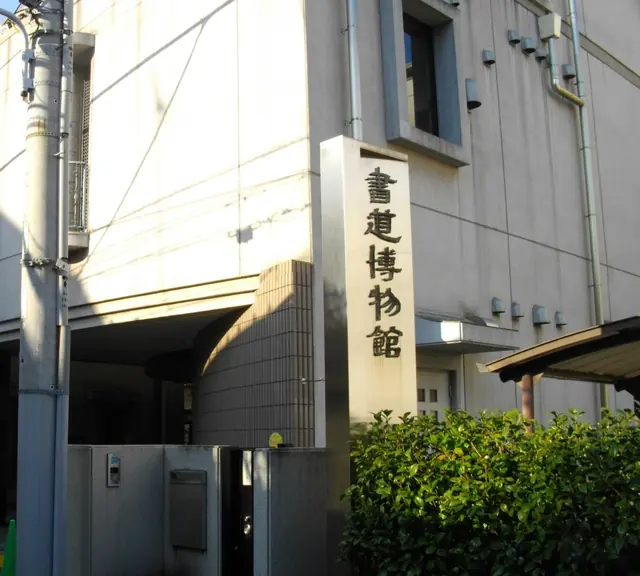
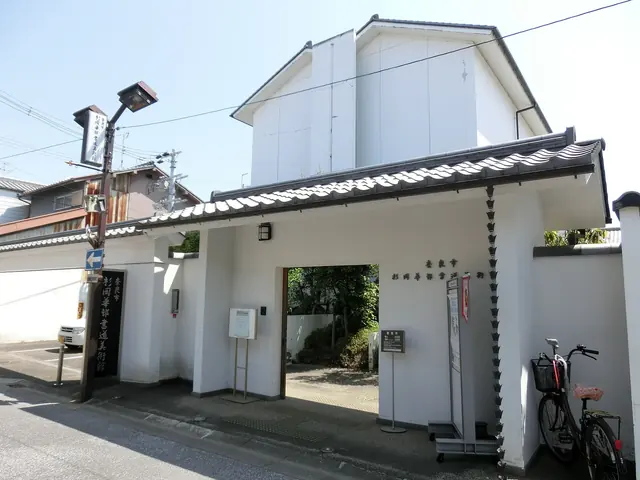
The Calligraphy Museum in Negishi, a short walk from Uguisudani Station on the Yamanote Line, holds the collection of Fusetsu Nakamura (1866–1943), a Western-style painter who was also a calligrapher in the Chinese tradition. He spent more than 40 years, close to half his life, gathering the history of writing in China and Japan. The museum opened in 1936, and Nakamura's family ran it for six decades before giving it to Taito City in 1995. It reopened as a city museum in 2000.
The collection runs to about 16,000 pieces, from bones and tortoiseshells inscribed in the Yin period to bronze vessels, seals, sutras carved in stone and rubbings. Twelve pieces are Important Cultural Properties and five are Art Treasures. The original main building, itself a historic site named by the Tokyo Metropolitan Government, shows the permanent collection on the history of Chinese characters. A newer hall named after the founder holds special exhibitions on different themes five or six times a year.
Taito City Calligraphy Museum
- Where: 2-10-4 Negishi, Taito City, Tokyo; 5 minutes' walk from Uguisudani Station (north exit) on the JR Yamanote and Keihin-Tohoku lines
- Hours: 9:30–16:30, with entry until 16:00
- Closed: Mondays (Tuesday instead when Monday is a holiday), over the New Year from 29 December through 3 January, and on some days between exhibitions
- Entry: ¥500 for adults and ¥250 for school students; ¥300 and ¥150 for groups of 20 or more
- Paying: cash, Visa, JCB, Mastercard, AMEX and Alipay
- Languages: guidance in Japanese, plus English, Chinese and Korean
In 2026 the museum turns 90, and its anniversary exhibition, on Fusetsu Nakamura and the museum he founded, shows off treasures from his collection. The show opened on 18 July and its second part runs from 6 October to Sunday 13 December 2026.
Nara City Museum of Calligraphy in Honour of Kason Sugioka
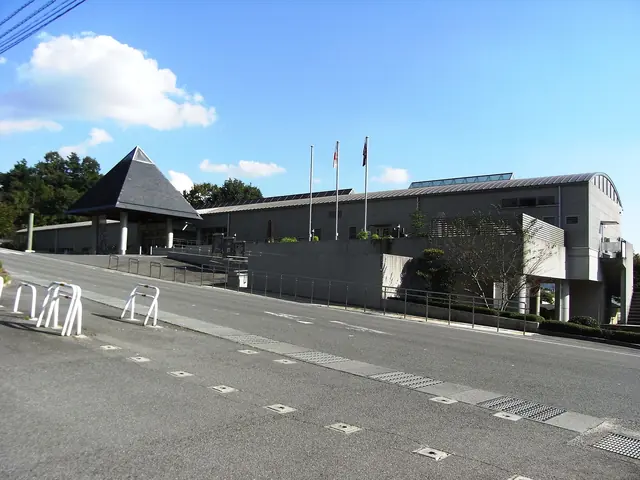
Nara has a museum given over to kana, the script Japan made its own. It honours Kason Sugioka, a leading kana calligrapher who received the Order of Culture in 2000. He donated his works to Nara City, and the city opened the museum on 4 August 2000 to keep them and to support calligraphy.
Keiko Fukumitsu recommends the museum for more recent and contemporary work, and suggests pairing it with a visit to the small brush and ink shops around Sanjo-dori street.
Osaka
For classic works in Osaka, Fukumitsu suggests the Osaka City Museum of Fine Arts, and she mentions the Nakanoshima Museum of Art, Osaka as well. Smaller private galleries, especially around Oimatsucho in Kita Ward, also show work by living calligraphers.
Brushes, ink and inkstones to take home
The three places in this guide each have their own tool: brushes from Kumano in Hiroshima, ink sticks from Nara and inkstones from Ogatsu in Miyagi. For other gifts to bring home, our souvenirs page has more ideas.
Kumano brushes
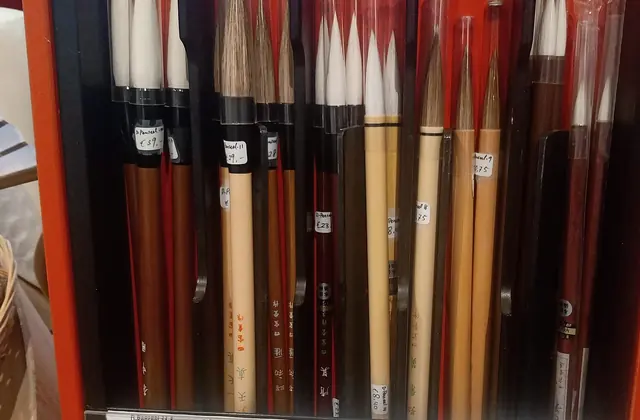
Kumano brush is the name for every brush made in the town of Kumano, in Aki District, Hiroshima Prefecture, Japan's biggest producer of writing, painting and make-up brushes. The story starts in the late Edo period. Kumano had little farmland, so in the slack months many farmers went to work in Yoshino and Kishu, today's Nara and Wakayama, and on the way home bought brushes and ink in Nara, Osaka and Hyogo to sell as they travelled. In time the town began to make brushes itself.
In 1975 Kumano brushes became the first craft in Hiroshima Prefecture to be named a national traditional craft. In 2021 the prefecture counted around 90 brush makers and about 2,500 of the town's 24,000 people in the trade, roughly one in ten.
Choosing a calligraphy brush
- The tuft: the kind of hair, how thick it is and how long, which Hiroshima Prefecture names as the first thing to check.
- The handle: pick one that sits well in your hand.
- The tip: a Kumano brush is finished without cutting the tip, for a fine point with some spring.
- The use: brushes for writing, painting and make-up are all made in Kumano, so say what you need.
Hiroshima City's brand programme lists a set of two Kumano calligraphy brushes by the maker Ikkyuen, made for the brand, at ¥20,900 including tax. The city names the shops that stock it: Shima Shoten on the second floor of ekie at Hiroshima Station, Hiroshima Fude Center on the Hondori shopping street, Sharyu in Fukuyama, and the main calligraphy supply shops around the country.
Fude no Sato Kobo, the brush village museum
In Kumano itself, Fude no Sato Kobo is the town's museum of brushes. It has a permanent exhibition on how brushes developed and how they are used, demonstrations of brush making by traditional craftsmen, a changing programme of special exhibitions and a shop that sells a selection of Kumano brushes. You can also make part of a brush yourself. The brush-making experience lets you do two steps out of the twelve that go into a brush: wrapping the outer hair and finishing. If you book a week ahead, your name can be engraved on the handle.
Fude no Sato Kobo
- Where: 5-17-1 Nakamizo, Kumano-cho, Aki-gun, Hiroshima Prefecture
- Hours: 9:30–17:00 (entry until 16:30); the hands-on activities run 9:30–15:30
- Closed: Mondays (Tuesdays after Monday holidays), plus the New Year break and some other days
- Entry: ¥800 for adults and ¥250 for school students; under school age free
- Activities: brush making ¥3,500, a hanging scroll ¥2,000 and a picture postcard ¥1,000, on top of entry
- Getting there: about 45 minutes from JR Hiroshima Station by bus, or 15 minutes from JR Yano Station and 35 from JR Kure Station; free parking
These fees come from the Hiroshima tourism association's page, which notes that entry can change with the exhibition. The museum's own site announced a new building for creative workshops, opened on 23 September 2026, and a bus route to the museum from 3 October 2026, so check its site for the latest route and fees before you go.
Ink sticks from Nara and stones from Ogatsu
For ink, Nara is the place, and Ogatsu's slate now goes into more than inkstones.
Ink and stone to look for
- Nara ink sticks: sold with brushes in the small shops around Sanjo-dori street that Fukumitsu points to.
- Ogatsu inkstones: most were once made for elementary schools.
- Ogatsu slate goods: the same stone is now cut into other things too, from tableware to picture frames.
Calligraphy through the year: New Year writing and the kanji of the year
Calligraphy is part of the Japanese calendar, above all at two points in the year. The first is the New Year. Kakizome, the first writing of the year, is a custom of writing characters that stand for your hopes or resolutions for the year ahead. Fukumitsu calls it a pleasant thing for families to do together, and says school groups often visit a local temple or shrine in January to write their aims in ink. Our guide to the Japanese New Year covers the other customs of the season.
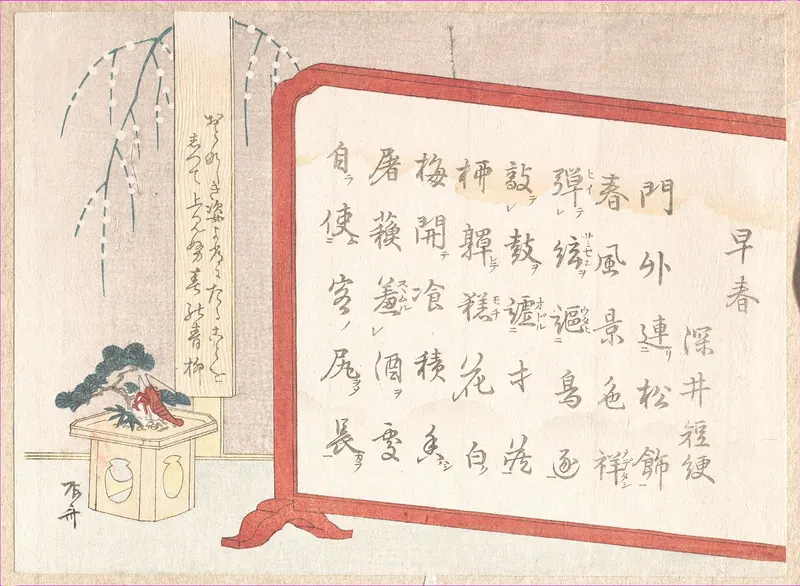
The second comes each December, when the head priest of Kiyomizu-dera in Kyoto announces the Kanji of the Year, a single character chosen through a nationwide poll to sum up the mood of the country.
A calligraphy calendar for winter 2026–27
- 23 November: gallery talk at the Sugioka museum in Nara, from 14:00
- 1–3 December: the UNESCO committee in Xiamen is due to decide on shodo
- 9–20 December: a show of children's entries to the Sugioka museum's mini calligraphy contest, at the Naramachi Center gallery, 10:00–17:00
- 12 December: a talk at the Sugioka museum, from 14:00
- 13 December: last day of the 90th anniversary show at the Taito City Calligraphy Museum
- December: the Kanji of the Year from Kiyomizu-dera
- January: kakizome, the first writing of the year
- 5 January 2027: the Taito museum reopens
- 11 January 2027: last day of the Nara Kason Prize show in Nara
Planning a calligraphy trip
Tokyo, Nara and Hiroshima each show a different side of the art.
Three stops for a calligraphy trip
- Tokyo: the Taito City Calligraphy Museum for ancient writing, then the class in Yushima to write your own piece.
- Nara: the Sugioka museum for kana writing, and the brush and ink shops around Sanjo-dori.
- Kumano, Hiroshima: Fude no Sato Kobo for the history of the brush and a chance to make part of one.
To build stops like these into a longer trip, see our itinerary planner. If time is short, Tokyo alone gives you both a museum and a class, and GO TOKYO places both in northern Tokyo.
Frequently asked questions
What is Japanese calligraphy called?
In Japanese it is called shodo, often explained as the way of writing: writing kanji, kana or both with a brush and ink.
Is Japanese calligraphy the same as Chinese calligraphy?
It grew from Chinese calligraphy, which reached Japan with Buddhism in the 6th century. Over time Japan developed its own forms, especially kana writing and the wayo style that appeared in the Heian period, so the two share roots but are not the same.
What ink is used in traditional Japanese calligraphy?
Traditional ink is a solid stick called sumi, made of soot pressed with glue. It is ground on an inkstone to make liquid ink. Nara has long been one of Japan's best-known places for ink sticks.
What do I need to start Japanese calligraphy?
The basic set is the four treasures: a brush, an ink stick, an inkstone and paper. When choosing a brush, look at the kind of hair, the thickness and length of the tuft, and a handle that suits your hand.
Where can I try Japanese calligraphy in Tokyo?
A class in Yushima, Bunkyo City, teaches in Japanese and English for ¥5,000, and you take home the board you write on. It needs at least two people. For a name written in kanji, a craft workshop in Mukojima ends its session with your name on a small wooden plaque.
Can I see old calligraphy in a museum?
Yes. The Taito City Calligraphy Museum in Tokyo holds about 16,000 pieces and charges ¥500 for adults. In 2026 it closes from 14 to 31 December and reopens on 5 January 2027. In Nara, a city museum is devoted to kana calligraphy.
Is Japanese calligraphy on the UNESCO list?
On 5 November 2026 UNESCO's evaluation body recommended adding shodo to UNESCO's list of intangible cultural heritage. The final decision is due between 1 and 3 December 2026 at the committee meeting in Xiamen, China.
Sources
Official and primary sources used for this page. Checked November 9, 2026.
- Agency for Cultural Affairs: Evaluation body's recommendation on the UNESCO listing of shodo (in Japanese) — recommendation, committee dates
- Agency for Cultural Affairs: Selection of the 2024 candidate for UNESCO intangible heritage (in Japanese) — second nomination
- Agency for Cultural Affairs: Registering shodo as an intangible cultural property (in Japanese) — definition, tools, history
- JNTO: The Art of Calligraphy — history, styles, seals, kakizome, museums
- JNTO: A truly authentic Japan experience in Kyoto — Kyoto classes, temple manners
Show all 22 sources
- JNTO: Cultural experiences in Tokyo — Chinese roots, Yushima class
- GO TOKYO: Japanese Calligraphy Workshop — Yushima class details
- GO TOKYO: Traditional cultural experience — Tokyo workshops
- GO TOKYO: Embrace mindfulness with traditional Japanese practices in Tokyo — how the class runs
- GO TOKYO: Make your own souvenir in Tokyo — kanji name plaque
- GO TOKYO: Calligraphy Museum — payment, languages, access
- Taito City Calligraphy Museum: About the museum — history, admission, hours
- Taito City Calligraphy Museum: Exhibitions and events — main building, special exhibitions
- Taito City Calligraphy Museum: Home page (in Japanese) — anniversary show, closing days
- Nara City Museum of Calligraphy in Honour of Kason Sugioka: Home page (in Japanese) — exhibition, talks, admission
- Nara City: Nara ink exhibition press release (PDF, in Japanese) — history of Nara ink making
- City of Hiroshima: Kumano Calligraphy Brushes (Ikkyuen) — brush set price, shops
- Fude no Sato Kobo: Home page (in Japanese) — new building, bus route
- DIVE! HIROSHIMA: Fudenosato Kobo — hours, fees, access
- Hiroshima Prefecture: Kumano brushes (in Japanese) — history, choosing a brush
- Government of Japan: Highlighting Japan, the brush village (in Japanese) — hair, brush making
- Government of Japan: Highlighting Japan, The Land and the Sea — Ogatsu inkstones, ink sticks
Related guides
To cite or link to this page: Japanese calligraphy: what shodo is, how it came from China, the 2026 UNESCO decision, the brush, ink stick, inkstone and paper, the styles and kana, classes in Tokyo and Kyoto, museums to visit, Kumano brushes and Nara ink to take home, and New Year writing — Japan Pocket Guide, https://japanpocketguide.com/culture/japanese-calligraphy/