Culture · New Year
Japanese New Year traditions: the dates of shogatsu, year-end cleaning and kadomatsu decorations, New Year's Eve noodles and the 108 temple bells, hatsumode at Meiji Jingu, the first sunrise, osechi and regional ozoni, New Year cards and the first sales, the Emperor's greeting on 2 January, and what stays open over the holiday
New Year, shogatsu, is the biggest holiday of the Japanese year, and it feels nothing like a night of fireworks followed by a quiet day. Homes are cleaned, bamboo and pine go up by the door, temple bells ring 108 times at midnight and millions of people queue at shrines in the first days of January. This guide goes through the customs in the order they happen, from the cleaning in mid-December to the rice porridge on 15 January, and shows where a visitor can watch or join in, with the dates for 2026 to 2027 and the places that close.
Last checked · Sources

In short
The main Japanese New Year traditions are a big year-end clean, decorations of bamboo, pine and straw rope at the door, toshikoshi soba noodles and temple bells rung 108 times on New Year's Eve, and hatsumode, the year's first shrine or temple visit, made from midnight to 3 January. Families eat osechi, cold dishes packed in stacked boxes, and ozoni, a soup with rice cakes that differs from region to region. People send New Year cards, shops hold their first sales with sealed fukubukuro bags, and the Emperor greets the public at the Imperial Palace on 2 January.
What shogatsu is and when it happens
Shogatsu is the Japanese New Year, and Japan keeps it from 1 January. It is a family holiday first of all. JNTO's Australian office describes a time spent at home with relatives and a very busy time for travel inside Japan, as many people go back to their home towns, and puts the break at around 28 December to 3 January, depending on the year. JNTO's American office gives 29 December to 3 January, with schools and government offices shut. The first three days of January have a name of their own, shogatsu sanganichi, and most of the customs below fall inside them.
The change of season is quick. JNTO's blog notes that on 26 December the Christmas wreaths in shops are taken down and bamboo and zodiac decorations take their place. It sums up the mood like this: "Japan stays in business all through Christmas, but things get very quiet leading into New Year." Christmas is a working day; New Year is when the country stops.
The New Year calendar at a glance
- 12 and 13 December: the soot-sweeping at Senso-ji in Tokyo, the start of the year-end cleaning season.
- 17 to 19 December: the battledore market at Senso-ji.
- 26 December: Christmas displays come down and New Year decorations go up.
- 29 December: government offices close until 3 January; banks close from the 31st.
- 31 December: omisoka, the last day of the year, with noodles, a song show and temple bells at midnight.
- 1 to 3 January: hatsumode shrine and temple visits, osechi and ozoni, the first sales.
- 2 January: the Emperor's New Year greeting at the Imperial Palace.
- 7 January: seven-herb rice porridge; the door decorations come down.
- 15 January: koshogatsu, the little New Year, with red-bean porridge.
The holiday ends in stages. JNTO's British office says the kadomatsu at the door stay up from 1 to 7 January, and JNTO lists Coming of Age Day, a public holiday for people who turn 20, on the second Monday in January, which falls on 11 January in 2027.
Getting ready: the big clean and the decorations
The New Year starts with a clean. JNTO's American office describes a major clean of the house and the workplace, along with paying off bills and tying up loose ends, so that the year can start fresh. The old word for it is susuharai, sweeping out the soot. Senso-ji in Asakusa explains that the word generally means the big year-end clean and that it marks the start of the New Year preparations. Its own sweeping is held on 12 and 13 December. The dusting of the inner shrine on the evening of the 12th is closed to the public, but at 2 p.m. on the 13th the doors of the shrine are opened again for a service, and only then can visitors see the stand-in image of the temple's main Buddha.
Kadomatsu, shimekazari and kagami mochi
Once the house is clean, the decorations go up. Most are bought rather than made: JNTO's blog notes that small versions are sold at shrines and even at 100-yen shops.
Three New Year decorations
- Kadomatsu: an arrangement for the entrance, made of three green bamboo poles with pine and sometimes plum twigs.
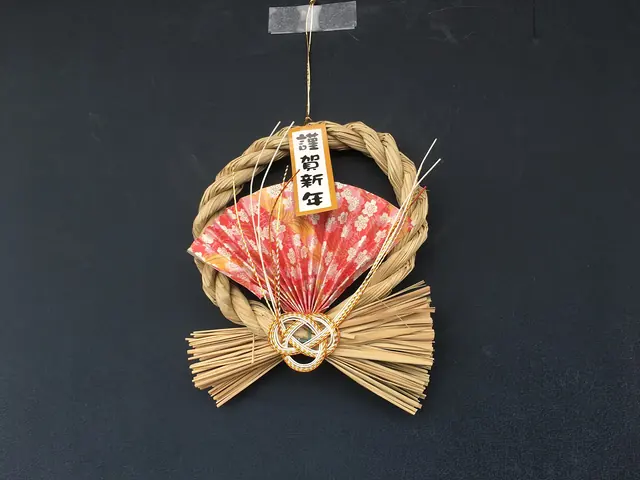
- Shimekazari: a decoration for the door made from shimenawa, the sacred straw rope, with pine and a bitter orange.
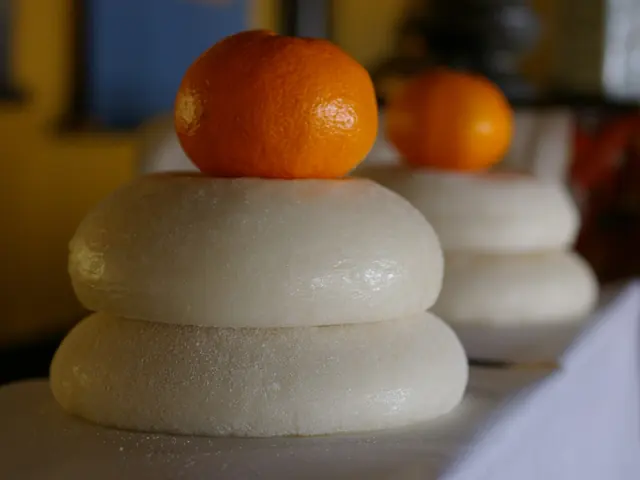
- Kagami mochi: two flat, round rice cakes stacked one on the other with a bitter orange on top, placed in the tokonoma alcove or on the household altar.
JNTO's British office calls the orange on the kagami mochi a daidai, and JNTO's blog adds that the rice cakes are offered on shrine altars too.
When the season is over, the decorations are not simply thrown away. JNTO's British office describes dondoyaki, a fire at local shrines into which people put their New Year decorations along with old charms. Not every shrine takes them, though. At Meiji Jingu the place for returning old items accepts only paper talismans, amulets, arrows and votive tablets, and the shrine asks visitors not to bring dolls, household altars, kumade rakes or New Year decorations.
The battledore market at Senso-ji
In Edo, as Tokyo was then called, the end of the year was a time for markets. Senso-ji explains that the 18th of each month is the day of its Kannon, and that 18 December, the last one of the year, has always drawn the biggest crowds. In the Edo period stalls selling goods for the New Year gathered in the grounds on the 17th and 18th to meet those crowds, and the year-end market they formed was the largest in the city, with stalls running all the way from Asakusabashi to Ueno.
From the late Edo period more and more of the stalls sold hagoita, the wooden paddles used to hit a feathered shuttlecock in the game of hanetsuki. The temple says a custom grew up of giving a hagoita to a household where a baby girl had been born, and the paddles became the stars of the market. Today it is called the Hagoita-ichi and runs for three days.
The temple describes the sellers' banter with customers as part of the show, enjoyed as much by the people watching as by the buyers, and calls the market a sign of December in Asakusa.
New Year's Eve: noodles, a song show and 108 bells
The last day of the year is omisoka. Most families spend the evening at home, and three customs mark it out from any other night: noodles, a song show on television and the temple bells.
The first is a bowl of noodles. JNTO's Australian office calls the dish toshikoshi soba, which it translates as "year-crossing buckwheat noodles". JNTO's American office says they are eaten just before midnight, as the new year arrives, and that in some regions the noodles are udon instead.
The last is the bell. Around midnight, temples ring their great bells 108 times in a custom called joya no kane. Senso-ji says that there are several explanations for the number: one is that it stands for the 108 worldly passions that people carry, another that it praises the 108 virtues of a bodhisattva.
Three customs on 31 December
- Toshikoshi soba: buckwheat noodles eaten late in the evening; udon in some regions.
- Kouhaku: the song contest on television, a red team of women singers against a white team of men, with the audience and judges deciding the winner; it ends a little before midnight.
- Joya no kane: temple bells rung 108 times around midnight.
The bell at Senso-ji, Tokyo
Senso-ji in Asakusa rings its bell on Bentenyama, the small hill in the south-east of the grounds. The temple describes the grounds filling with people as the evening goes on. A service is held in front of the bell first, and at midnight the bell sounds to announce the new year, to loud cheers and applause. Three strokes that are not counted come first, called sutegane, and then members of the temple's Hyakuhachi-kai, its 108 Society, strike it 108 times. The whole ringing takes about 40 minutes.
The great bell at Chion-in, Kyoto
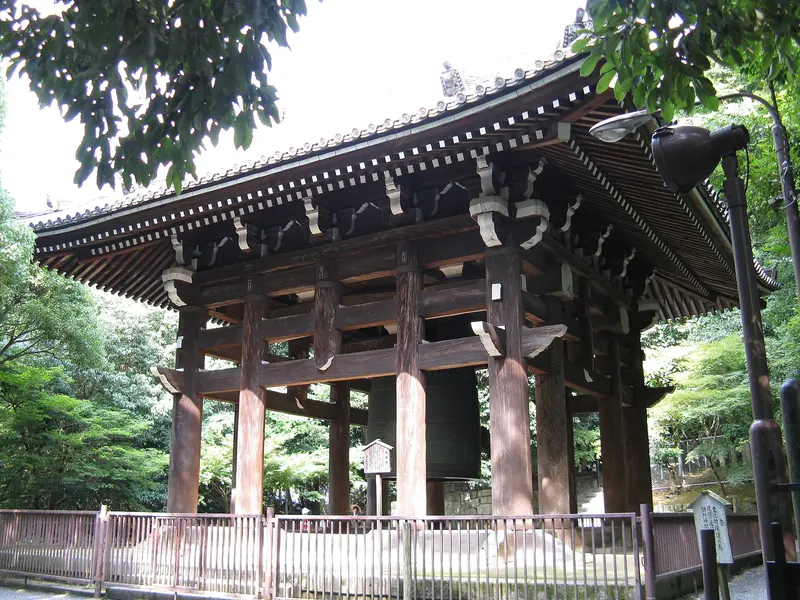
Chion-in, the head temple of the Jodo school of Buddhism, has a bell counted among Japan's three great temple bells. "Due to its size, it takes a team of seventeen monks to strike the bell", and the temple explains that one monk holds the main rope while 16 pull on the side ropes, calling out "Ee hitotsu" and "sōre" with each of the 108 strokes. Because of this special way of ringing, visitors cannot strike the bell themselves.
The great bell of Chion-in
- 1636the year the bell was cast
- 3.3 mits height
- 70 tits weight
Watching the ringing needs an advance booking. For New Year's Eve 2025 the temple took online applications from 2 p.m. on 1 December, for four groups of 500 people, and sold another four groups of 100 tickets at the Yuzen-en garden counter from 8 to 24 December, in cash only. The fee was 3,000 yen; children up to primary-school age went free. Without a ticket there was no entry on the night. The temple also streams the ringing live on YouTube.
Chion-in's rules on the night
- No open flames anywhere in the grounds.
- Follow the one-way route and the staff's directions.
- Dress warmly: the temple warns of a long wait in the cold.
- No tripods, selfie sticks, drones or flash photography.
- No live streaming of your own.
- Visit the toilets before you enter the belfry area.
If you cannot get a ticket, there is another way to hear the bell. Chion-in holds an open rehearsal of the ringing, tameshi-zuki, at its great belfry from 2 p.m. on 27 December 2026. In 2025 no booking was needed for the rehearsal, and the temple limited entry when the belfry became crowded.
Hatsumode: the first shrine or temple visit
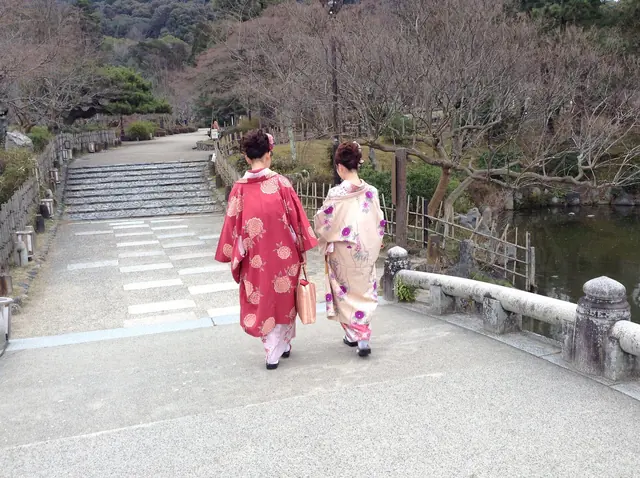
Hatsumode, the year's first trip to a shrine or temple, is the New Year custom you are most likely to see as a visitor. JNTO's Australian office says people go late on New Year's Eve or on 1, 2 or 3 January, and JNTO's Singapore office adds that the shrines and temples are at their busiest then, with many visitors dressed in kimono. People pray for the year ahead, and many spend a few hours in the queue before midnight.
The custom in its present form is younger than it looks. JNTO's vocabulary guide traces it to eho-mairi, an Edo-period folk custom, and explains that the idea of hatsumode only took shape in the late 19th century, when state and private railway companies started to sell New Year trips. The two most famous examples, it says, are Naritasan Shinshoji in Chiba and Kawasaki Daishi in Kanagawa, both Buddhist temples. "Both can be accessed easily by the greater Tokyo railway network." The guide names Meiji Jingu in Tokyo as the most visited hatsumode destination of all.
How hatsumode grew
- Edo period: eho-mairi, a New Year folk custom of visiting a shrine or temple.
- Late 1800s: railway companies sell New Year trips to temples near Tokyo.
- Today: crowds of millions at the big shrines and temples.
Meiji Jingu at New Year
JNTO's Singapore office says Meiji Jingu receives about 3 million visitors for hatsumode alone. The shrine does not close its gates at the turn of the year, so you can wait for midnight inside the grounds. For New Year 2026 it posted these gate times.
Meiji Jingu's gate times, New Year 2026
- 31 December: 6:40 to midnight, then open through the night.
- 1 January: open until 18:30.
- 2 and 3 January: 6:40 to 18:00.
- 4 January: 6:40 to 17:30.
- From 5 January: 6:40 to 16:20, later during the New Year season.
There are three entrances, near Harajuku, Yoyogi and Sangubashi stations. Cars cannot enter the grounds during the first three days, and the roads around the shrine have traffic controls.
For the crowds, the shrine adds extra hand-washing stations and counters for amulets, and runs an area of food stalls from 31 December.
New Year at Senso-ji
Senso-ji's New Year prayers start at the same moment as its bell. At midnight a special service begins in front of the shrine that holds the main image, and from New Year's Day to 7 January it is held every 30 minutes or every hour until near closing time. Nakamise, the shopping street leading to the temple, is hung with New Year decorations throughout the season.
The way to pray does not change at New Year, and the guide to shrine etiquette sets out the steps at a shrine and at a temple. To make the visit in kimono, see the guide to kimono rental.
Hatsuhinode: the first sunrise of the year
JNTO's British office says some people stay up all night to watch hatsuhinode, the first sunrise of the new year, and its Singapore office describes people looking for a good vantage point with a clear view of the rising sun. The sun rises late in Japan's winter, so there is no need to be up in the middle of the night: the National Astronomical Observatory of Japan (NAOJ) gave these times for 1 January 2026.

First sunrise on 1 January 2026
- Tokyo: 6:51
- Sapporo: 7:06
- Nagoya: 7:01
- Kyoto and Osaka: 7:05
- Hiroshima: 7:16
- Fukuoka: 7:23
- Naha, Okinawa: 7:17
NAOJ notes that the times change very little from one year to the next, so the table is a fair guide for 2027 as well. Height helps too. In Tokyo, NAOJ gave 6:50 at Odaiba on the waterfront, 6:48 from 150 metres up Tokyo Tower and 6:46 from 450 metres up the Skytree.
Where the sun rises first
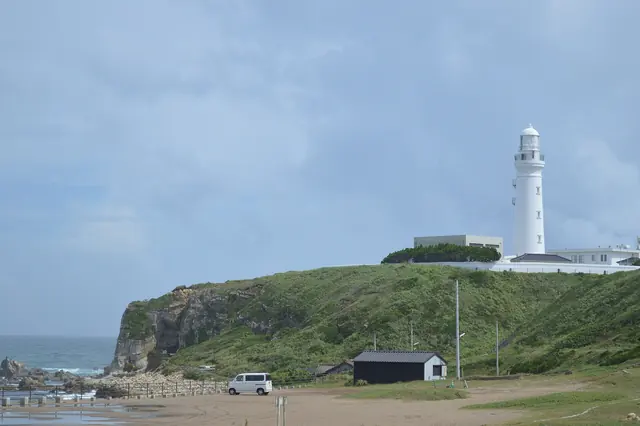
The answer depends on how you ask the question, NAOJ explains. In winter the sun rises earlier the further south-east you go, which is why Cape Inubo, Inubosaki, in Chiba, is the first place on flat land on the four main islands to see it, at 6:46, ahead of Cape Nosappu in Hokkaido further east. Counting mountains, the summit of Mount Fuji is first. Counting islands, the earliest of all is Minamitorishima, far out in the Pacific, at 5:27, but nobody lives there permanently. NAOJ thinks the first inhabited place is probably Hahajima in the Ogasawara Islands, at 6:20.
First light, by NAOJ's answer
- 5:27Minamitorishima, the first in Japan
- 6:20the Ogasawara Islands, the first inhabited
- 6:46Inubosaki, the first on flat land
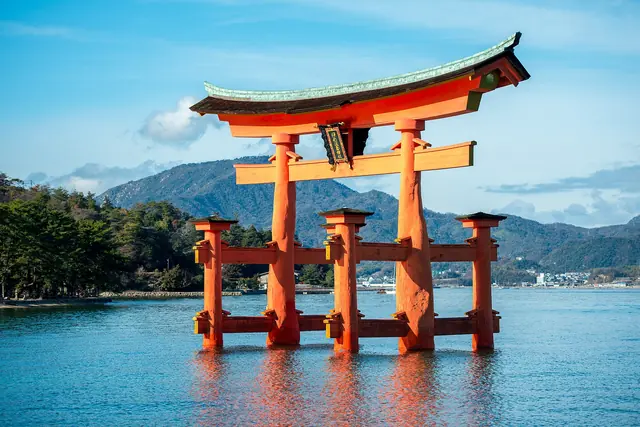
In western Japan, JNTO's guide to January points to Miyajima, the island of Itsukushima Shrine near Hiroshima. It suggests crossing to the island on 31 December for the Chinka-sai fire festival and staying to see the first sunrise the next morning, from the top of Mount Misen or another spot on Miyajima. The shrine also holds performances of traditional music and dance on 1, 2, 3 and 5 January, JNTO adds.
New Year food: osechi, ozoni and mochi
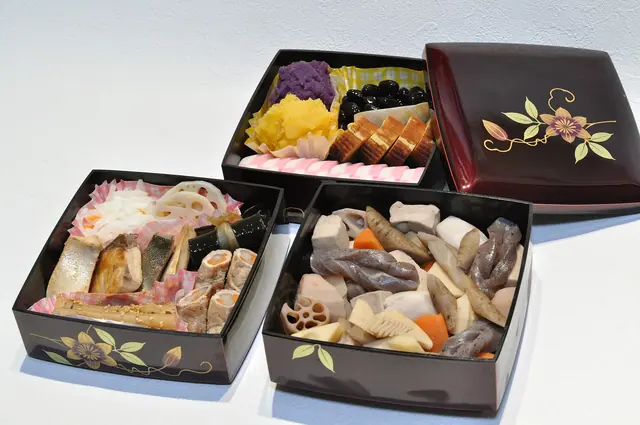
Two dishes matter most at home: osechi, the New Year dishes packed in boxes, and ozoni, a soup with rice cakes.
Osechi, the New Year boxes
The word osechi once had a wider meaning. The Ministry of Agriculture, Forestry and Fisheries (MAFF) explains that it first meant the food prepared for all five of the seasonal festivals, the sekku: 7 January, 3 March, 5 May, 7 July and 9 September. Over time only the most important of them, the New Year meal, kept the name. The meal settled into its basic form towards the end of the Edo period. JNTO's British office describes the dishes set out in a box called jubako, which it compares to a bento box.
The food is made to last. JNTO's Australian office explains: "In the past, the food for this period needed to last for the first 3 days of the year without refrigeration", which is why so many of the dishes are sweet or salty. JNTO's American office adds that osechi is not eaten before 1 January.
MAFF names three dishes that have been part of the New Year meal since that time, the iwai-zakana: black soya beans, kuromame; small anchovies, tazukuri; and herring roe, kazunoko. The other staple is nishime, vegetables simmered together in stock. MAFF adds that many of the dishes are chosen for a play on words.
What some osechi dishes are said to mean
- Tazukuri: the anchovies were once used as fertiliser on the fields, so the dish is linked with a good harvest.
- Datemaki: a rolled sweet omelette said to look like the pattern of a kimono, so a wish never to be short of clothes.
- Renkon: lotus root, whose holes are said to let you see through to the year ahead.
- Kobumaki: kelp rolls, a pun on yorokobu, to be glad.
- Buri: yellowtail, a fish whose name changes as it grows, linked with rising in the world.
- Kuromame: black beans, a play on mame, for the wish to work diligently.
Making the whole set takes a long time, and JNTO's American office says many people now buy it instead. JNTO's blog says osechi is not usually sold in restaurants, but department store food halls make the dishes to buy, and JNTO's Australian office also mentions buying it from department stores. For the wider story of Japanese food at New Year, see the guide to what to eat in Japan.
Ozoni: one soup, many recipes
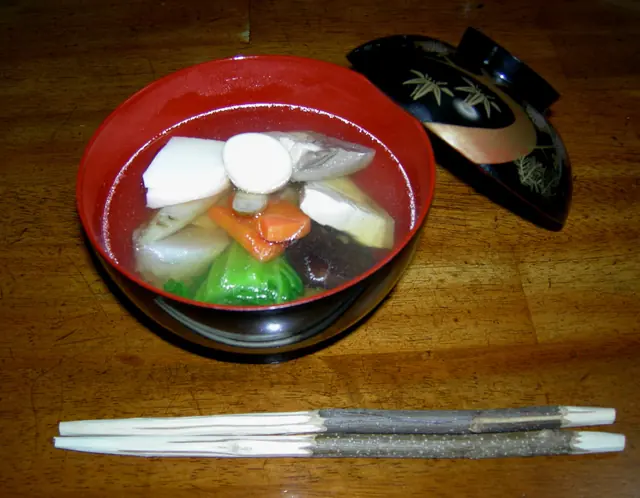
Ozoni is a soup with rice cakes, mochi, eaten on the morning of 1 January. JNTO's American office notes that its flavours and ingredients differ a great deal from region to region. MAFF's database of local dishes shows how far apart two versions can be.
Two regional ozoni
- Hakata zoni, Fukuoka: a clear stock made with grilled flying fish, yaki-ago, with slices of yellowtail, small round rice cakes, shiitake, taro, carrot and katsuona, a local leafy green.
- An-mochi zoni, Kagawa: a white miso soup with round rice cakes filled with sweet bean paste, rounds of daikon and red kintoki carrot, finished with green aonori seaweed.
Each one has a story. In Hakata, MAFF explains, the wives of merchant households, the goryonsan, had so many New Year guests that they threaded each person's ingredients onto a bamboo skewer in advance. Katsuona, a relative of takana mustard greens, is said to take its name from the bonito flavour of its stems, and every Hakata household uses it.
In Kagawa, the sweetness goes back to sugar. MAFF says that in the Edo period sugar cane was encouraged as a local industry in Kagawa's warm, dry climate, and Sanuki white sugar became one of the area's three famous white products, along with cotton and salt. Sugar was too precious for everyday meals, and from around the Meiji era families began to put it into a once-a-year dish: the bean-paste rice cake in the New Year soup.
Eating mochi safely
The Tokyo Fire Department warns that choking on mochi rises in December and January, and its figures for the five years from 2020 to 2024 show why.
Choking on mochi in Tokyo, 2020 to 2024
- 338people taken to hospital by ambulance
- 90%of them aged 65 or over
- 135cases in January alone
January and December together, with 135 and 42 cases, made up more than half of the total, and the most cases were among people in their 80s.
After the first three days
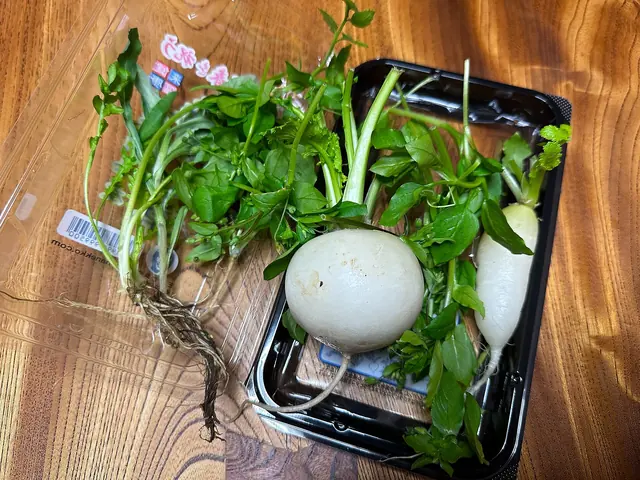
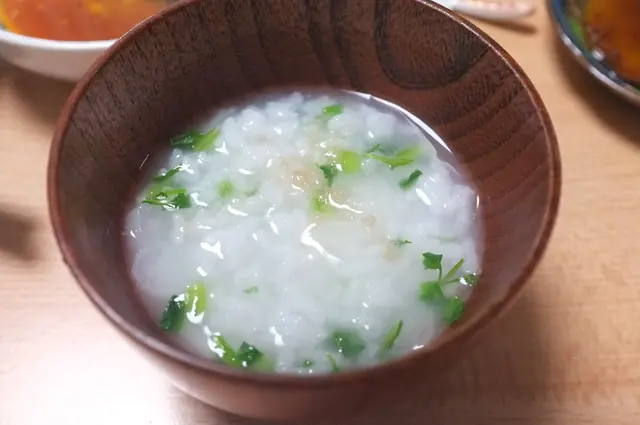
The food calendar goes on past 3 January. On 7 January, jinjitsu, families eat nanakusa-gayu, rice porridge with seven spring herbs, and on 15 January, koshogatsu, a porridge with azuki red beans. MAFF notes that sets of the seven herbs now go on sale once the first three days are over.
New Year cards and the first sales
JNTO's British office describes the second half of December as the time when people clear up unfinished business, clean their homes and send New Year cards to their friends and acquaintances. The cards are called nengajo. Japan Post calls the custom an important part of Japan's traditional culture, a way to mark the start of the year and to reach people who have helped you or who live far away. It also says that greetings by social media are now an ordinary sight and that the habit of sending cards is changing. Its first print run for 2027 shows how: 560 million cards, about 74.3 per cent of the 750 million first printed for 2026.
New Year cards for 2027
- 2 November 2026, 9:00: the cards go on sale at post offices and other outlets.
- 20 December (Sun): post offices start to accept cards as New Year mail.
- 27 December (Sun): the last day to post a card for delivery on New Year's Day.
- 1 and 3 January: the delivery days for New Year cards in the first three days.
- 15 January 2027 (Fri): the last day of sales.
Japan Post adds that cards posted on or before 19 December go as ordinary mail and arrive before the end of the year, not on 1 January. Its New Year card website has free templates, including designs with the sheep, the zodiac animal of 2027, and colouring-in cards for children to fill in with their parents.
The first sales and lucky bags
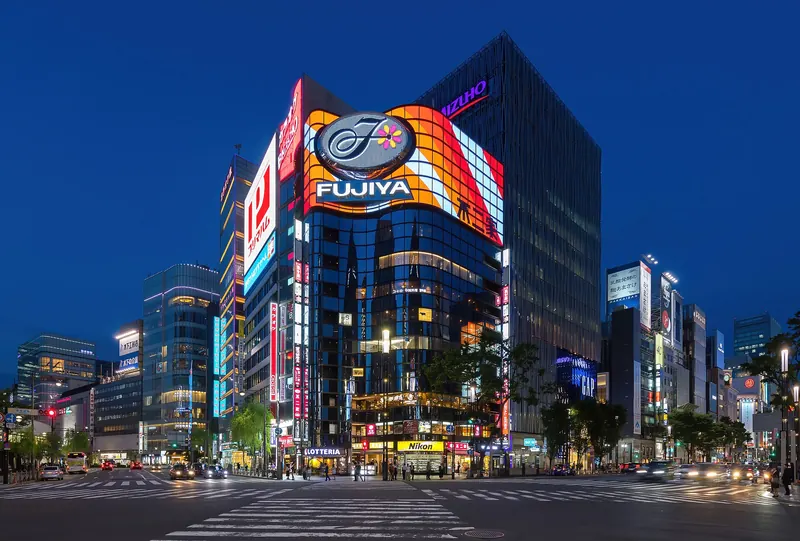
The other New Year ritual in the big cities is shopping. JNTO's guide to January says the first sale of the year, hatsu-uri, takes pride of place there, with crowds queuing outside department stores and other shops for a bargain. Stores open their doors on 1 or 2 January in Tokyo's main shopping districts, Ginza, Shibuya, Harajuku and Aoyama, with luxury goods in Ginza and a younger crowd in Shibuya. JNTO's Singapore office adds that the opening day depends on each store's own schedule and names Mitsukoshi and Isetan as popular choices.
Three New Year firsts
- Hatsuhinode: the first sunrise of the year, on the morning of 1 January.
- Hatsumode: the first visit to a shrine or temple, from New Year's Eve to 3 January.
- Hatsu-uri: the first sale of the year, from 1 or 2 January in the big cities.
The draw is the fukubukuro, or lucky bag. JNTO describes a bag you cannot see into, packed with several items worth well beyond the price, and its Singapore office puts the price at about a third of the value of what is inside. You cannot pick the contents. At Mitsukoshi and Isetan, JNTO says, the bags can hold anything from clothes, cosmetics and jewellery to food and furniture, and they can sell out in minutes, so experienced shoppers check the start times and arrive early. JNTO's British office says some people start queuing hours before the doors open.
The Emperor's New Year greeting on 2 January
On 2 January every year, members of the public go to the Imperial Palace in Tokyo to offer their New Year wishes to the Emperor and Empress. The Imperial Household Agency (IHA) explains that the couple, joined by members of the wider Imperial Family, come out several times onto a balcony of the Chowa-Den hall, and the Emperor speaks to the crowd in the East Court below. The day before, 1 January, is for the New Year reception, a state event for the Imperial Family, Diet leaders, ministers, judges, governors and ambassadors.
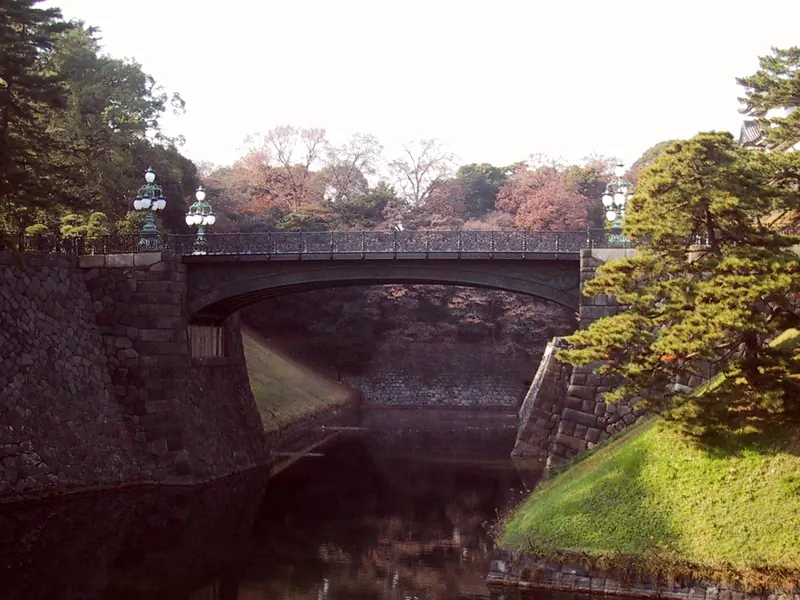
The public visits began on 1 January 1948. No member of the Imperial Family appeared that year; visitors signed their names in books set out by the iron bridge just inside the Main Gate, while Emperor Showa watched the scene from the roof of the IHA building.
How the public greeting began
- 1948: the first public visits, on 1 January, with visitors' books but no appearance.
- 1951: the first appearance, by Emperor Showa and Empress Kojun.
- 1953: the greeting moves to 2 January.
- 1969: it is held at the present palace for the first time.
For 2 January 2026 the IHA set the entry hours at 9:30 to 14:10, all through the Main Gate, Nijubashi. Visitors walk in lines and leave by one of four gates: Sakashita-mon, Kikyo-mon, Ote-mon or Inui-mon. The East Gardens are closed that day, although visitors on their way out may walk through them to the Ote-mon gate.
Appearances on 2 January 2026
- First: around 10:10
- Second: around 11:00
- Third: around 11:50
- Fourth: around 13:30
- Fifth: around 14:20
There is a bag check at the gate, so the IHA asks visitors to arrive well before the gate closes and to keep their belongings to a minimum. It also asks each visitor to watch only one appearance: "In order to allow as many people as possible to visit, please do not stay for more than one appearance."
What the IHA asks of visitors
- Leave large bags in station lockers before you come.
- Do not bring knives, scissors or other sharp objects.
- No selfie sticks, tripods, stepladders or drones.
- No animals, except guide dogs.
- Wear shoes you can walk in: the courtyard is gravel and there are slopes.
- Come by public transport: there is no parking.
For wheelchair users, there is a set space in the East Court, but no wheelchairs to borrow, so bring your own. The Emperor's address is interpreted into sign language in the East Court. The visit may be cancelled in heavy snow or other bad weather. The IHA counted 60,140 visitors in 2026 and 60,690 in 2025; the greeting was cancelled in 2021 and 2022 because of COVID-19, and in 2024 after the Noto Peninsula earthquake.
What is open over New Year, and how to plan
The holiday changes how a trip works. JNTO's American office says many businesses close for at least part of the period from 29 December to 3 January, though it adds that some restaurants and department stores now open over the holiday. JNTO's blog is more careful. It warns that nearly every restaurant shuts on New Year's Day, perhaps for a few more days as well, and suggests keeping some food in hand.
Offices and banks follow the law. National government offices close from 29 December to 3 January, and bank counters from 31 December to 3 January. If you rely on cash, read the guides to ATMs in Japan and to paying by cash or card before the holiday begins. Museums set their own dates: the Tokyo National Museum, for one, closes from 26 to 31 December 2026 and opens on 1 January 2027 from 12:00 to 20:00.
Getting around takes planning too. JNTO's guide to January warns that hotel rooms, flights and train tickets around New Year cost more and are harder to find.
Planning a visit over New Year
- Book early: rooms, flights and trains are scarcer and dearer around New Year.
- Do your errands by 28 December: government offices close from the 29th and bank counters from the 31st.
- Plan your meals for 1 January: most restaurants close on New Year's Day.
- Check each shrine's and temple's times in December: each posts its own plan for the season.
- Check your train line for the night of 31 December: many cities run trains late for hatsumode.
If this is your first trip, the first-time guide covers the basics, and the guide to Japanese festivals covers the big events at other times of the year.
Frequently asked questions
When is Japanese New Year?
On 1 January. The holiday runs from about 29 December to 3 January, and some customs go on to 7 and 15 January.
What do Japanese people do on New Year's Eve?
Most families stay at home, eat toshikoshi soba noodles, watch the Kouhaku song contest and hear temple bells rung 108 times around midnight.
Can visitors join hatsumode?
Yes. Meiji Jingu in Tokyo leaves its gates open all night on 31 December; it is busiest from 22:00 to 3:00 that night and after 10:00 on 1 to 3 January.
Can I ring a temple bell on New Year's Eve?
Not at Chion-in or Senso-ji, where monks or the temple's own society ring the bell. Watching at Chion-in needs a ticket, but its rehearsal on 27 December is open.
What food is eaten at Japanese New Year?
Osechi, a set of dishes in boxes, and ozoni, a soup with rice cakes that differs by region. Many people now buy osechi from department stores.
When is the Emperor's New Year greeting?
On 2 January, at the Imperial Palace in Tokyo. In 2026 the gate was open from 9:30 to 14:10, and there were five appearances.
Are shops and restaurants open on New Year's Day?
Almost all restaurants close on 1 January, though some now open. Many department stores start their sales on 1 or 2 January. Bank counters close from 31 December to 3 January.
Sources
Official and primary sources used for this page. Checked November 6, 2026.
- JNTO: New Year celebrations in Japan — decorations, *osechi*, restaurants, trains
- JNTO UK: Japanese New Year — decorations, Kouhaku, cards, lucky bags
- JNTO Australia: 5 Japanese customs not to miss — holiday dates, soba, *osechi*
- JNTO US: New Year's in Japan — holiday dates, cleaning, *ozoni*
- JNTO US: Useful Japanese vocabulary: O-shogatsu — history of *hatsumode*
Show all 30 sources
- JNTO Singapore: Countdowns, hatsu-uri and hatsumode — Meiji Jingu, first sales
- JNTO Singapore: Things to do during the New Year season — *hatsumode* crowds
- JNTO: Japan in January — Miyajima, sales, travel
- Ministry of Agriculture, Forestry and Fisheries: Wa-gohan and osechi (in Japanese) — *osechi*
- Ministry of Agriculture, Forestry and Fisheries, Hokkaido office: New Year events (in Japanese) — porridges
- Ministry of Agriculture, Forestry and Fisheries: Hakata zoni (in Japanese) — Hakata *ozoni*
- Ministry of Agriculture, Forestry and Fisheries: An-mochi zoni (in Japanese) — Kagawa *ozoni*
- Imperial Household Agency: Visit of the General Public to the Imperial Palace for the New Year Greeting — the 2026 greeting
- Imperial Household Agency: New Year's Greetings — history, visitors
- Meiji Jingu: Hatsumode guide (in Japanese) — times, crowds, old items
- Chion-in: Joya no kane (in Japanese) — the bell, booking, rules
- Chion-in: FAQ (in Japanese) — ringing the bell
- Chion-in: Joya-no-kane Open Rehearsal — the rehearsal
- Senso-ji: Joya no kane (in Japanese) — the bell
- Senso-ji: New Year prayers (in Japanese) — New Year prayers
- Senso-ji: Hagoita-ichi (in Japanese) — the market
- Senso-ji: Soot-sweeping (in Japanese) — *susuharai*
- Senso-ji: Annual events (in Japanese) — hall hours
- National Astronomical Observatory of Japan: The first sunrise, January 2026 (in Japanese) — sunrise times
- National Astronomical Observatory of Japan: Where is the first sunrise in Japan? (in Japanese) — earliest sunrise
- Tokyo Fire Department: Choking on mochi (in Japanese) — figures, tips
- Japan Post: New Year cards for 2027 (PDF, in Japanese) — card dates
- e-Gov: Act on the Holidays of Administrative Organs (in Japanese) — office holidays
- e-Gov: Order for Enforcement of the Banking Act (in Japanese) — bank holidays
- Tokyo National Museum: Getting Here, Admission & Hours — year-end hours
Related guides
To cite or link to this page: Japanese New Year traditions: the dates of shogatsu, year-end cleaning and kadomatsu decorations, New Year's Eve noodles and the 108 temple bells, hatsumode at Meiji Jingu, the first sunrise, osechi and regional ozoni, New Year cards and the first sales, the Emperor's greeting on 2 January, and what stays open over the holiday — Japan Pocket Guide, https://japanpocketguide.com/culture/japanese-new-year/