Culture · Swords
Japanese swords in Japan: tachi, katana, wakizashi and tanto, how a blade is made from tamahagane, how to read one in a museum, where to see them in Tokyo, Bizen, Seki and Okuizumo, forging days, and buying a sword and taking it home
In Japan a sword is treated first as a work of art. Museums light each blade so you can follow the pale line along its edge, the grain of the folded steel and the smith's name cut into the tang, and the law only lets people own one because it has been registered as an art object. Below you will find the four types and their names, how a blade is made from tamahagane steel, what to look at in a display case, the museums in Tokyo, Okayama, Gifu and Shimane, the days when smiths forge in public, and the paperwork for buying a real sword and carrying it out of the country.
Last checked · Sources

In short
Japanese swords come in four main types: the tachi, hung from the belt with the edge facing down; the katana, pushed through the belt with the edge up; the shorter wakizashi; and the tanto, a dagger. Tokyo's Japanese Sword Museum, in Ryogoku, opens 9:30–17:00 except Mondays and charges adults 1,000 yen on normal days, or 1,500 yen during the special exhibition that runs to 20 December 2026. To watch steel being folded, go to the Bizen Osafune Sword Museum in Okayama Prefecture on the second Sunday of the month, with a phone booking. A real sword in Japan is a registered art object, and taking one abroad needs an export certificate from the Agency for Cultural Affairs, applied for by post, which normally takes 10 working days once the papers are complete and is currently taking longer.
The four types of Japanese sword
In Japanese the everyday word is nihonto, "Japanese sword", while the law on weapons uses the wider term token, which takes in swords, spears and halberds. Museum labels sort blades into four main shapes, and the Bizen Osafune Sword Museum in Okayama gives each a rough length in shaku, an old Japanese measure of about 30 cm.
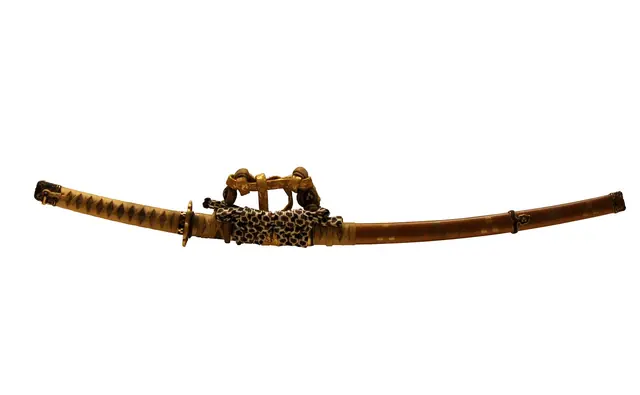
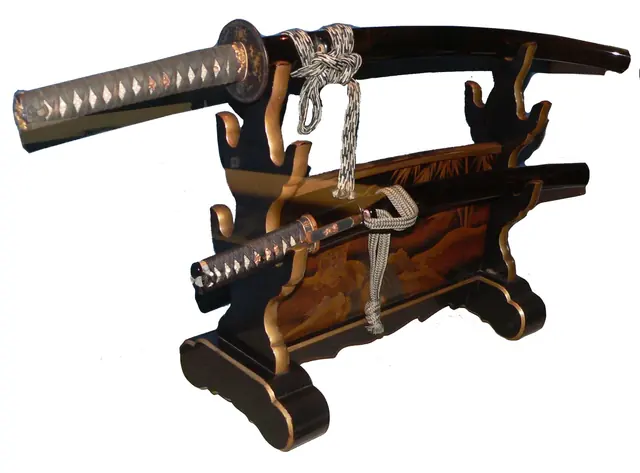
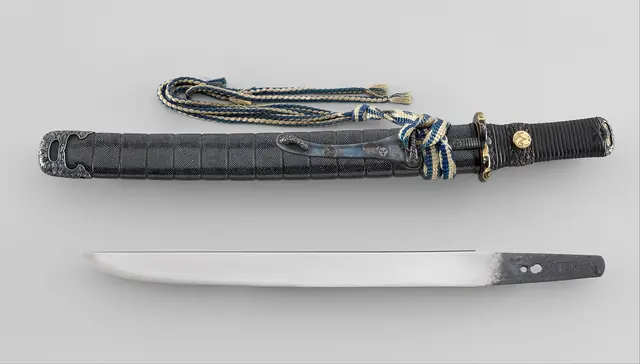
Four shapes on a museum label
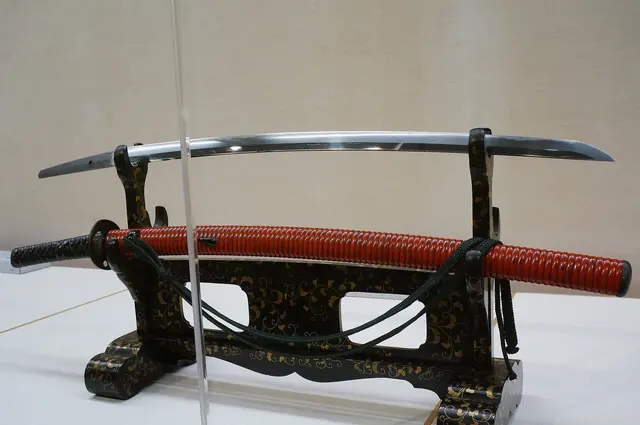
- Tachi: a long sword of roughly 2 shaku, about 60 cm of blade, slung from the belt with the cutting edge facing the ground. It belongs to the age of mounted warfare, between the late Heian and early Muromachi periods.
- Katana: the long sword of foot soldiers, worn pushed through the belt with the edge facing up. It took over from the tachi in the Muromachi period and stayed in use until the end of the Edo period.
- Wakizashi: the companion short sword, between 1 and 2 shaku, worn at the waist like the katana. One under 40 cm is called a ko-wakizashi.
- Tanto: a dagger under 1 shaku. The Kyoto National Museum puts a typical one at around 24 cm, and other names for it are koshigatana and aikuchi.
The Bizen museum explains the change from tachi to katana as a change in how wars were fought. A horseman needed a long, deeply curved blade that hung from his belt; when battles moved to the ground, swords became a little shorter and flatter and were thrust through the sash instead. The museum still turns each kind the way it was worn, so the way a blade lies in its case tells you its type before you read the label.
How to tell them apart in a display case
The Kyoto National Museum's beginner's sheet gives a simple test for any blade on show or in a painting.
The edge test
- Edge pointing down: a tachi.
- Edge pointing up and long: a katana.
- Edge pointing up and short: a wakizashi or, if it is shorter still, a tanto.
- Signature side: the smith's name is usually cut on the face that looked outwards when the sword was worn on the left hip.
Old swords and new swords
Labels also split swords by age. Koto, "old swords", is the broad name for anything made before the start of the 17th century, from classical and medieval tachi to the katana, wakizashi and tanto of the 1500s. Shinto, "new swords", covers blades from the 17th century on. Kyoto's own smiths kept working through both eras; the museum's sheet traces Kyoto schools starting in the late Heian period and ending with the Horikawa group of the early 1600s, founded by Horikawa Kunihiro.
How a Japanese sword is made
Every traditional blade starts as tamahagane, a steel made by smelting iron sand with charcoal in a clay furnace called a tatara. JNTO's step-by-step guide says the furnace team has to stay on watch for 72 hours without a break, feeding in sand and charcoal, before the clay walls are broken open and the steel is taken out. The Japan Tourism Agency's guide to Okuizumo in Shimane calls the tatara the only way to produce tamahagane, and Okuizumo the only place where it is still worked.
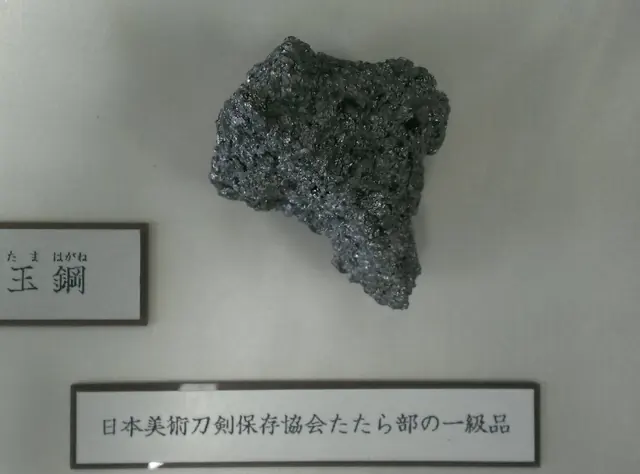
From iron sand to finished blade
- Smelting: iron sand and charcoal burn in the tatara for about three days, leaving a bloom of iron, slag and steel that weighs several tons.
- Sorting: the steel is broken up and graded by how much carbon it holds.
- Folding: the smith hammers the pieces flat, stacks them, heats them in a charcoal fire of about 1,300°C, then cuts and folds the bar again and again, up to 16 times, to drive out slag. This is orikaeshi tanren.
- Core and skin: hard, high-carbon kawagane is wrapped around a softer, tougher core called shingane.
- Drawing out: the bar is lengthened in the fire, then shaped with a small hammer; the point, or kissaki, is hammered out at this stage.
- Rough shaping: a plane-like tool called a sen and files even out the surfaces.
- Clay and quench: a thick layer of clay and charcoal powder is spread over the back and sides, the edge gets only a thin coat, and the blade comes out of the fire straight into water.
- Polishing and mounting: after a rough polish the smith hands the blade to a specialist polisher; metalworkers then add the guard, a lacquered wooden scabbard is made, and the finished sword goes back to the smith for a last check.
Where the curve comes from
Nobody hammers the curve in. During the quench, the hard edge steel and the softer steel behind it shrink at different speeds and by different amounts, so the blade bends on its own in the water tank. JNTO says the blade is heated to just under 815°C before this step, because any hotter risks cracking it. The Bizen museum describes the same moment: once it is in the water, the body of the sword starts to warp and the curve, sori, appears by itself.
The clay does a second job. The uneven coat is what creates the hamon, the wavy line along the edge that you look for in a museum case, and it only becomes clear after the final polish. According to JNTO, that polish is done with a series of stones and can last several weeks, sometimes months.
How to look at a sword in a museum
A row of swords in a case can look like a lot of grey steel at first. The Kyoto National Museum's introduction for first-time visitors boils it down to three things, and once you know them each case becomes much easier to read.
Three things to look for
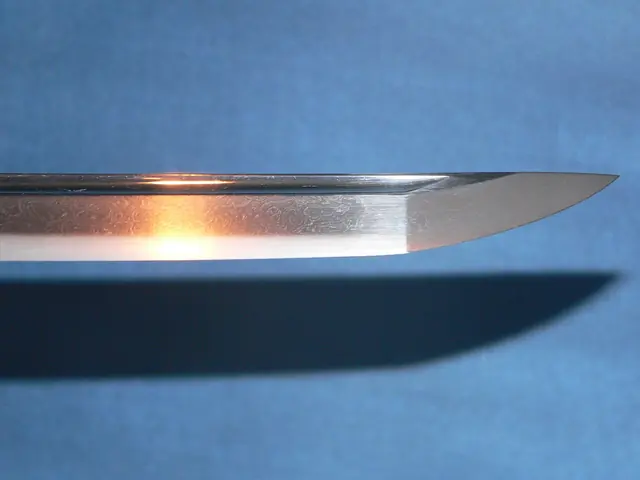
- The hamon: the crystalline line that runs along the cutting edge. The smith shaped it during the quench, and it can show his skill and the school he belonged to.
- The hada: the texture of the steel surface, left by the folding, forging and quenching. Like wood grain, it can hint at when and where a blade was made.
- The mei: the signature cut into the tang, the part normally hidden inside the hilt. It can give the smith's name, the date it was made or its provenance, and it matters a great deal when experts authenticate and appraise a sword.
Patterns along the edge
The Kyoto sheet groups the hamon into straight and irregular types and gives the commonest irregular ones their own names.
Common hamon patterns
- Suguha: a straight line, though most straight ones have a slight curve.
- Notare: a gentle, rolling undulation.
- Choji: tight scallops named after clove buds.
- Gunome: a continuous line of tight waves or zigzags; the name means alternating eyes.
- Midareba: the general name for an irregular line rather than a straight one.
- Toran: big rolling waves, a style the Osaka smith Sukehiro is credited with creating.
The grain has names too. Itame, which the museum translates as cathedral grain, is the most common; masame runs in nearly straight, parallel lines; and mokume, burled grain, shows patterns of concentric circles.
Words on a museum label
- Kissaki: the point, the area at the tip of the blade.
- Mune: the back, or spine.
- Sori: the curvature, measured as the depth of the arc.
- Nakago: the tang, which fits into the hilt.
- Mekugi-ana: the peg holes in the tang that hold the hilt in place.
- Ha-machi and mune-machi: two small notches, one on the cutting edge and one on the back.
- Blade length: measured between the back notch and the end of the point.
Names, famous blades and shortened swords
Some swords carry a proper name, a go. Others have the word meibutsu, "celebrated object", in front of their name, which means the sword appeared in an early list of prized blades. The Kyoto sheet explains that such names come from a sword's story, its shape or a famous owner, and usually end with the smith's name. A wakizashi called Namazuo Toshiro, for example, takes its name from a shape like a catfish tail and from the nickname of the smith Yoshimitsu, and Mikazuki Munechika, "Crescent Moon Munechika", is named for crescent shapes in its hamon.
Old blades were often cut down. Shortening, suriage, cuts away the end of the tang, taking some or all of the signature along with it; when a tachi was turned into a katana and the whole tang was cut off, the term is o-suriage. A new inscription was sometimes added afterwards, and the shortening can change the curve and balance of the blade quite a lot.
One famous sword lives in Okayama.
Where to see Japanese swords in Japan
Tokyo has the national society's museum, the old sword towns of Osafune in Okayama and Seki in Gifu still have working forges, and Okuizumo in Shimane is where the steel itself comes from.
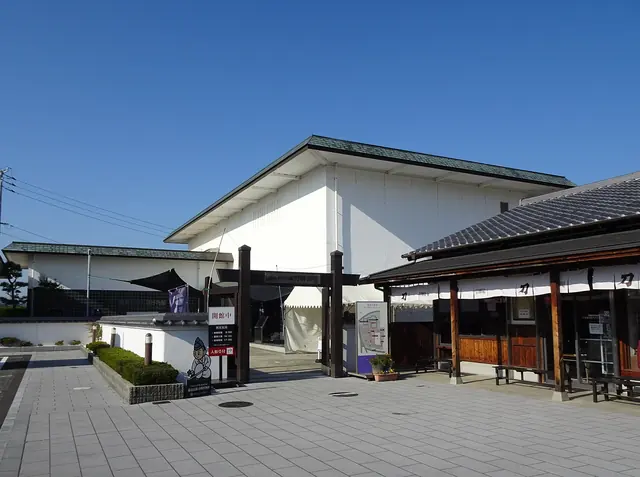
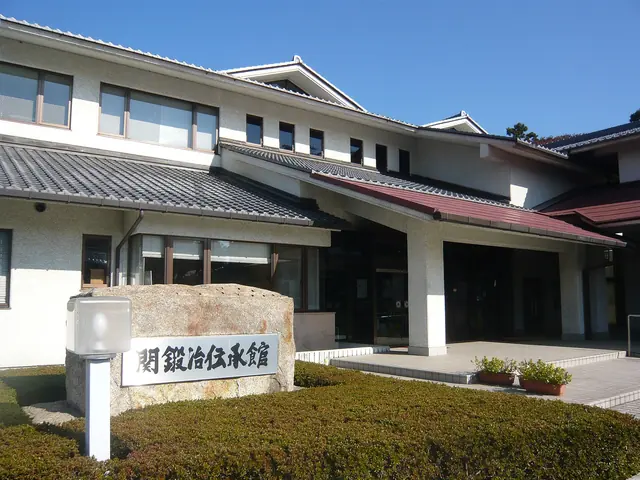
Four places built around the sword
- Ryogoku, Tokyo: the Japanese Sword Museum, which fits easily into a Tokyo sightseeing day.
- Osafune, Okayama: the Bizen Osafune Sword Museum, with smiths, polishers and scabbard makers at work on the same grounds.
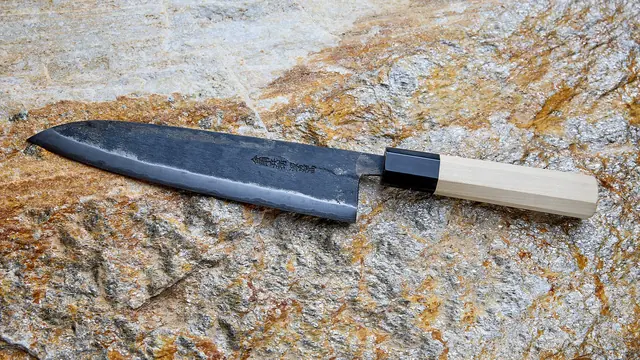
- Seki, Gifu: a sword town for some 700 years, now better known for knives, with public forging days.
- Okuizumo, Shimane: the home of tatara smelting and of a small museum about it.
Japanese Sword Museum, Tokyo
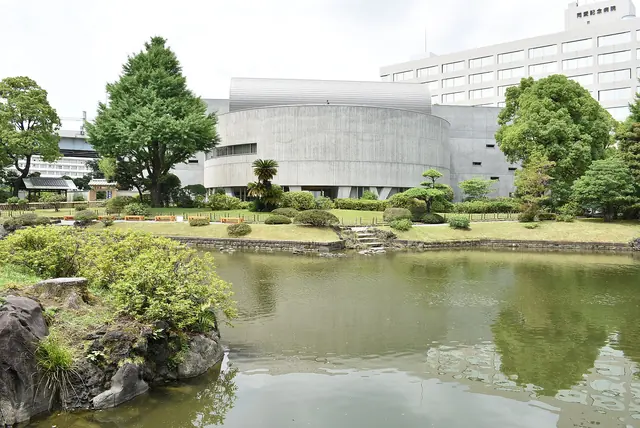
The museum belongs to the Society for the Preservation of Japanese Art Swords, known by its initials NBTHK. JNTO explains that the society was set up in 1948, after the Occupation Forces tried to seize and destroy every sword in Japan at the end of the Second World War. Its building now stands inside the Kyu-Yasuda Garden, a small park in Ryogoku, and covers about a thousand years of sword history, with old documents and archives as well as blades.
The ground floor is free and has an information corner on how swords are made, so you can learn the basics before deciding to pay. The blades themselves are upstairs, in specially designed cases in the third-floor gallery.
Floor by floor
- 1F: information corner, museum shop and ticket desk, café and lecture hall.
- 2F: a reading room.
- 3F: the paid exhibition hall and a roof garden.
Until 20 December 2026 the gallery holds a special exhibition, Master Swordsmiths of East and West: Kotetsu and Sukehiro. It sets two famous Edo-period smiths side by side: Kotetsu, who worked in Edo, and Sukehiro, who worked in Osaka and created the toran wave pattern described above.
For more on the museum alongside sword classes, see our guide to samurai experiences, and if you are in the area for a tournament, sumo tickets.
Bizen Osafune Sword Museum, Okayama
Osafune, now part of Setouchi City, has produced swords since the Kamakura period, and its museum is one of very few in Japan given over entirely to them. Around 40 blades are on show across two floors at any time, with about six exhibitions a year. The rest of the grounds are just as interesting. The forge is where licensed smiths make blades; in the craft workshop you can watch polishing, carving, and the making of scabbards and hilts at close range; and a small gallery on the sword and the region has tamahagane and whetstones you are allowed to touch.
The autumn exhibition ends on 23 November 2026. From 5 December 2026 to 14 February 2027 the winter special exhibition, Ko-Bizen: The Dawn of the Sword Kingdom, looks at the Ko-Bizen smiths, a group active from the late Heian period who are said to have shaped the later Osafune and Fukuoka Ichimonji schools. Its centrepiece is a tachi signed by Nobufusa, an Important Cultural Property recently given to the museum. One surviving Nobufusa blade is a national treasure and four are Important Cultural Properties. Prices for this show are 1,200 yen for adults, 1,000 yen for over-65s and 800 yen for high school and university students. The museum's notice for it allows photos, but not with flash, selfie sticks, tripods or monopods, and no video. After that, a smaller theme exhibition on hamon and sword mountings runs from 20 February to 18 April 2027 at the normal price.
Getting to Osafune
- From Osaka: the shinkansen from Shin-Osaka to Okayama takes about 45 minutes, then a local train to Kagato about 30 minutes.
- From Kagato Station: about 20 minutes on foot.
- From Osafune Station: about 7 minutes by taxi, or about 15 minutes on a sightseeing bus that runs only on weekends and holidays.
Seki, Gifu
JNTO calls Seki the city of blades. Around 300 swordsmiths were working there in the 1500s, and JNTO adds that the samurai sword is thought to have been invented and refined there. Its swordsmiths' museum, the Seki Kaji Denshokan, traces some 700 years of local smithing from the Kamakura period and shows blades by famous smiths such as Magoroku Kanemoto and Kanesada, alongside the work of knife makers.
Renovation work has kept the building shut since 7 September 2026, and the closure is scheduled to last until 31 March 2027, though those dates may move. Its forging hall stays in use all the same. Whether demonstrations go ahead during the closure is not stated, so check with the city's tourism office before you travel.
JNTO also features a forging demonstration by a family of smiths who once supplied swords to the Tokugawa shoguns and still make the ceremonial swords given to new yokozuna, sumo's top-ranked wrestlers. It is held at the Seki Hamono Museum in the Oze district, lasts about an hour, and the museum also has swords on display and shows sharpening and scabbard making. To get there, ride the JR Tokaido Main Line from Nagoya to Gifu, about 20 minutes, then a bus for about 40 minutes to Oyana and walk about 15 minutes. Seki's kitchen knives and cutlery shops have their own section in the Japanese knives article.
Okuizumo, Shimane
The Japan Tourism Agency says the first half of the museum follows the rise and decline of tatara smelting, and the second half the modern effort to revive it so that today's smiths have steel to work with.
Twice a month a master smith and helpers work tamahagane in the museum's small forge. JNTO says the crowd is small, and many of those watching get to take a turn with the hammer on the red-hot steel. The furnace that makes tamahagane for the country's swordsmiths is nearby, but it is not open to visitors.
Watching a sword being forged
The moment most visitors want to see is the folding: a glowing block of tamahagane struck again and again with heavy hammers while sparks fly. Okayama's tourism board notes that this work gave Japanese the phrase aizuchi wo utsu, now used for chiming in during a conversation.
Public forging days at a glance
- Bizen Osafune, Okayama: second Sunday of each month at 11:00 and 14:00, free with a museum ticket, booked by phone about a month ahead.
- Seki, Gifu: the first Sunday of most months in normal years, plus 2 January and the October knife festival, with the museum itself closed until 31 March 2027.
- Okuizumo, Shimane: twice a month at the Tatara and Sword Museum, where some visitors are handed a hammer.
At Bizen Osafune the smiths show orikaeshi tanren, the old way of folding: the steel is heated to between 1,200 and 1,300°C, beaten with a heavy sledgehammer and folded over again and again to work out the impurities. Watching is free once you have paid for admission. Visitors go in for 30 minutes at a time, 15 people per turn, with two turns in the morning from 11:00 and two in the afternoon from 14:00.
The next dates are 13 December 2026, for which phone booking opened on 10 November, and 10 January 2027, with booking planned to open around mid-December. On the day, give the name on your booking at the museum desk and collect a numbered ticket before your start time; without one you cannot enter the forge while the demonstration is running. Visitors do not take a turn with the hammer here.
Before a forging demonstration
- Booking made by phone, about a month before the date
- Museum ticket bought; the forging itself is free
- Numbered ticket collected at the desk before your turn
- Clothes that do not catch fire easily and do not leave much skin bare, because sparks can fly
- Flash switched off, and no tripod, monopod, chair, stepladder or selfie stick
- In summer, water with you, because the forge gets very hot; drinks are allowed inside the forge but not in the galleries
The museum lends safety goggles to protect your eyes.
Classes at Bizen Osafune
The museum runs three hands-on classes, all booked by phone, and the two paid ones take cash only.
Classes at the Bizen Osafune Sword Museum
- Sword-care lesson: about once a month from 11:00 to 12:00, using swords from the museum's own collection. Free with admission, for up to six people, and you are asked to bring a mask to protect the blade. The next is on 12 December 2026.
- Small-knife course: first and third Saturdays from 10:00 to 16:00, for up to ten people. It costs 2,000 yen a day including admission, plus 20,000 yen for materials per knife, cash only, and a knife takes two to four sessions. Remaining 2026 dates are 5 and 19 December.
- Paper-knife class: mornings on days other than the first and third Saturdays, starting between 9:00 and 10:00. It costs 2,000 yen a person plus admission, cash only, for five to ten people; smaller groups can take part by paying for five. Book at least two weeks ahead.
Dates for both the care lesson and the small-knife course from January 2027 have not been fixed yet.
Buying a Japanese sword in Japan
Japan's Firearms and Swords Control Law starts from a ban: under Article 3 nobody may own a gun or a sword unless one of the listed exceptions applies. For blades the main exception is in Article 14. Prefectural boards of education register swords that are valuable as works of art, and each registration has to rest on an appraisal by the board's registration examiners. Registration with the board in the owner's home prefecture is what makes it legal to keep one.
The registration comes as a certificate, the torokusho. It records the inscription, the length, the curve, the peg holes and other details, and the Agency for Cultural Affairs will not issue an export certificate if the blade in your photos does not match it. Changing a registered blade, for example its length or inscription, needs its own procedure with the board.
What happens when you buy a registered sword
- Check the certificate: compare the torokusho with the blade in front of you, especially the inscription, length, curve and number of peg holes.
- Keep the certificate with the sword: you need copies of its front for the export application, and it has to be handed back once the sword leaves Japan.
- Notify within 20 days: under Article 17, anyone who acquires a registered sword, by transfer such as a purchase or by inheritance, must tell the board of education that registered it within 20 days.
- Plan the export early: if the sword is leaving Japan with you, the export certificate is the slow part, as the next section explains.
Not everything sword-shaped can be registered. Tokyo's board of education says blunt replica swords and foreign-made swords, which differ from Japanese swords made by traditional methods, cannot be registered. That does not make replicas a free-for-all: Article 22-4 of the same law bans carrying metal replica swords that closely resemble real ones without a work-related or other legitimate reason. Kitchen knives and the rules on carrying smaller blades are covered in the Japanese knives guide.
Bringing a sword into Japan
Swords also come the other way, for example a registered blade returning from a trip abroad.
Taking a sword home from Japan
Tokyo's board of education counts any trip abroad with a registered sword as an export. Selling a sword to someone overseas is an export, and so is taking one back to your own country, and the same applies to short trips: carrying a sword abroad for an iaido demonstration, or lending it to a foreign museum for an exhibition of about a month.
Every one of these needs an export certificate from the Agency for Cultural Affairs. National treasures, Important Cultural Properties and items recognised as Important Art Objects may not, as a rule, leave the country, and customs can ask for proof that an antique is none of these. The certificate, issued on the owner's application, is that proof.
Papers for the export certificate
- Application form in two copies, with the separate list form for registered swords if there is more than one item, all on A4 paper
- Two identical sets of colour photos printed or stuck on A4: the whole blade on both sides with the scabbard, hilt and collar, habaki, taken off, and a close-up of both sides of the tang or a rubbing of it
- Photos clear enough to show the hamon, the inscription and the peg holes, ideally with a ruler beside the blade
- Two copies of the front of the registration certificate, each on its own A4 sheet
- A return envelope with your address: a Letter Pack, or an A4 envelope with enough stamps, ideally with tracking
The application goes by post to the Agency's office in Kyoto; it does not accept applications any other way. Once every paper has arrived in order, the certificate normally takes 10 working days. The Agency warns that applications have risen sharply and that issuing now takes longer, that it will not handle requests to rush, and that it only answers questions about progress once 30 days have passed with no news.
From the shop to the airport
- Buy early in your trip: the paperwork that follows takes weeks rather than days.
- Apply by post: send the forms, photos and certificate copies to the Agency for Cultural Affairs in Kyoto.
- Wait for the certificate: 10 working days at best once the papers are complete, and currently longer.
- Show the original at customs: one certificate covers one export declaration, and it is valid for a year for a single export.
- Return the registration certificate: it stops being valid once the sword leaves Japan.
Rules in your home country
Japan's papers only get the sword out of Japan. What happens on arrival depends on your own country, and some countries ban long curved blades outright.
In the United Kingdom, GOV.UK defines a sword as any curved blade 50 cm or longer, with the length taken in a straight line from the handle's top to the blade's point. It is illegal to own one, bring one into the country, sell, hire, lend or give one away, unless an exemption applies. Knives and weapons more than 100 years old are among the exemptions, and Border Force's import guidance also lists antiques and swords made by traditional methods. For a particular sword, the government advises asking the local police or getting legal advice.
In Australia, a customs notice from the Australian Border Force sets out the general rule: "Weapons are prohibited on entry to Australia unless permission has been granted in accordance with the requirements in Schedule 13 of the Regulations." The same notice says penalties for bringing in a prohibited weapon without a permit can reach a fine of 2,500 penalty units, then worth A$525,000, ten years in prison, or both.
Frequently asked questions
What are Japanese swords called?
The general word is nihonto. The four main types are the tachi, a long sword worn edge down; the katana, worn edge up through the belt; the wakizashi, a short sword of about 30 to 60 cm; and the tanto, a dagger under about 30 cm.
What are Japanese swords made of?
Tamahagane, a steel smelted from iron sand and charcoal in a clay furnace called a tatara. A hard, high-carbon outer steel is wrapped around a softer core so that the edge stays sharp and the blade does not snap.
Why are Japanese swords curved?
The curve forms during quenching. The edge has only a thin coat of clay and hardens and shrinks differently from the thickly coated back, so the blade bends by itself in the water.
What is the difference between a tachi and a katana?
The tachi is the older type, hung from the belt with the edge facing down, for fighting on horseback. The katana replaced it in the Muromachi period and was thrust through the sash with the edge up. The Bizen Osafune Sword Museum displays each the way it was worn.
Can a tourist buy a real Japanese sword in Japan?
Yes, if the sword is registered with a prefectural board of education. To take it home you need an export certificate from the Agency for Cultural Affairs, applied for by post, and the registration certificate has to be returned once the sword has left Japan.
Can I bring a Japanese sword into the UK?
Only if an exemption applies. UK law bans curved swords whose blades are 50 cm or longer, with exemptions that include items over 100 years old. Ask your local police or a lawyer about a specific sword before you buy it.
Where can I watch a Japanese sword being forged?
At the Bizen Osafune Sword Museum in Okayama on the second Sunday of each month, booked by phone, and twice a month at the Okuizumo Tatara and Sword Museum in Shimane. Seki in Gifu holds public forging on the first Sunday of most months in normal years, but its museum is closed until 31 March 2027.
Sources
Official and primary sources used for this page. Checked November 21, 2026.
- Japanese Sword Museum: Visitor information — hours, admission, floors, access
- Japanese Sword Museum: Current exhibition (in Japanese) — Kotetsu and Sukehiro exhibition
- Japanese Sword Museum: Admission (in Japanese) — special and normal admission
- JNTO: The Japanese Sword Museum — the NBTHK, floors, the garden
- JNTO: How a traditional samurai sword is made — smelting, folding, quenching, polishing
Show all 29 sources
- JNTO: Bizen Osafune Japanese Sword Museum — train times
- JNTO: See firsthand how Japanese swords are made — Seki history, forging, access
- JNTO: Okuizumo Tatara Sword Museum — address, access, forging twice a month
- Japan Tourism Agency: Okuizumo Tatara and Sword Museum — tatara smelting, the museum's two halves
- Gifu Prefecture tourism: Seki Kaji Denshokan (in Japanese) — closure, admission, free days
- Gifu Prefecture tourism: Public forging in Seki (in Japanese) — forging days and times
- Okayama Prefecture tourism: Bizen Osafune Sword Museum (in Japanese) — displays, forge, workshops, the aizuchi phrase
- Setouchi City: Visiting the Bizen Osafune Sword Museum (in Japanese) — hours, admission, payment, access
- Setouchi City: Ko-Bizen winter special exhibition (in Japanese) — winter exhibition, prices, photo rules
- Setouchi City: Classes and events at the Bizen Osafune Sword Museum (in Japanese) — classes and public forging
- Setouchi City: Regarding types of Japanese sword — the four types
- Setouchi City: The procedure of making Japanese sword — the making process
- Setouchi City: Exhibition schedule for 2026 (in Japanese) — exhibition schedule
- Setouchi City: The national treasure Yamatorige (in Japanese) — Yamatorige
- Kyoto National Museum: Introduction to Japanese Swords (PDF) — hamon, grain, signatures, names
- e-Gov: Firearms and Swords Control Law (in Japanese) — Articles 2, 3, 14, 17 and 22-4
- Tokyo Metropolitan Board of Education: Registration of firearms and swords (in Japanese) — registration
- Tokyo Metropolitan Board of Education: Exporting swords (in Japanese) — export and re-registration
- Tokyo Metropolitan Board of Education: Importing swords (in Japanese) — hand luggage, fee, what cannot be registered
- Saitama Prefecture: Exporting swords (in Japanese) — returning the certificate
- Agency for Cultural Affairs: Export certificate for antique art (in Japanese) — papers, photos, processing time, customs
- GOV.UK: Buying and carrying knives — sword definition, exemptions
- GOV.UK: Import controls on offensive weapons — import exceptions
- Australian Border Force: Customs Notice 2019/31 (PDF) — permission rule, penalties
Related guides
To cite or link to this page: Japanese swords in Japan: tachi, katana, wakizashi and tanto, how a blade is made from tamahagane, how to read one in a museum, where to see them in Tokyo, Bizen, Seki and Okuizumo, forging days, and buying a sword and taking it home — Japan Pocket Guide, https://japanpocketguide.com/culture/japanese-swords/