Things to do · Bridges and bay views
Rainbow Bridge in Tokyo: walking across, walkway hours, the light-up and the best views
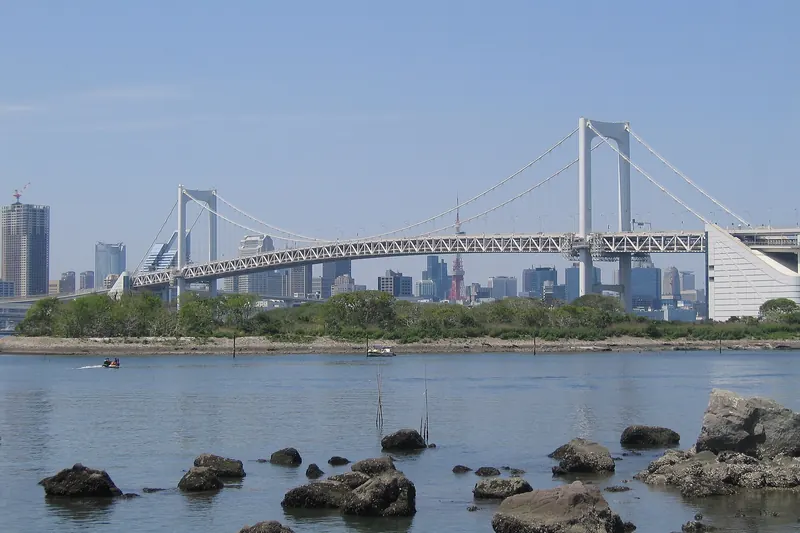
Rainbow Bridge is the white suspension bridge that carries an expressway, a road, the Yurikamome line and two footpaths across the north of Tokyo Bay between Shibaura and Odaiba. This guide covers walking across it, the walkway's hours and closed days, what the lights do after dark and where to stand for the view. Hours, rules and lighting times are those published by the Tokyo Metropolitan Government's Bureau of Port and Harbor, Metropolitan Expressway Co. and Yurikamome Inc., as read on 12 October 2026.
Last checked · Sources

In short
Yes, you can walk across Rainbow Bridge, and it is free. The walkway is 1.7 km from the Shibaura entrance to the Odaiba entrance and takes about 20 to 30 minutes. Between April and October the gates are open 9:00 to 21:00; in the winter half, November to March, 10:00 to 18:00. The last entry is half an hour before the gates shut, and the third Monday of every month is a closed day. After dark the lights come on about half an hour after sunset and stay on to midnight. The towers are white on ordinary nights; in 2025 they turned rainbow-coloured on five announced evenings in December.
Can you walk across Rainbow Bridge, and how long does it take?
Yes. Rainbow Bridge has a pedestrian walkway on each side of its lower deck, and anyone can walk from one shore of Tokyo Bay to the other during opening hours. The Tokyo Metropolitan Government's Bureau of Port and Harbor, whose page sets out the walkway's rules, measures it at 1.7 km from the Shibaura entrance to the Odaiba entrance and reckons on 20 to 30 minutes to walk it.
Other official pages put the time a little higher. GO TOKYO, the travel guide the city itself publishes, warns: "You can also walk the bridge, but expect it to take a good 30 minutes." JNTO's page on crossing on foot gives joggers about 20 minutes and walkers 30 to 40, depending on how often they stop to look and to take pictures. A fair plan is half an hour of walking plus whatever time the views take.
The 1.7 km is measured from entrance to entrance, so it is more than the bridge alone. The suspension bridge itself is 798 metres long in the figures of Metropolitan Expressway Co., whose expressway runs along the upper deck.
Running is not ruled out. The bureau's page sets rules for bicycles, wheelchairs and pets and none against running, and JNTO describes the walkway as "popular with local joggers".
Rainbow Bridge walkway hours and closed days
The walkway keeps two sets of hours, a long day in the warmer half of the year and a short one in winter. These are the times on the Bureau of Port and Harbor's page:
| Period | Open | Last entry |
|---|---|---|
| 1 April to 31 October | 9:00 to 21:00 | 20:30 |
| 1 November to 31 March | 10:00 to 18:00 | 17:30 |
The gates stop letting people in half an hour before the close, and JNTO's list of rules adds that walkers have to be off the bridge by closing time. As the bureau's own walking time is 20 to 30 minutes, the last entry leaves no slack. Go in at 20:30 in summer or 17:30 in winter and you will be walking straight through without a stop.
The winter hours matter more than they look. From November to March the walkway shuts at 18:00. In December the bridge's lights come on about an hour before that, but by mid-March they come on after the gate has shut, so the long evening walk that works in summer does not work in winter. The section on the lights further down has the times month by month.
Which days is the walkway closed?
The walkway takes one day off a month, the third Monday. If a public holiday falls on that Monday, the closure moves to the Tuesday.
The bureau does not publish a list of dates, so the table below is this site's own count, made from the bureau's rule and the Cabinet Office's list of national holidays for 2026 and 2027.
| Month | Closed day |
|---|---|
| October 2026 | Monday 19 October |
| November 2026 | Monday 16 November |
| December 2026 | Monday 21 December |
| January 2027 | Monday 18 January |
| February 2027 | Monday 15 February |
| March 2027 | Monday 15 March |
| April 2027 | Monday 19 April |
| May 2027 | Monday 17 May |
| June 2027 | Monday 21 June |
| July 2027 | Tuesday 20 July, because Monday 19 July is Marine Day |
| August 2027 | Monday 16 August |
| September 2027 | Tuesday 21 September, because Monday 20 September is Respect for the Aged Day |
The bureau adds that it may also turn visitors away for maintenance or because of the weather. JNTO's page names the weather that does it: "May be closed in cases of strong winds". This guide came across no page that posts closures on the day, so on a stormy day be ready to cross by train instead.
New Year's Eve is the exception in the other direction. In recent years the walkway has stayed open through the night of 31 December; the details are further down this page.
Rainbow Bridge entrance fee and tickets: what does it cost?
Nothing. Walking across is free. Yurikamome Inc., which runs the line over the bridge, marks the walkway as free admission on its page, and JNTO says the same in one line: "Entrance to the bridge is free." No official page consulted here mentions a ticket, a booking or a time slot. You simply walk in during opening hours.
What can cost money is getting there, or driving over:
- The train. Both entrances are reached by the Yurikamome line, and the Odaiba side by the Rinkai Line as well. This page does not quote fares. The Tokyo Subway Ticket covers neither line, so that leg is paid separately; the guide to Suica and PASMO explains paying ride by ride with an IC card.
- The expressway. JNTO describes the upper deck as a toll road, part of the Shuto Expressway. Neither JNTO nor Metropolitan Expressway's page on the bridge gives the toll, so this site does not quote one.
- The road underneath. The lower deck carries a local road alongside the Yurikamome. The bureau notes one restriction on it: mopeds of 50 cc or less may not use the roadway, while machines of 51 cc and above may.
- Parking. There is no car park at either entrance. The bureau's New Year notice tells drivers to use private car parks nearby.
Where is Rainbow Bridge, and which entrance should you use?
Rainbow Bridge crosses the northern part of Tokyo Bay. One end is at Shibaura Pier on the mainland side; the other is at Odaiba, the entertainment district on the bay. Each shore has its own entrance to the walkway, and you can go in at one and come out at the other.
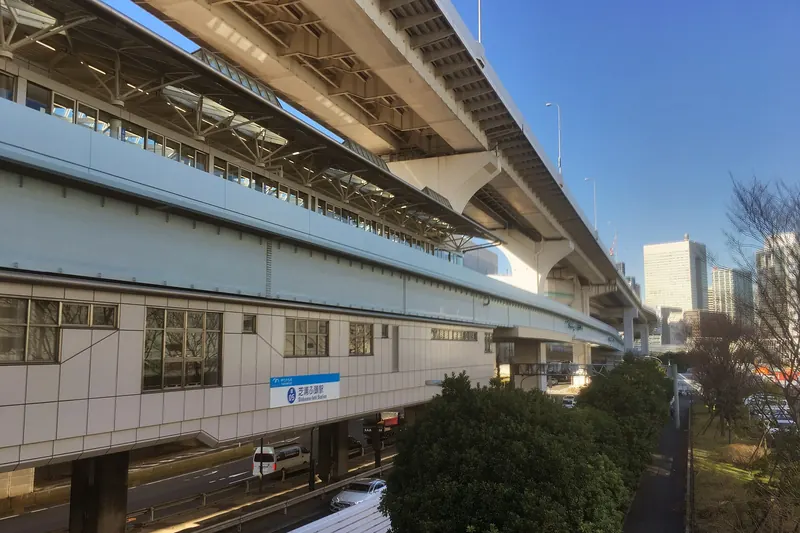
The Shibaura side
The nearest station is Shibaura-futo on the Yurikamome line, four stops from Shimbashi and one stop before the train crosses the bridge. JNTO's directions from the ticket gate are short: leave by the east exit, walk straight on until the Shibaura Anchorage is in sight, turn left, and the entrance is on the right. (The same page also calls the building the Shibaura Mooring.) A lift then goes up to the seventh floor, where the walkway begins.
The bureau's own pamphlet, an edition dated May 2011, puts the entrance five minutes on foot from Shibaura-futo Station. From JR Tamachi Station the sources disagree: the pamphlet says 20 minutes from the east exit and JNTO says 10. Allow 20.
Yurikamome's station page lists toilets, a barrier-free toilet, coin lockers and lifts at Shibaura-futo. The walkway's own toilets are at this end too, and there are none on the Odaiba side.
JNTO recommends beginning here: "It is easier to start on the Shibaura side as one must take an elevator to the start of the walkway." It is just as plain about the surroundings: "Most of the immediate area is offices and warehouses."
The Odaiba side
There is no lift at this end. JNTO describes a long sloping path from the ground up to the level of the walkway, and calls a start from Odaiba slightly more challenging for that reason.
The nearest stations are Odaiba-kaihinkoen (Yurikamome line) and Tokyo Teleport (Rinkai Line), which JNTO puts 5 to 10 minutes' walk away. Once you are off the bridge there are convenience stores and grocery shops close by, JNTO says, and keeping to the waterline brings you to Odaiba Seaside Park.
Getting there from central Tokyo
GO TOKYO gives these routes to Odaiba:
| From | Route | Time |
|---|---|---|
| Tokyo Station | JR Yamanote Line to Shimbashi, then the Yurikamome to Odaiba-kaihinkoen | around 30 minutes |
| Shinjuku Station | Toei Oedo Line to Shiodome, then the Yurikamome to Odaiba-kaihinkoen | around 45 minutes |
| Shinjuku Station | JR Saikyo Line through to Tokyo Teleport, no change | 22 minutes |
Shibaura-futo is the stop before Odaiba-kaihinkoen on the Yurikamome, so the first two routes serve the Shibaura entrance as well. Get off one stop earlier.
This site's suggestion is to start at Shibaura and finish at Odaiba. The lift does the climbing, the toilets are at the start, the slope at the far end is walked downhill, and the walk finishes at a beach and shops rather than among warehouses.
North route or south route: which side has the better view?
The bridge has a walkway along each side, the north route and the south route, and the two look out in opposite directions. JNTO's advice is to "pick the side with the view you most want to see".
| Route | What you see |
|---|---|
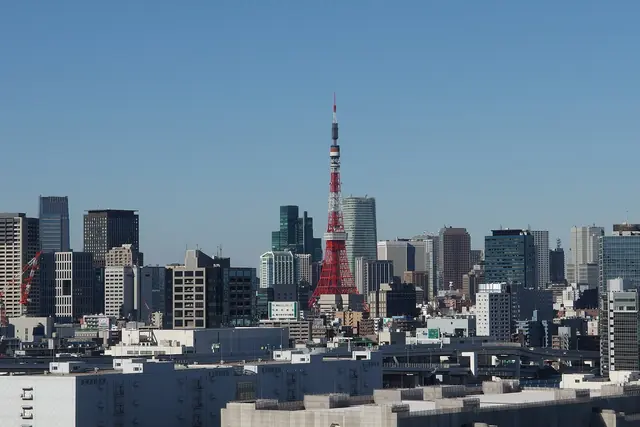
| North route | Westwards, the skyscrapers with Tokyo Tower among them; eastwards, Tokyo Skytree; the piers at Shibaura, Hinode and Takeshiba |
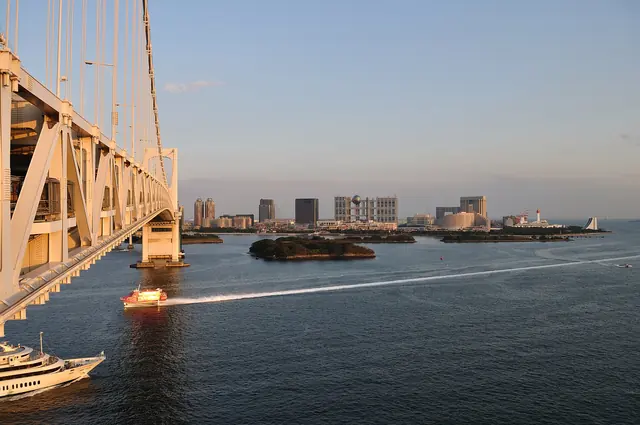
| South route | Odaiba Seaside Park and the buildings of Daiba; the shipping channel; the container piers at Shinagawa and Oi; Mt Fuji on a clear day |
The table combines JNTO's description with the bureau's pamphlet.
JNTO adds one picture from the south side, where "the shipping cranes look like giant birds". It also names the view over Odaiba Seaside Park as the most popular of the views from the bridge, and the pamphlet places that park on the south route. The bureau's New Year notice gives the south walkway one more point: the first sunrise of the year is seen from it.
Whether walkers can change from one route to the other part-way across is not stated on any official page found for this guide. Choose before you go up.
What the walkway is like
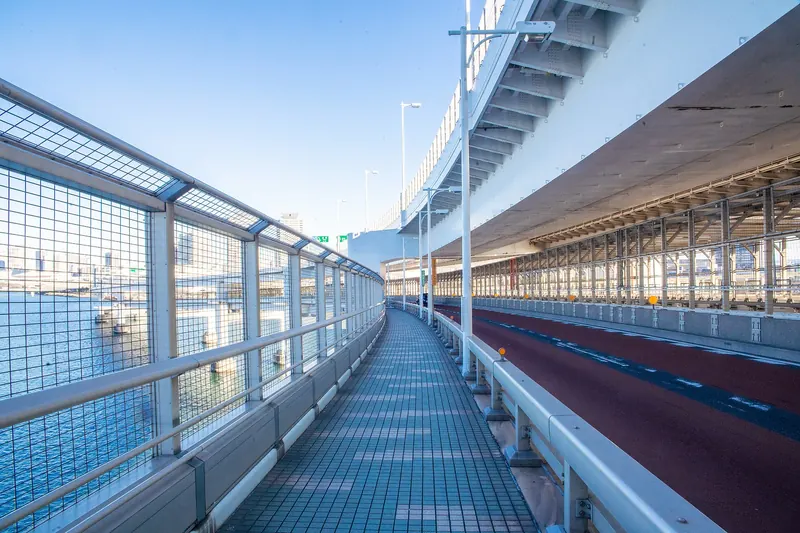
The walkway is roofed over, and its sides are closed in with wide wire mesh so that nothing can drop from the bridge. A phone camera fits between the wires easily enough, JNTO says, while a bigger lens struggles. The same page offers a way round that: "there are several observation balconies that provide a clearer view". On the north route, the deck at the middle carries a diagram that names the landmarks in front of you, and JNTO's other page mentions benches at the midpoint where people sit with the view.
The walk rises towards the centre. JNTO gives the figure: "The highest point of the pedestrian route is in the middle at 58m (190ft) high." Markers on the route tell you how far across you are.
You are not alone on this level. The walkways share the lower deck with the local road and the Yurikamome line, and the expressway runs overhead.
One line on the bureau's page is headed photography. It asks people to contact the office that manages the port roads and does not say what kind of shooting it has in mind. JNTO, for its part, writes about taking pictures with a smartphone through the mesh as an ordinary thing to do. This site reads the bureau's line as aimed at organised shoots rather than holiday snaps, but the page does not say so. Tripods are banned outright during the New Year's Eve opening.
Rules on the walkway: bicycles, pets, wheelchairs and running
These are the Bureau of Port and Harbor's rules, with JNTO's list where it adds something:
- Bicycles. Riding is not allowed. A bicycle can be pushed across on a trolley lent for the purpose, or folded or taken apart and carried in a bag made for it. JNTO adds that people with bicycles have to keep to the routes set for them, while walkers may take either side.
- Wheelchairs. Allowed. Because the walkway slopes steeply, the bureau asks wheelchair users always to come with a helper.
- Pushchairs. JNTO's list of rules says strollers are fine.
- Pets. Allowed only in a cage. A pet in a bag with its head out is not accepted. JNTO's list says simply no pets; the bureau's wording is the more detailed of the two, and this page follows it.
- Running. The bureau's page has no rule against it, and JNTO mentions the joggers who use the walkway.
- Toilets. At the Shibaura end only.
- Smoking. JNTO lists no smoking. The bureau's New Year notice says that smoking and drinking alcohol on the walkway are banned.
- Anything over the side. JNTO's list forbids throwing things from the bridge.
- Closing time. You have to be off the bridge by the time it closes, not merely through the gate.
When does Rainbow Bridge light up?
Every evening. Metropolitan Expressway Co. sets out the pattern on its page about the bridge: from roughly half an hour after sunset through to midnight, the main towers and the underside of the deck are lit across their whole surface, and the anchorages are lit at their base.
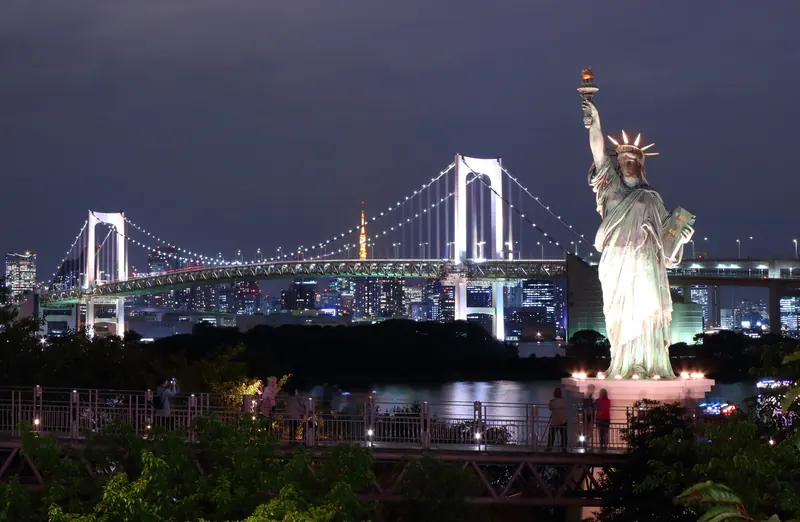
The colour of the towers changes with the season, and the cables do something different again:
- Towers, April to October. A cool white, which the company calls the summer pattern.
- Towers, November to March. A warm white, the winter pattern.
- Cables. A separate line of lights that changes with events, the day of the week and the hour. There is a weekday pattern for Monday to Friday, a weekend pattern for Saturday and Sunday, a public-holiday pattern and an event pattern that runs on a one-hour cycle.
Highlighting Japan, a magazine published by the Japanese government, names the cable colours as white, green and coral pink. Metropolitan Expressway says Rainbow Bridge was the first bridge in the world whose illumination changed between three colours.
The lamps themselves are new. The company replaced every one of the floodlights, which were about 30 years old, with LED units, and Highlighting Japan dates the completion of that work to 2020. The original lighting concept was kept, power use came down, and full-colour LED floodlights allow more varied displays than the old lamps did.
What time do the lights come on?
The company gives no clock time, only the rule: about 30 minutes after sunset. The table below does the sum for the 15th of each month, using the sunset times for Tokyo published by the National Astronomical Observatory of Japan. The third column is this site's own arithmetic, not an official switch-on time.
| Date | Sunset in Tokyo | Lights from about | Walkway closes |
|---|---|---|---|
| 15 October 2026 | 17:06 | 17:36 | 21:00 |
| 15 November 2026 | 16:35 | 17:05 | 18:00 |
| 15 December 2026 | 16:29 | 16:59 | 18:00 |
| 15 January 2027 | 16:51 | 17:21 | 18:00 |
| 15 February 2027 | 17:22 | 17:52 | 18:00 |
| 15 March 2027 | 17:48 | 18:18 | 18:00 |
| 15 April 2027 | 18:14 | 18:44 | 21:00 |
| 15 May 2027 | 18:39 | 19:09 | 21:00 |
| 15 June 2027 | 18:58 | 19:28 | 21:00 |
| 15 July 2027 | 18:57 | 19:27 | 21:00 |
| 15 August 2027 | 18:31 | 19:01 | 21:00 |
| 15 September 2027 | 17:49 | 18:19 | 21:00 |
Three things follow from the table:
- From April to October the lit walk is easy. The walkway stays open until 21:00. Even in mid-June, when the lights come on latest, that leaves roughly ninety minutes of lit bridge before closing.
- From November to January it is short. The lights come on between about 17:00 and 17:20, and the walkway closes at 18:00 with last entry at 17:30.
- In February and March it barely exists. In mid-February the lights come on eight minutes before closing, and in mid-March they come on after the walkway has shut.
What you see from the walkway after dark is the city more than the bridge. Highlighting Japan picks out Tokyo Tower and Tokyo Skytree, both lit, as the evening view from it. The lit bridge itself is seen best from the shore, and the places to stand are listed further down this page.
Why is Rainbow Bridge not rainbow-coloured?
Because the regular design is white. On an ordinary night the towers are lit white and only the lights along the cables change colour. The towers turn rainbow-coloured on special dates that are announced in advance, which is the subject of the next section.
The rainbow light-up in December
The rainbow comes out in December. In a release dated 25 November 2025, Metropolitan Expressway Co. announced a limited-period special light-up, held to promote the expressway and to liven up the Odaiba district that the bridge connects.
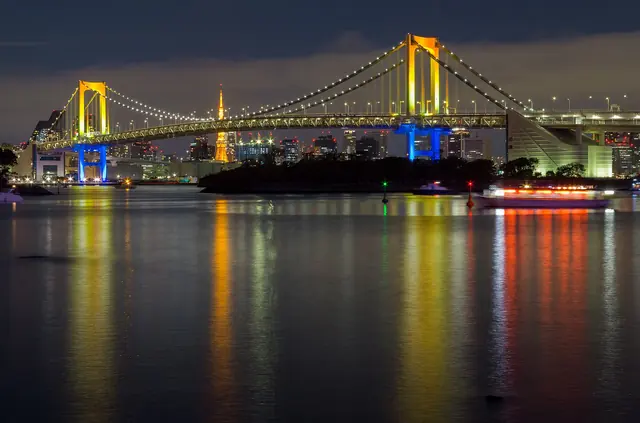
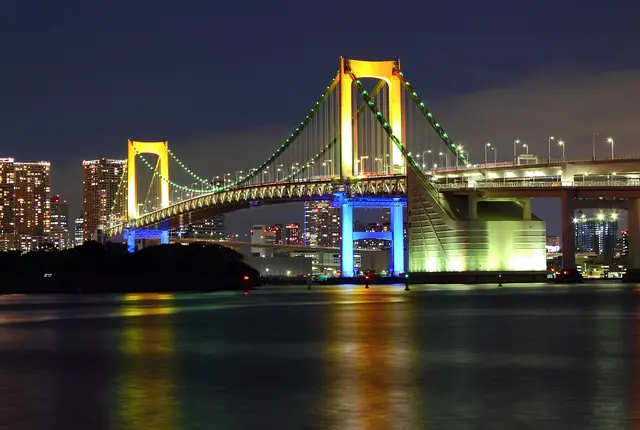
The release described the light-up as being held again that year, and the photograph that came with it showed the display of the year before. For the fireworks it gave no times and only pointed to a link, so this page gives none either.
As of 12 October 2026, the dates for December 2026 had not been announced. Last year's release came out on 25 November, so late November is the time to look at the company's news page. This site does not guess the dates.
The towers change colour at other times as well. On Saturday 16 and Sunday 17 May 2026 they were lit purple for an awareness day. On Friday 3 July 2026 the company held a special light-up to coincide with events around Odaiba; its notice, dated the same day, gave neither the colour nor the hours.
If your trip misses all of these, JNTO has a consolation: "The bridge and its views are quite beautiful even when illuminated in regular lights during the rest of the year."
New Year's Eve on Rainbow Bridge
On New Year's Eve the walkway does not close for the night. For 2025–26 the Bureau of Port and Harbor, in a notice posted on 15 December 2025, kept it open without a break from 10:00 on 31 December to 18:00 on 1 January. Up to 30 December and from 2 January the normal hours applied. The notice for 2023–24 set the same times.
The notice for 2026–27 had yet to appear by 12 October 2026, when this page was written. The last one was posted in mid-December, so read the bureau's notice before planning a night around it.
For that planning, 31 December 2026 is a Thursday and 1 January 2027 a Friday. The National Astronomical Observatory puts sunset in Tokyo on 31 December 2026 at 16:37 and sunrise on 1 January 2027 at 6:50. By the usual rule the lights would come on at about 17:07 and stay on until midnight. Whether they stay on later that night is not stated anywhere this guide looked.
Best views of Rainbow Bridge: where to stand
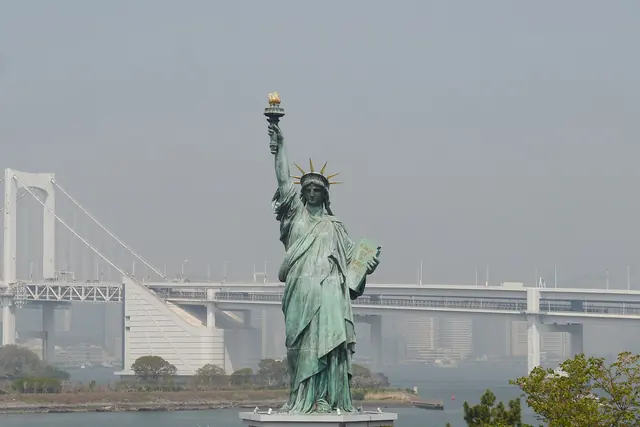
The walkway shows you the city. To look at the bridge itself you need to step back from it, and most of the places the official guides name are on the Odaiba shore:
| Place | What the official page says you see | Nearest station |
|---|---|---|
| Odaiba Seaside Park | The bridge, Tokyo Tower and the skyscrapers, from the beach, the lawn or the observation deck | Odaiba-kaihinkoen or Daiba, about 3 minutes |
| Decks Tokyo Beach, Seaside Terrace | The bay and the bridge; Mt Fuji far off on some clear days | Odaiba-kaihinkoen, 2 minutes |
| Telecom Center observatory | Tokyo Tower, the bridge and Tokyo Skytree from 99 m up | Telecom Center, directly connected |
| Toyosu Gururi Park | The bridge at sunset | Toyosu |
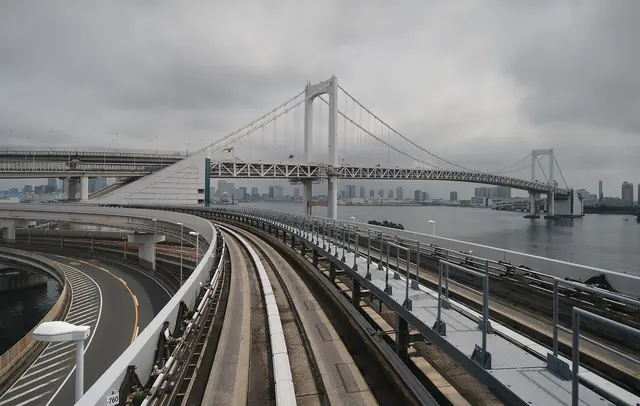
| The Yurikamome | The bridge from the train that crosses it | Any station on the line |
| A water bus | The bridge from the bay | Piers at Odaiba Seaside Park, Hinode and Asakusa |
Odaiba Seaside Park
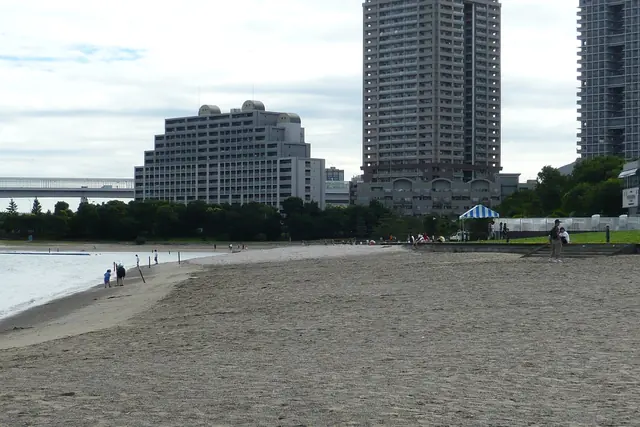
This is the park the walk across the bridge ends at. GO TOKYO's page on the park uses the name Odaiba Marine Park; it is the same place. Yurikamome Inc. describes a sandy beach and a rocky shore around an inlet, joined to Daiba Park, which was once the Third Battery. From it you look back at the bridge, Tokyo Tower and the skyscrapers behind them, and the company singles out the view at night. It suggests watching from the sand at the water's edge or from the lawn, or going up to the observation deck or the Skywalk.
JNTO puts the view in one line: "Spot Tokyo Tower and the Rainbow Bridge, both particularly impressive after dark." GO TOKYO agrees about the hour: "The best time to see it is at night, when it is illuminated, becoming one of Tokyo's most iconic landmarks."
Yurikamome and JNTO both put the park about three minutes on foot from Odaiba-kaihinkoen Station or Daiba Station. GO TOKYO says five from Odaiba-kaihinkoen. From the Rinkai Line's Tokyo Teleport Station, Yurikamome allows about ten.
The beach is for looking, not bathing. GO TOKYO says swimming is prohibited, and both guides mention windsurfing on the water in front of it.
The Statue of Liberty that turns up in so many photographs of the bridge stands here. GO TOKYO tells the story. The replica came in 1998 to mark Japan's ties with France and was meant to stand only for a while; it was liked so much that it was kept for good from 2000. The two guides disagree about its size. JNTO describes a statue 11 metres tall that weighs nine tons, and GO TOKYO's page on the park gives 12.5 metres. This page reports both figures rather than choosing between them.
A newer reason to stay until dark is Tokyo Aqua Symphony, a fountain show that opened at the park in March 2026. GO TOKYO describes jets as high as 150 metres along a front 250 metres wide, set to music and lights with the bay behind them. It is free, it runs every day and it needs no ticket or booking. The page sends readers to the show's own website for the schedule, so this guide gives no show times.
Decks Tokyo Beach
Decks Tokyo Beach, one of the shopping buildings GO TOKYO lists in Odaiba, faces the bay two minutes' walk from Odaiba-kaihinkoen Station and five from Tokyo Teleport. Yurikamome Inc. picks out its Seaside Terrace, which takes in the bay and the bridge together, and says Mt Fuji can sometimes be made out in the distance on a clear day. After sunset, the company adds, the lights of the ships join those of the bridge and Tokyo Tower.
The Telecom Center observatory
For height, Yurikamome Inc. points to the Telecom Center Building, a glass office block shaped like a gate at the south end of the waterfront district. Its observatory is on the 21st floor, 99 metres up, and has been recognised as a Japan Night View Heritage site, Nihon yakei isan (日本夜景遺産). The view covers Tokyo Tower, Rainbow Bridge, Tokyo Skytree and the Aomi pier, and the room has sofas, tables and free binoculars. The building is connected directly to Telecom Center Station on the Yurikamome line. Yurikamome's page lists neither an admission charge nor opening hours, so this site quotes none.
From the Yurikamome
The easiest moving view is the train. GO TOKYO's advice: "For a less strenuous perspective of the bridge, hop on the Yurikamome sky train." The line shares the lower deck with the road and the walkways, so the train crosses at the same level as the walk, without the walking.
At sunset: Toyosu and the water
For sunset, JNTO's page on crossing on foot looks east of Odaiba. Its first suggestion is Gururi Park in Toyosu, reached on foot after the crossing or from Toyosu Station. The walk from the Odaiba end runs past the Ariake Sports Center, left onto Route 484 and over Fujimi Bridge, and the page says it adds about 2 km. Its second suggestion is to be on the water, on a water bus or a bay cruise. On a clear day with the timing right, it says, Mt Fuji's outline shows behind the bridge.
See it before you go
We have made a four-minute video walk of the bridge and Odaiba. It is narrated and captioned in English and runs from the daytime view across the bay to the towers lit at night. More walks like it are on our page of video walks around Japan.

Rainbow Bridge facts: length, height, age and name
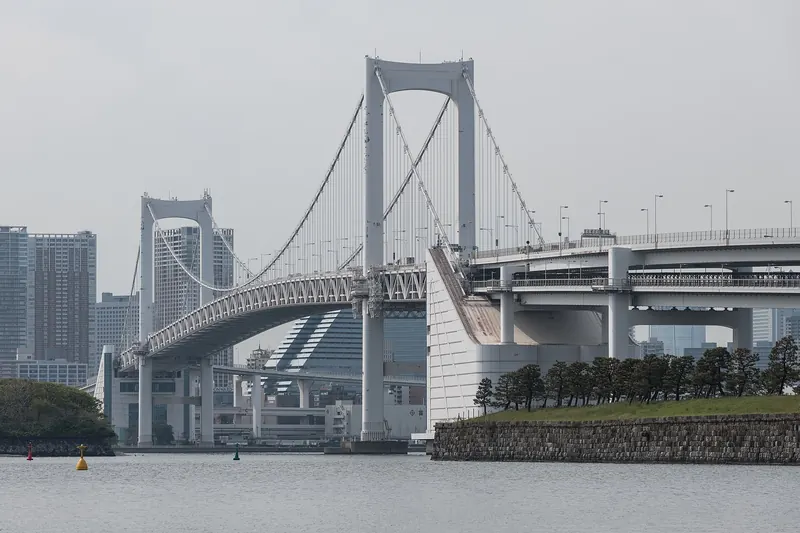
The figures below are Metropolitan Expressway Co.'s, apart from the two walkway lines, each of which names its own source.
How old is Rainbow Bridge?
Building began in January 1987. The opening followed on 26 August 1993, six and a half years later. It rained on the opening day, Metropolitan Expressway Co. records. Highlighting Japan noted the bridge's 30th anniversary in 2023.
The same magazine, quoting an official of the Bureau of Port and Harbor, describes the bridge as a joint project of the Tokyo Metropolitan Government and the Metropolitan Expressway Public Corporation, the body that has since become Metropolitan Expressway Co. The company's page explains what it was for. Expressway Route 11, the Daiba Line, was built to tie the new waterfront district to the centre of the city, and the bridge carries that line together with the port road and the Yurikamome.
Why is it called Rainbow Bridge?
The name came from the public. While it was being built the bridge was known as Tokyo-ko Renraku-kyo (東京港連絡橋), the Port of Tokyo connecting bridge. Metropolitan Expressway Co. says the leaflet for the naming appeal asked people to name a pure white bridge fit to be Tokyo's gateway from the sea. The appeal drew 20,023 entries, and the winning name was announced in November 1992, before the bridge opened.
Highlighting Japan gives the thought behind the choice: the name carried a hope that the bridge, like a rainbow, would lead on to the future. JNTO links the nickname to the rainbow colours of the December lights instead, and adds that "it is officially known as the Tokyo Bay Connector Bridge".
Why does it look the way it does?
Two neighbours shaped it: the port below and the airport nearby. JNTO puts the problem this way: "One of the challenges in creating the bridge was to make it high enough to allow large shipping vessels to pass underneath, but low enough for airplanes landing at Haneda airport."
Metropolitan Expressway Co. and Highlighting Japan fill in the rest:
- A suspension bridge. Large ships needed a wide channel through the port, and a suspension bridge kept that channel clear.
- Towers of limited height. The bridge stands near Haneda Airport, so a limit was set on how tall the main towers could be.
- Clean towers. Above the expressway deck the towers have no cross-beam all the way to the top, a shape the company says was chosen for its looks.
- White. Other colours were on the table, cherry-blossom pink and silver among them.
- The Shibaura loop. The approach on the mainland side curls round in a loop. The official quoted by Highlighting Japan explains that the access road had to be made longer because of the land use around it and the limit on how steep it could be.
- Deep foundations. The foundations sit on soft rock 46 metres below the sea. They were built by the pneumatic caisson method, on a scale the company describes as among the largest in the world at the time.
Seeing Rainbow Bridge from a water bus
A water bus gives the view from the bay, and it can double as the ride home from Odaiba. GO TOKYO's page on the city's cruise ships says the lines "all offer prime views of Tokyo landmarks such as TOKYO SKYTREE, Rainbow Bridge, and the unusually-shaped Asahi Group Headquarters Building".
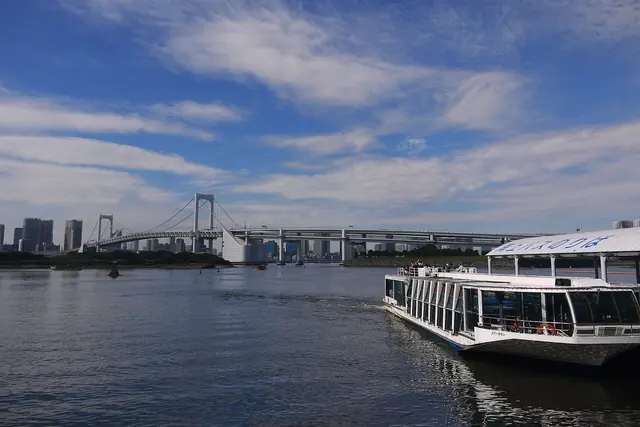
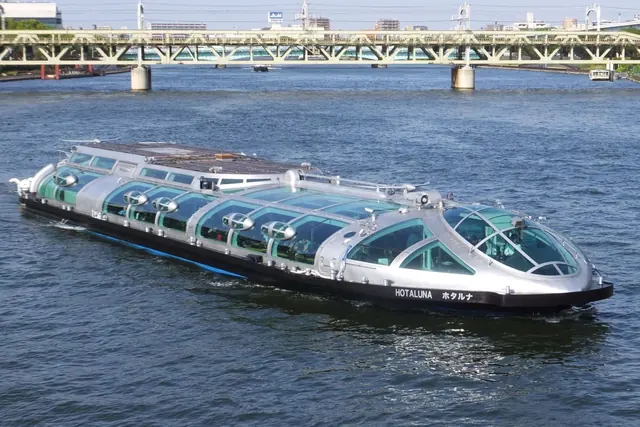
The boats that call at Odaiba Seaside Park belong to Tokyo Cruise. These are the routes and adult fares on GO TOKYO's page, which carries an update date of 1 September 2026:
| Line | Leg | Fare (child) | Time |
|---|---|---|---|
| Hotaluna | Hinode Pier to Odaiba Seaside Park | 1,000 yen (500 yen) | about 15 minutes |
| Hotaluna | Odaiba Seaside Park to Asakusa | 2,000 yen (1,000 yen) | about 60 minutes |
| Himiko | Asakusa to Odaiba Seaside Park | 2,000 yen (1,000 yen) | about 50 minutes |
| Emeraldas | Odaiba Seaside Park to Asakusa | 2,000 yen (1,000 yen) | about 55 minutes |
GO TOKYO lists roughly two departures a day on each of these three lines, so this is a boat to plan around, not one to turn up for. All three vessels were designed by the manga artist Leiji Matsumoto, the page says. The page also notes that the operator runs other routes, and it sends readers to the operator's own page on the day's operating status for the latest information.
Some practical points:
- The pier at Odaiba. Tokyo Cruise puts its Odaiba Seaside Park pier roughly a 5-minute walk from Daiba Station or Odaiba-kaihinkoen Station, and about 7 minutes from Tokyo Teleport.
- Hinode Pier. GO TOKYO puts it 8 minutes on foot from the South Exit of Hamamatsucho Station. The 15-minute hop from here to Odaiba is the shortest and cheapest of the legs in the table.
- The Sumida River Line. This line runs between Asakusa, Hama-rikyu Gardens and Hinode Pier, and does not go to Odaiba.
- Tokyo Mizube Line. GO TOKYO says the Asakusa-Odaiba Cruise of this second operator was suspended on 18 January 2026 because its vessels were ageing, with a restart planned for summer 2026. The page still carried that note when it was updated on 1 September 2026. Check with the operator before counting on it.
Which of these boats passes under the bridge, and how close each one comes to it, is not stated on any page this guide found. This site makes no promise about that.
Is Rainbow Bridge worth visiting?
For most people with a spare hour, yes. The reasons are simple ones.
- It is free. There is no ticket, no booking and no queue described on any official page.
- It is short. Twenty to thirty minutes of walking shows you the bay, the port and the skyline from the middle of the water.
- It ends somewhere. Start at Shibaura and the walk delivers you to a beach with the bridge behind you and Odaiba's shops in front.
- It lights up every night. You do not need a special date to see it lit.
There are honest reasons to skip the walk as well:
- Mesh. The sides of the walkway are closed in with wire mesh, so the photographs are better from the balconies and from the shore.
- Short winter hours. From November to March the gate shuts at 18:00, just as the lights are getting going.
- Closed days. The third Monday of the month is out, and strong wind can close the walkway on any day.
- The Shibaura end. JNTO says plainly that the area around that entrance is offices and warehouses.
- The slope. There is no lift on the Odaiba side, and the bureau asks wheelchair users to bring a helper.
If the walk does not appeal, the bridge still does. Ride the Yurikamome across it, get off at Odaiba-kaihinkoen and watch the lights come on from the beach. That costs a train fare and no effort.
This site's pick for a first visit is an evening between April and October. Go up at the Shibaura side an hour or so before sunset, cross in daylight, and be on the sand at Odaiba Seaside Park when the towers light. In winter, turn it round in time: be through the gate by about 17:00, cross in the last of the light, and watch the bridge from the shore afterwards.
Frequently asked questions
What is Rainbow Bridge in Tokyo?
A white suspension bridge with two decks across the north of Tokyo Bay, between Shibaura and Odaiba. An expressway runs along the top; a local road, the Yurikamome line and two walkways share the deck below.
Can you walk on Rainbow Bridge in Tokyo?
Yes. There is a walkway along each side of the lower deck and anyone can use it during opening hours. There is no charge and nothing to book.
How long does it take to walk across Rainbow Bridge?
The Tokyo Metropolitan Government's Bureau of Port and Harbor puts the 1.7 km between the two entrances at a walk of 20 to 30 minutes. JNTO gives joggers about 20 minutes and walkers 30 to 40 with stops for the view.
How long is Rainbow Bridge in Tokyo?
The suspension bridge is 798 metres long, with a centre span of 570 metres, in Metropolitan Expressway Co.'s figures. The walkway is longer, at 1.7 km, because it is measured from the Shibaura entrance to the Odaiba entrance.
How high is Rainbow Bridge?
The main towers stand 126 metres above the sea. JNTO puts the highest point of the walkway, at the middle of the bridge, at 58 metres.
How much does it cost to walk across Rainbow Bridge?
Nothing. There is no entrance fee and no ticket to buy. Drivers pay a toll on the expressway that uses the upper deck.
What are the opening hours of the Rainbow Bridge walkway?
In the warmer half, 1 April to 31 October, the gates open at 9:00 and close at 21:00, and the last entry is 20:30. In the winter half, 1 November to 31 March, the times are 10:00 and 18:00, and the last entry is 17:30. Walkers have to be off the bridge by closing time.
Which day is the Rainbow Bridge walkway closed?
Once a month, on the third Monday. If a public holiday lands on that day, the walkway shuts on the Tuesday instead. It can also close for strong wind, other bad weather or maintenance.
What time does Rainbow Bridge light up?
The lights come on about 30 minutes after sunset and go off at midnight, according to Metropolitan Expressway Co. By this site's sum that means about 17:36 in mid-October, 16:59 in mid-December and 19:28 in mid-June. For today's time, add half an hour to today's sunset in Tokyo.
Is Rainbow Bridge actually rainbow-coloured?
Not on most nights. Its everyday lighting is white: on an ordinary night the towers are white and only the line of lights on the cables changes colour. The towers are lit in rainbow colours on special dates that are announced beforehand.
When is Rainbow Bridge lit in rainbow colours?
In December, on evenings that Metropolitan Expressway Co. announces. In 2025 they were 6, 13, 20, 24 and 27 December, from 19:00 to midnight. The dates for December 2026 had not been announced as of 12 October 2026.
Can you walk across Rainbow Bridge at night?
From April to October, yes. The walkway stays open until 21:00 and the lights are on well before then. From November to March it closes at 18:00, which leaves about an hour of lit walking in December and none by mid-March.
How did Rainbow Bridge get its name?
The name was picked through a public naming appeal that drew 20,023 entries. It was announced in November 1992, nine months before the bridge opened.
What is the official name of Rainbow Bridge?
The official name in English, on JNTO's page, is Tokyo Bay Connector Bridge. During construction it was known as Tokyo-ko Renraku-kyo, the Port of Tokyo connecting bridge.
When was Rainbow Bridge built?
Construction started in January 1987, and the opening day was 26 August 1993.
Where is Rainbow Bridge in Tokyo?
Over the northern part of Tokyo Bay. One end is at Shibaura Pier on the mainland side and the other is at Odaiba.
Which station is nearest to Rainbow Bridge?
For the Shibaura entrance it is Shibaura-futo on the Yurikamome line, five minutes on foot by the bureau's pamphlet. For the Odaiba entrance it is Odaiba-kaihinkoen, also a Yurikamome stop, or the Rinkai Line's Tokyo Teleport.
Which side should you start the walk from?
The Shibaura side is the easier start, because a lift takes you up to the walkway and the toilets are there. The Odaiba side has a long slope and no lift.
Can you run on Rainbow Bridge?
The Bureau of Port and Harbor's page sets no rule against running, and JNTO mentions local joggers on the walkway. Runners are bound by the same opening hours and closed days as walkers.
Can you cycle across Rainbow Bridge?
Not in the saddle. A bicycle is pushed across on a trolley that is lent to you, or it is folded or taken apart and carried in a bag.
Can you take a dog across Rainbow Bridge?
Only inside a cage. The bureau does not accept a pet carried in a bag with its head showing.
Is the Rainbow Bridge walkway suitable for wheelchairs and pushchairs?
Wheelchairs are allowed, but the walkway is steep and the bureau asks wheelchair users to bring a helper. The Shibaura side has a lift and the Odaiba side does not. JNTO's list of rules says pushchairs are fine.
Are there toilets on Rainbow Bridge?
Only at the Shibaura end of the walkway. Shibaura-futo Station has toilets as well.
Where is the best view of Rainbow Bridge?
From the Odaiba shore. The official pages name Odaiba Seaside Park, the Seaside Terrace at Decks Tokyo Beach and the observatory in the Telecom Center Building, and JNTO suggests Toyosu Gururi Park for sunset.
Can you see Rainbow Bridge and Tokyo Tower together?
Yes, from Odaiba. Odaiba Seaside Park looks back at the bridge and Tokyo Tower, and the Telecom Center observatory has both in view from 99 metres up.
Can you see Mt Fuji from Rainbow Bridge?
On a clear day, from the south route, JNTO says. Yurikamome Inc. says the same of the Seaside Terrace at Decks Tokyo Beach.
Why is there a Statue of Liberty near Rainbow Bridge?
GO TOKYO explains that the replica came in 1998 to honour Japan's ties with France and was only meant to stay for a time; it was made permanent in 2000. It stands in Odaiba Seaside Park, with the bridge behind it.
Is Rainbow Bridge open on New Year's Eve?
In recent years the walkway has stayed open through the night. For 2025–26 it was open without a break from 10:00 on 31 December to 18:00 on 1 January. The notice for 2026–27 had not been published as of 12 October 2026.
Is there a boat tour that passes Rainbow Bridge?
Tokyo Cruise water buses call at Odaiba Seaside Park, and GO TOKYO says the city's cruise lines give views of the bridge. The shortest leg, from Hinode Pier, costs 1,000 yen and takes about 15 minutes. Which boats pass under the bridge is not stated on the pages this guide found.
Is there a live camera of Rainbow Bridge?
Not that this guide could find on the official pages it used.
Can you drive across Rainbow Bridge?
Yes. The upper deck is a toll expressway and the lower deck carries a local road. Mopeds of 50 cc or less are not allowed on the roadway, and neither walkway entrance has a car park. No toll figure is given on this site.
Is it worth walking across Rainbow Bridge?
For most visitors with a spare hour, yes. The walk is free and short and it finishes at a beach. Those who would sooner not walk can cross on the Yurikamome and watch the lit bridge from Odaiba Seaside Park.
Sources
Official and primary sources used for this page. Checked October 12, 2026.
- Tokyo Metropolitan Government, Bureau of Port and Harbor: Rainbow Bridge (in Japanese) — the walkway's length and walking time, its hours and closed days, the rules for bicycles, wheelchairs and pets, the toilets, the lack of a car park and the moped rule
- Tokyo Metropolitan Government, Bureau of Port and Harbor: レインボーブリッジ RAINBOW BRIDGE, pamphlet, May 2011 edition (PDF, in Japanese) — the walking times from Shibaura-futo and Tamachi stations and what each route looks out on
- Tokyo Metropolitan Government, Bureau of Port and Harbor: 東京都港湾局管理施設の年末年始の特別開場・開園について, 15 December 2025 (in Japanese) — the date of the 2025–26 New Year notice
- Tokyo Metropolitan Government, Bureau of Port and Harbor: 年末年始のお知らせ レインボーブリッジ(遊歩道) 東京ゲートブリッジ(歩道), 2025–26 (PDF, in Japanese) — the New Year opening hours and rules, the first sunrise from the south walkway and the note on parking
- Tokyo Metropolitan Government, Bureau of Port and Harbor: 年末年始のお知らせ レインボーブリッジ(遊歩道) 東京ゲートブリッジ(歩道), 2023–24 (PDF, in Japanese) — the same times in the notice of two years earlier
Show all 27 sources
- Tokyo Metropolitan Government, Bureau of Port and Harbor: トピックス (in Japanese) — the list of notices, which had no New Year notice for 2026–27 on 12 October 2026
- Metropolitan Expressway Co.: レインボーブリッジ (in Japanese) — the length, centre span and tower height, the dates of construction and opening, the naming appeal, the towers, the colour, the foundations and the lighting pattern
- Metropolitan Expressway Co.: レインボーブリッジ景観照明LED化 (in Japanese) — the replacement of the old floodlights with LED units
- Metropolitan Expressway Co.: 今年もレインボーブリッジスペシャルライトアップを実施します, 25 November 2025 (in Japanese) — the dates and hours of the 2025 rainbow light-up and the fireworks held on the same days
- Metropolitan Expressway Co.: HAEDAYにレインボーブリッジをパープルライトアップします, 14 May 2026 (in Japanese) — the purple light-up of 16 and 17 May 2026
- Metropolitan Expressway Co.: レインボーブリッジの特別ライトアップを実施します, 3 July 2026 (in Japanese) — the special light-up of 3 July 2026
- Yurikamome Inc.: レインボーブリッジ (in Japanese) — free admission to the walkway and the nearest stations
- Yurikamome Inc.: 芝浦ふ頭 駅・時刻表 (in Japanese) — the facilities at Shibaura-futo Station and the order of the stations on the line
- Yurikamome Inc.: 臨海副都心のビュースポット (in Japanese) — Odaiba Seaside Park, the Seaside Terrace at Decks Tokyo Beach and the Telecom Center observatory
- JNTO: Rainbow Bridge — the official name, the December colours, the benches at the midpoint and the advice on choosing a side
- JNTO: Crossing Rainbow Bridge on Foot — the two routes and their views, both entrances, the walking times, the list of rules, the mesh and the balconies, and the sunset suggestions
- JNTO: Odaiba Seaside Park — the park's view after dark, the walk from the stations and the size of the Statue of Liberty replica
- GO TOKYO: A guide to Odaiba — the routes from Tokyo and Shinjuku stations, the walking time, the Yurikamome view, the Statue of Liberty's history, Tokyo Aqua Symphony and Decks Tokyo Beach
- GO TOKYO: Odaiba Marine Park — the bridge at night, the no-swimming rule, the statue's height and the walk from the station
- GO TOKYO: Cruise Ships & Waterbuses — the water-bus lines, fares and times, the vessels' designer and the Tokyo Mizube Line suspension
- GO TOKYO: Tokyo Cruise Hinode Pier — the walk from Hamamatsucho Station to the pier
- Tokyo Cruise: Odaiba Seaside Park — the walking times from the stations to the pier at Odaiba
- Highlighting Japan (Government of Japan), March 2024: The Rainbow Bridge, A Symbol of Tokyo — the joint project, the thought behind the name, why a suspension bridge and a loop were chosen, the cable colours, the LED work and the evening view from the walkway
- National Astronomical Observatory of Japan: 日の出入り@東京(東京都) 令和 8年(2026)10月 (in Japanese) — sunset in Tokyo on 15 October 2026; the pages for the months that follow in the same series, to September 2027, gave the rest of the table
- National Astronomical Observatory of Japan: 日の出入り@東京(東京都) 令和 8年(2026)12月 (in Japanese) — sunset on 15 and 31 December 2026
- National Astronomical Observatory of Japan: 日の出入り@東京(東京都) 令和 9年(2027)01月 (in Japanese) — sunrise on 1 January 2027 and sunset on 15 January 2027
- Cabinet Office: National holidays — the 2026 and 2027 holiday dates used to work out the closed days
Related guides
To cite or link to this page: Rainbow Bridge in Tokyo: walking across, walkway hours, the light-up and the best views — Japan Pocket Guide, https://japanpocketguide.com/things-to-do/rainbow-bridge-tokyo/