Things to do · Resorts
Greenpia Onuma, Hokkaido: the ski slopes, the onsen, rooms, prices and how to get there
Greenpia Onuma is a hotel, onsen and ski resort in the town of Mori in southern Hokkaido, on grounds of 4.39 million square metres facing Mt Komagatake. This guide covers where it is and how to reach it by car, by train and by the free shuttle; the ski area, its 2026-27 season and its lift tickets; the onsen hall, its hours and its prices for day visitors; hotel rooms, capsules, dome tents, villas and camp sites; the restaurants; and the ticket system for the outdoor activities. Hours, prices and dates are those on the resort's official Japanese and English pages, read on 13 October 2026, and the photographs are this site's own from the same day. The section before the FAQ lists what will change first.
Last checked · Sources

In short
Greenpia Onuma (LiveMax Resort Hakodate Greenpia Onuma) is in Mori Town, Hokkaido, about 50 minutes by car from Hakodate and about 10 minutes from Onuma Park. It has an 82-room hotel, an onsen hall open to day visitors for 1,000 yen per adult, an indoor pool, three camp sites and a ski area with six courses and two pair lifts. The 2026-27 ski season is planned to run from 25 December 2026 to 7 March 2027, and an adult's one-day lift ticket costs 5,500 yen. Guests staying the night can book a free shuttle from Shin-Hakodate-Hokuto and Onuma-Koen stations by 18:00 on the day before.
Where is Greenpia Onuma?
Greenpia Onuma is in the town of Mori in southern Hokkaido, about 50 minutes by car from Hakodate on the road towards Sapporo and about 10 minutes by car from Onuma Park. Its full name, LiveMax Resort Hakodate Greenpia Onuma, sends some visitors looking for it inside the city of Hakodate; the address the resort itself gives is Akaigawa, Mori Town, in Kayabe District. The resort's English site puts the scale first: "Greenpia Onuma is a resort hotel located in Hakodate, Hokkaido with a vast area of 4.39 million square meters."
The resort in four numbers
- 4.39 millionsquare metres of grounds
- 82rooms in the hotel building
- 600free parking spaces, roughly
- 3camp sites
Those grounds hold a hotel block, an onsen hall that also takes day visitors, an indoor pool, log-house villas, dome tents, camp sites and a ski area. Mt Komagatake, the volcano in this site's photographs, is the view the hotel is turned towards.
| Item | What the resort's pages say |
|---|---|
| Address | Akaigawa 229, Mori Town, Kayabe District, Hokkaido |
| Grounds | 4.39 million square metres |
| Hotel building | 82 rooms |
| Check-in and check-out | 15:00 and 10:00 |
| Car park | about 600 spaces, free |
| By car from Hakodate | about 50 minutes |
| By car from Onuma Park | about 10 minutes |
| Paying | cash, credit cards and electronic money |
For the rest of the prefecture, from Hakodate to the far north, see this site's Hokkaido page.
Greenpia Onuma in photos: the resort in mid-October
In the middle of October the resort sits between its two seasons. The outdoor activities are down to weekends and public holidays, the ski slope is still grass, and the hill beside the hotel is changing colour. This site's photographs were all taken between 14:30 and 14:50 on 13 October 2026.
What the photographs show
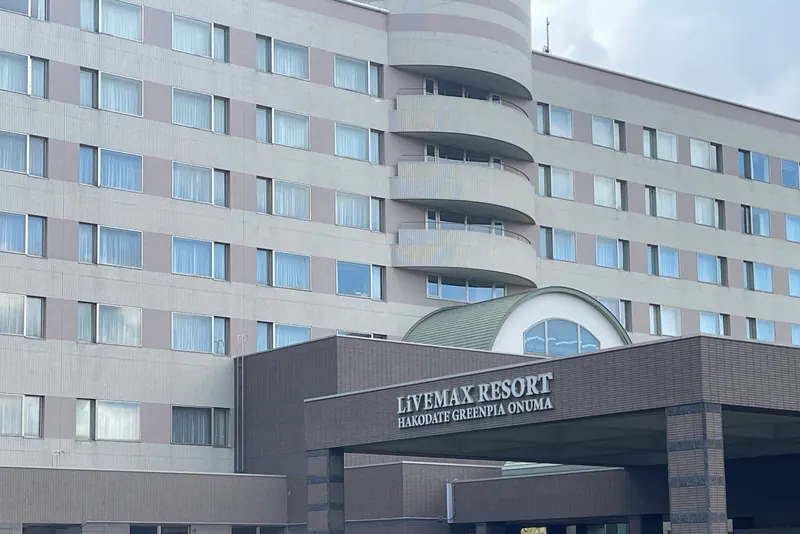
- Hotel building: a long multi-storey block with a round tower, set behind a lawn
- Entrance: a canopy carrying the name LiveMax Resort Hakodate Greenpia Onuma
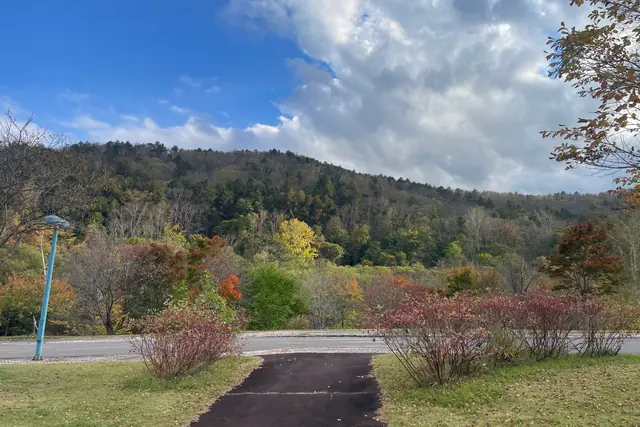
- Hillside: trees going yellow and orange, with red shrubs at the edge of the lawn
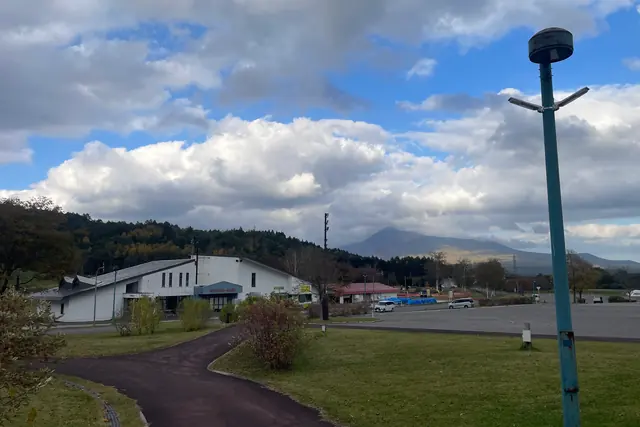
- Mt Komagatake: visible from the grounds, its summit partly in cloud that afternoon
- Ski slope: green, with no snow on it yet
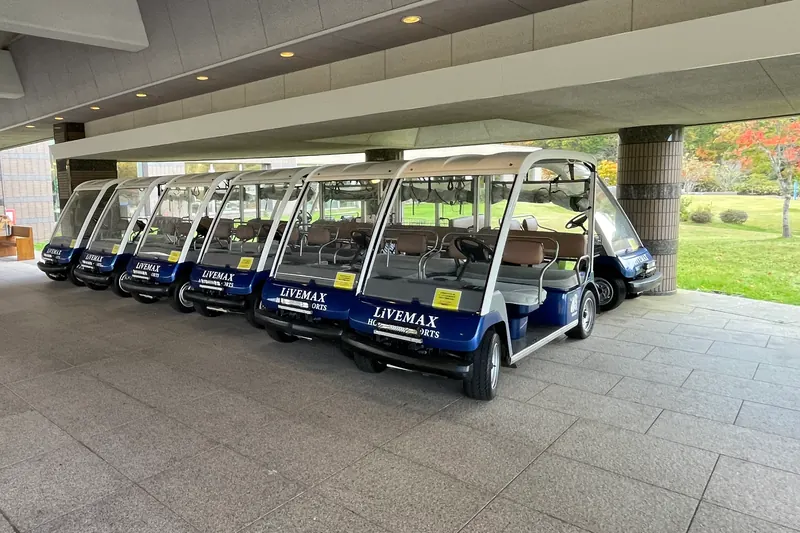
Under the entrance canopy a row of open electric carts stood parked, blue and white with brown bench seats. The canopy is also where the resort's access page puts its covered parking for motorbikes, for up to eight machines, or about ten bicycles.
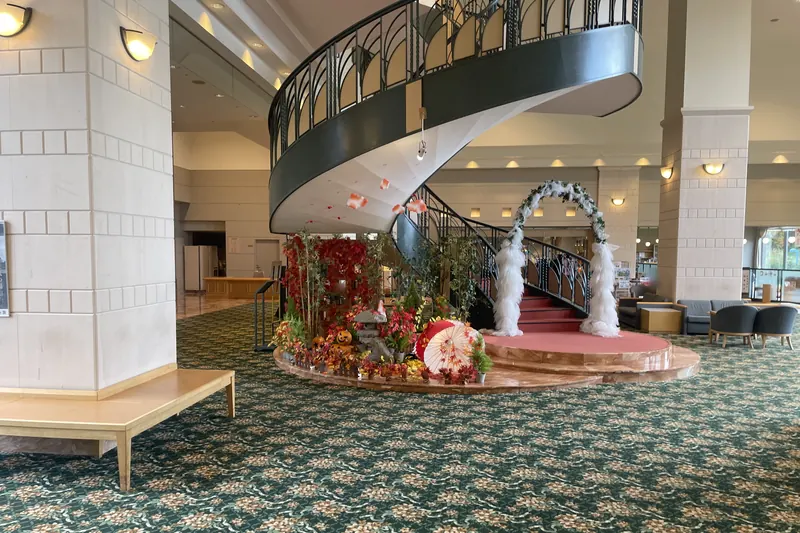
Inside, the lobby had been dressed for autumn: red maple leaves, a stone lantern and a paper parasol arranged beside a spiral staircase, with a white floral arch on a round red stage. The resort's FAQ places the front desk on the floor numbered 2F. Its facilities page lists two things in the entrance hall that a visitor may want:
In the hotel's entrance hall
- Hotel shop: drinks and souvenirs, 8:00 to 21:00, with hours that shift a little by season
- Coffee lounge: free coffee for guests staying the night, 9:00 to 11:00 and 14:00 to 17:00
The facilities page also says the resort has been through a full renewal. The dated pieces of it on the pages read are the onsen hall's lounge and its restaurant in July 2024, the villas and the capsule rooms in August 2024, and the dome tents in September 2024.
How to get to Greenpia Onuma
Most visitors come by car, and the resort is laid out for that: roughly 600 free spaces, with the main car park in front of the hotel. Without a car the usual route is a train to Onuma-Koen Station and then a taxi of about 15 minutes. Guests staying the night have a third choice, a free shuttle from Shin-Hakodate-Hokuto Station, where the Shinkansen from Tokyo arrives.
Three ways in
- Car: about 50 minutes from Hakodate
- Train and taxi: about 55 minutes from Hakodate Station
- Free shuttle: about 50 minutes from Shin-Hakodate-Hokuto Station, staying guests only
By train, bus and plane
The Japanese and English access pages give these routes. Where the total is blank, the page gives only the separate legs.
| From | Route | Total |
|---|---|---|
| Hakodate Station | JR train to Onuma-Koen Station, about 40 minutes, then a taxi, about 15 minutes | about 55 minutes |
| Hakodate Airport | shuttle bus to Onuma-Koen Station, about 1 hour 10 minutes, then a taxi, about 15 minutes | about 1 hour 25 minutes |
| Sapporo Station | limited express Hokuto to Onuma-Koen Station, about 3 hours 20 minutes, then a taxi, about 15 minutes | about 3 hours 35 minutes |
| New Chitose Airport | train to Minami-Chitose, then the limited express Hokuto to Onuma-Koen Station, about 3 hours, then a taxi, about 15 minutes | |
| Tokyo Station | Shinkansen Hayabusa to Shin-Hakodate-Hokuto Station, about 4 hours 15 minutes, then a taxi, about 25 minutes |
From Tokyo by air, the English page puts the flight from Haneda at about 1 hour 20 minutes to Hakodate and about 1 hour 30 minutes to New Chitose. This site has separate guides to buying Shinkansen tickets, to domestic flights and to taxis in Japan.
The free shuttle for guests staying the night
The English access page is brief about who may ride: "A free shuttle bus is available for hotel guests only." The bus starts at Shin-Hakodate-Hokuto Station, calls at Onuma-Koen Station and takes about 50 minutes over the whole run. The table gives the time it leaves each station.
| Shin-Hakodate-Hokuto | Onuma-Koen |
|---|---|
| 11:00 | 11:20 |
| 12:25 | 12:45 |
| 14:05 | 14:25 |
| 15:30 | 15:50 |
Going back, buses leave the resort for both stations at 10:00, 13:20 and 16:30.
Booking and boarding the shuttle
- Book by 18:00 on the day before, by e-mail or telephone, through the shuttle page on the resort's site.
- At Shin-Hakodate-Hokuto Station, leave by the north exit and wait at the car park outside the front entrance on the ground floor.
- At Onuma-Koen Station, wait outside the station building.
- Tell the hotel if plans change and the seat is no longer needed.
The same page carries one more line that matters on a 50-minute ride: "Note: No restroom breaks on the way." The Japanese page adds that the times are a guide rather than a promise and that pets cannot ride.
By car
Driving from Hakodate
- Take Route 5 towards Sapporo for about 30 km, passing Onuma Quasi-National Park.
- Turn left at the junction in Akaigawa, Mori Town, signed for Greenpia Onuma and road 149. A convenience store stands on the left just before it.
- Follow prefectural roads 149 and 843 for about 2.7 km to the resort.
From Sapporo the access page says about 4 hours: the Do-o Expressway to the Onuma-Koen interchange, a right turn at the junction signed for Greenpia Onuma and road 843, and about 2 km more. The resort's FAQ gives a shorter figure for the same trip, a little over 3 hours.
Parking at the resort
- Cars: about 600 spaces, free
- Electric cars: a paid charging point beside the hotel
- Motorbikes: covered spaces for up to 8 under the entrance canopy
- Map code for car navigation: 490 282 798*64
Visitors hiring a car will find the basics in this site's guides to renting a car in Japan and to driving in Japan.
How far Greenpia Onuma is from other places
The FAQ lists driving times from the resort. They show how large Hokkaido is: Furano's lavender fields are about five hours away.
| Place | By car |
|---|---|
| Onuma Park | about 10 minutes |
| Shin-Hakodate-Hokuto Station | about 20 minutes |
| Centre of Mori Town | about 20 minutes |
| Hakodate Station | just under 1 hour |
| Hakodate Airport | about 1 hour |
| Lake Toya | 1 hour 40 minutes |
| Muroran | just over 2 hours |
| New Chitose Airport | about 2 hours 40 minutes |
| Tomakomai | 2 hours 40 minutes |
| Sapporo | just over 3 hours |
| Otaru | 3 hours 30 minutes |
| Furano | about 5 hours |
| Asahikawa | 5 hours 30 minutes |
Shops, cash and phones nearby
The resort is in the countryside, and its FAQ is plain about what is not next door. The English FAQ says of money: "There are no banks close by."
What the FAQ says is nearby
- A convenience store about 5 minutes away by car
- No chemist nearer than the centre of Mori Town or the area around Shin-Hakodate-Hokuto Station
- One clinic, near Onuma-Koen Station
- Good mobile phone signal on the grounds
The resort takes cash, credit cards and electronic money. For where to draw yen before leaving a city, see this site's guides to ATMs in Japan and to cash or card.
Greenpia Onuma ski resort: season, courses and lift tickets
The ski area is a small one on the resort's own hill: six courses, two pair lifts and a free snow escalator, between 182 metres at the base and 442 metres at the top. The 2026-27 season is planned to run from Friday 25 December 2026 to Sunday 7 March 2027, and an adult's one-day lift ticket is listed at 5,500 yen. The resort's English ski page says who the hill is meant for: "Greenpia Onuma has six ski slopes that can be enjoyed by everyone from beginners to advanced skiers."
The ski area in four numbers
- 442metres at the top
- 182metres at the base
- 6courses
- 2pair lifts
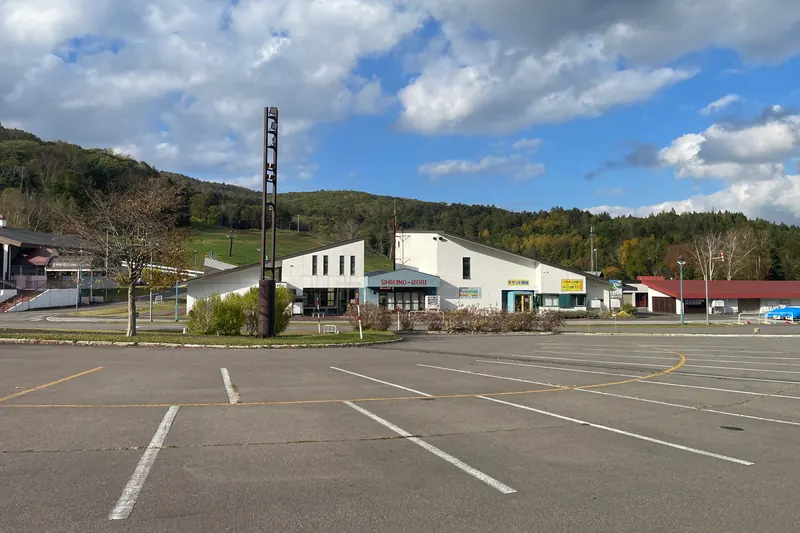
On 13 October 2026 the slope was still grass. This site's photograph shows it rising behind an empty car park, with the white Shiki no Mori building and a red-roofed lodge at its foot.
Season and opening hours
The 2026-27 season as the resort lists it
- Season: Friday 25 December 2026, marked as planned, to Sunday 7 March 2027
- Daytime: 9:00 to 17:00, every day
- Night skiing: Fridays and Saturdays, 17:00 to 20:45
- Last season: ended on Sunday 8 March 2026
The opening date carries the word planned on the Japanese ski page. The English ski page still shows the opening date of an earlier winter, and notes beside it that the date depends on how much snow has fallen, so the dates here are the Japanese page's. A status block lower on the Japanese page gives the night session as 17:00 to 21:00, with the last lift at 20:45.
The courses
The course table on the English ski page has seven names, although both language versions give the number of courses as six. This site does not know how the count is made, and the table below repeats the names, levels, steepest gradients and lengths as that page lists them.
| Course | Level | Steepest slope | Length |
|---|---|---|---|
| Family road | beginner to intermediate | 14 degrees | 1,200 m |
| Milky way | beginner to intermediate | 17 degrees | 550 m |
| Panorama course | beginner to intermediate | 22 degrees | 800 m |
| Romance course | beginner | 17 degrees | 800 m |
| Skyway | intermediate to advanced | 30 degrees | 400 m |
| Cosmic course | advanced | 24 degrees | 560 m |
| Super advanced course | advanced | 26 degrees | 200 m |
The longest run, Family road, covers 1,200 metres and never passes 14 degrees; the steepest, Skyway, reaches 30 degrees over 400 metres. Both language versions also mention a separate slope for children. It describes the view from the top like this: "From the top of the mountain, you can see not only beautiful Mt. Komagatake, Lake Onuma and Lake Konuma, but also Uchiura Bay and Mt. Yotei in the distance."
The lifts
Two pair lifts, with chairs for two, carry skiers up the hill, and beginners have a moving walkway on the snow. The English page puts it in one sentence: "Greenpia Onuma ski resort has two pair lifts and a free snow escalator that is safe for children."
| Lift | Length | Daytime | Night |
|---|---|---|---|
| Pair lift 1, Rainbow | 690 m | 9:00–16:30 | 17:00–20:45 |
| Pair lift 2, Aurora | 483 m | 9:00–16:00 | none |
The lift page gives 16:00 as the end of the day for lift 2, while the status block on the ski page gives 16:20; plan around 16:00. On evenings the English page says: "Lift 1 is open for night skiing on weekends." The hours line on the Japanese page is more exact, naming Fridays and Saturdays.
The ski-school page explains what the snow escalator is for. Beginners can start without the worry of getting on and off a chairlift.
Lift ticket prices
Lift tickets are sold at the Shiki no Mori Ticket Center, which the FAQ places right in front of the ski area, and unused tickets are not refunded. Guests staying at the resort pay 10% less. The prices below are those on the resort's Japanese lift page on 13 October 2026. The page carries no label saying which winter they belong to, so look at it again before opening day.
Prices for day visitors:
| Ticket | Adult | Primary-school pupil | Student or senior |
|---|---|---|---|
| One day | 5,500 yen | 2,500 yen | 4,500 yen |
| 4 hours | 4,700 yen | 2,300 yen | 3,700 yen |
| 2 hours | 3,700 yen | 1,900 yen | 2,900 yen |
| Book of 11 rides | 4,500 yen | 3,000 yen | 3,500 yen |
| Single ride | 450 yen | 300 yen | 350 yen |
| Night | 2,000 yen | 800 yen | 1,500 yen |
Prices for guests staying at the resort:
| Ticket | Adult | Primary-school pupil | Student or senior |
|---|---|---|---|
| One day | 4,950 yen | 2,250 yen | 4,050 yen |
| 4 hours | 4,230 yen | 2,070 yen | 3,330 yen |
| 2 hours | 3,330 yen | 1,710 yen | 2,610 yen |
| Book of 11 rides | 4,050 yen | 2,700 yen | 3,150 yen |
| Single ride | 400 yen | 270 yen | 310 yen |
| Night | 1,800 yen | 720 yen | 1,350 yen |
Reading the ticket tables
- The one-day ticket is not valid for night skiing
- The 4-hour and 2-hour tickets can be used at night
- Student covers junior high school, high school, vocational school, junior college and university
- Senior means 60 and over
The youngest children need no ticket at all. The English page: "Preschoolers can use lifts free of charge." The FAQ adds that guests who ski on the day they check out can leave their luggage at the hotel's front desk.
Season pass
A season pass costs less the earlier it is bought, and the lift page says it is also valid for the weekend night sessions.
| Bought in | Discount | Adult | Primary-school pupil | Student or senior |
|---|---|---|---|---|
| August | 20% | 30,400 yen | 23,200 yen | 26,400 yen |
| September | 15% | 32,300 yen | 24,650 yen | 28,050 yen |
| October | 10% | 34,200 yen | 26,100 yen | 29,700 yen |
| November | 5% | 36,100 yen | 27,550 yen | 31,350 yen |
| After that | none | 38,000 yen | 29,000 yen | 33,000 yen |
Applying for a season pass
- Bring three things: the application form, the fee in cash or by credit card, and one face photograph 3 cm high and 2.5 cm wide.
- Hand them in at the hotel's front desk or at the Shiki no Mori Ticket Center.
- Collect the pass at the lift-ticket counter from opening day onwards.
Rental, lessons and snow play
Visitors who do not ski still have something to do on the snow, and those who do can arrive without equipment.
What else the ski area offers
- Rental: ski and snowboard sets, wear and sledges; 20% off for guests staying at the resort, 30% off for people taking a lesson
- Lessons: ski, snowboard and children's lessons from certified instructors; preschool children can join from the age of 5
- Sledging: two hours of unlimited play at 2,000 yen a person, or 1,600 yen for staying guests; a sledge alone is 500 or 800 yen, or 400 or 640 yen for staying guests
- Snow scoot: a bicycle built for snow, 2,500 yen an hour, or 2,000 yen for staying guests
The English page places the rental counter at the entrance to the slopes. The Japanese pages give no prices for renting skis, boards or wear; the English page does list some, but beside the dates of an earlier winter, so this site does not quote them. For a break from skiing, the Japanese ski page points to the resort's two restaurants, which are covered further down this page.
The onsen at Greenpia Onuma: hours, prices and rules
The onsen hall, called Hottopia, takes day visitors from 6:00 to 9:30 and from 11:00 to 21:00 at 1,000 yen per adult, and is free for guests staying at the resort. It has an open-air bath, a large indoor bath and a sauna. The English hot-spring page introduces it this way: "Hottopia, a hot spring recreation facility in Greenpia Onuma, offers baths with natural hot spring water."
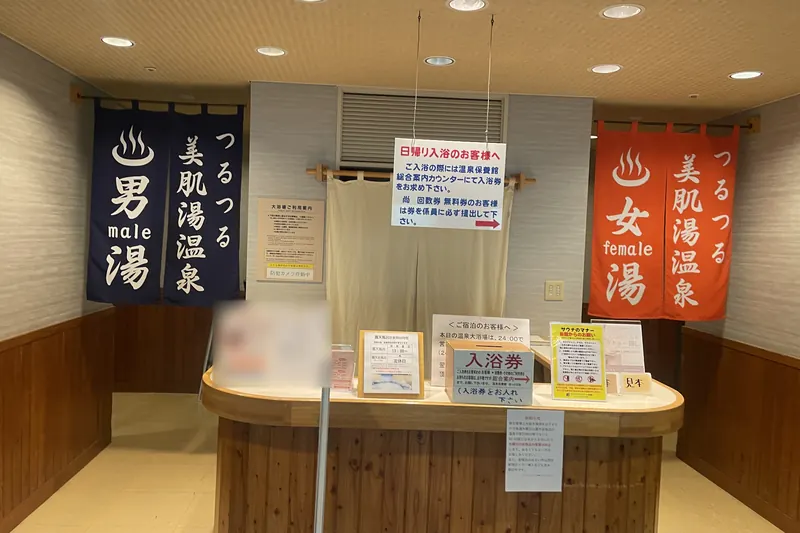
At the entrance to the baths on 13 October 2026, two noren curtains hung side by side, navy for men and orange for women, beside a counter with a box for bathing tickets. A sign told day bathers to buy their ticket at the hall's information counter first.
Opening hours
Whoever the bather is, the baths shut for an hour and a half in the morning, from 9:30 to 11:00.
| Who | Hours | Notes |
|---|---|---|
| Hotel guests | 5:30–9:30 and 11:00–24:00 | the sauna keeps the same hours |
| Guests in the villa area | 6:00–9:30 and 11:00–22:00 | |
| Camp guests | 13:00–21:00 on the day of arrival, 6:00–9:30 the next morning | last entry 20:00 and 8:30 |
| Day visitors, early | 6:00–9:30 | reception at the hotel's front desk, last entry 8:30 |
| Day visitors, daytime | 11:00–21:00 | reception at the onsen hall, last entry 20:00 |
Guests staying at the resort bathe free for the whole stay, and the FAQ says that covers the hours before check-in and after check-out too.
Prices for day visitors
| Bather | General price | Residents of Mori Town |
|---|---|---|
| Adult | 1,000 yen | 800 yen |
| Senior (60 and over) or student | 900 yen | 700 yen |
| Child (age 3 to primary school) | 500 yen | 400 yen |
Extras at the counter
- Book of 10 tickets: 7,000 yen for adults, 6,000 yen for seniors and students, 3,000 yen for children, at the general price
- Towel rental: 220 yen for a bath towel, 110 yen for a face towel
- Hand towel to keep: the resort's own design, 240 yen
- Proof to show: ID for the senior and resident prices, a student card for the student price
Hotel guests do not pay for towels; the FAQ asks them to bring the ones from their room. The hand towel on sale is a tenugui, the thin cotton cloth that Japanese bathers carry.
The baths
The baths in the hall
- Open-air bath: an outdoor bath with greenery around it
- Large indoor bath: a jacuzzi, a bubble bath and a bath for lying down in
- Falling-water bath: warm water dropping from above, in the large bath
- Sauna: built of hiba wood, which the English page calls Aomori cypress
The falling-water bath is an utaseyu, a fixture of older Japanese bath houses. The spring is named Shukunobe no Yu, and the Shukunobe River is the one that runs through the resort's grounds. The English page gives the water's type as "Sodium-hydrogencarbonate spring (hypotonic, alkaline, high temperature)". Only one bath is fed straight from the source: the Japanese FAQ says the open-air bath alone is free-flowing, and that the water in the other baths is circulated and heated. The same FAQ says the water is not for drinking.
The washing area has shampoo, conditioner, body soap and a baby chair. The changing room has free coin lockers, hair dryers, a baby bed and massage machines. A phone app, opened from a QR code posted in the hall, shows how crowded the large bath is at that moment.
Rules for bathers
The English FAQ is blunt on two points. On pregnancy: "Expectant mothers may not use these hot spring baths." On bathing in private: "This hotel does not provide private spa baths."
Other rules on the resort's pages
- A child may use the other sex's bath only under the age of 7
- Children may bathe without an adult from the fourth year of primary school
- No baby bath is provided
- Day visitors get no loungewear
- The onsen hall has no free Wi-Fi; the hotel lobby does
- The baths have handrails, but there are steps inside the hall
None of the resort's pages read for this guide, in Japanese or in English, mentions tattoos, so this site cannot say what the rule is here. Anyone with tattoos should ask the resort before travelling. For how a shared Japanese bath works, and how tattoos are usually handled, see this site's guide to ryokan.
Wednesdays: sauna sessions
Every Wednesday the resort holds löyly sessions in the sauna, led by a neppashi, a heat-wave master who sends the hot air through the room. The event page gives the place as the large bath of the onsen hall and lists four start times.
Wednesday sauna sessions
- First: 16:30
- Second: 17:30
- Third: 19:00
- Fourth: 20:00
A second event page announces a Wednesday-only plan for unlimited use of the onsen and sauna. It shows no price on the page itself, so this site does not quote one.
The after-bath lounge
Past the baths is a lounge for cooling down, signed ONSEN LOUNGE on the day of this site's visit. The facilities page gives its hours as 10:00 to 19:30 and says drinks there are charged.
In the lounge
- Comic corner: shelves of comics to read on the spot
- Recliners: each with its own television, and blankets to borrow
- Tiered beds: stepped platforms for lying down with a comic or a phone
- Drink bar: drinks and soft-serve ice cream
- Kids' corner: a play space in the rest area
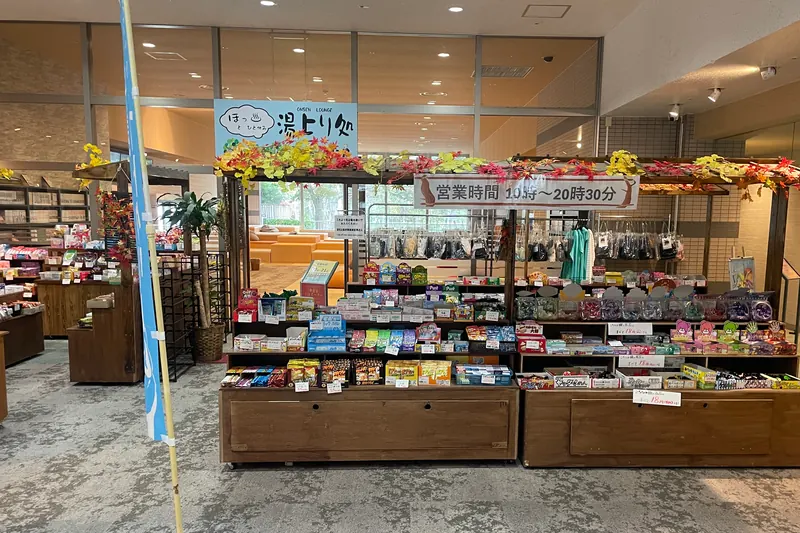
Inside the onsen hall: penny sweets, local vegetables and capsule toys
The onsen hall doubles as a small market. Its shop sells local vegetables, milk and pickles, a separate corner sells old-fashioned penny sweets, and both are open from 10:00 to 20:30. The English hot-spring page mentions it in passing: "In addition to hot springs, local vegetables, milk, and sweets are sold at the hot spring facility Hottopia."
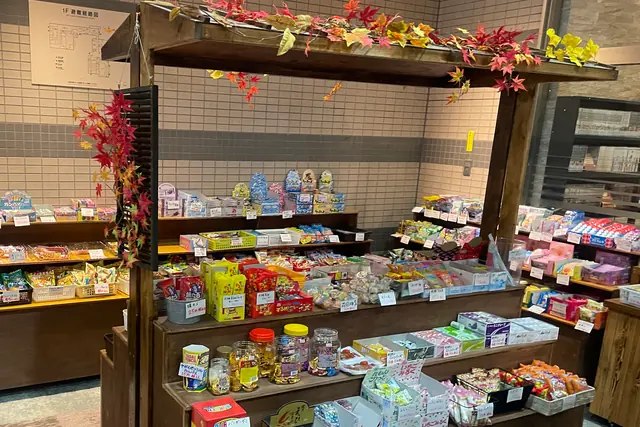
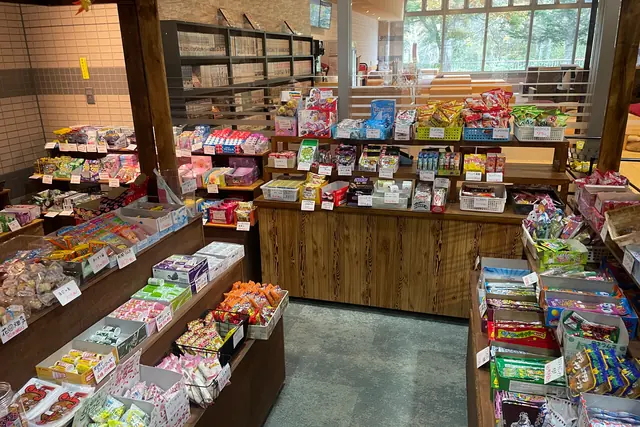
The sweets are dagashi, the cheap, brightly wrapped snacks that Japanese children have long bought with pocket money. The facilities page claims one of the largest selections in southern Hokkaido for the corner. That is the resort's own description, not something this site has measured. On 13 October 2026 the corner was a wooden market-style stall under a small roof trimmed with artificial maple leaves, with more sweets laid out on wooden counters under handwritten price tags.
Prices read on 13 October 2026
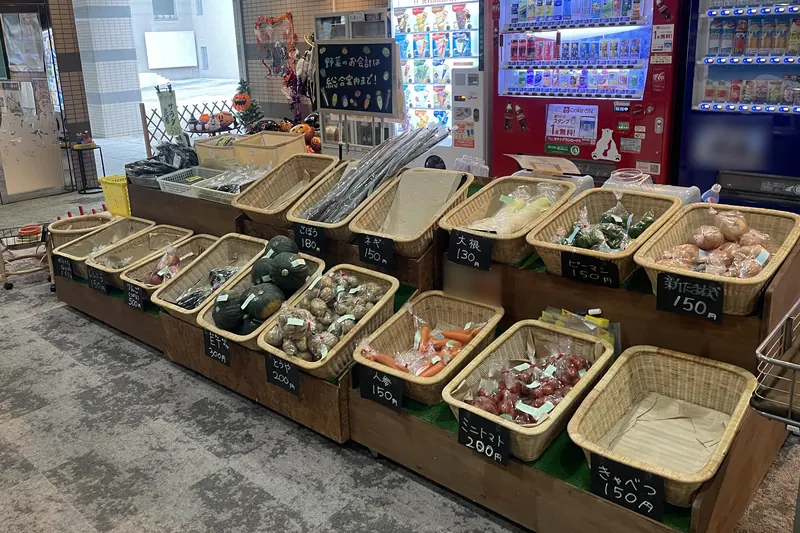
- Burdock root: 180 yen
- Long onions: 150 yen
- Daikon radish: 130 yen
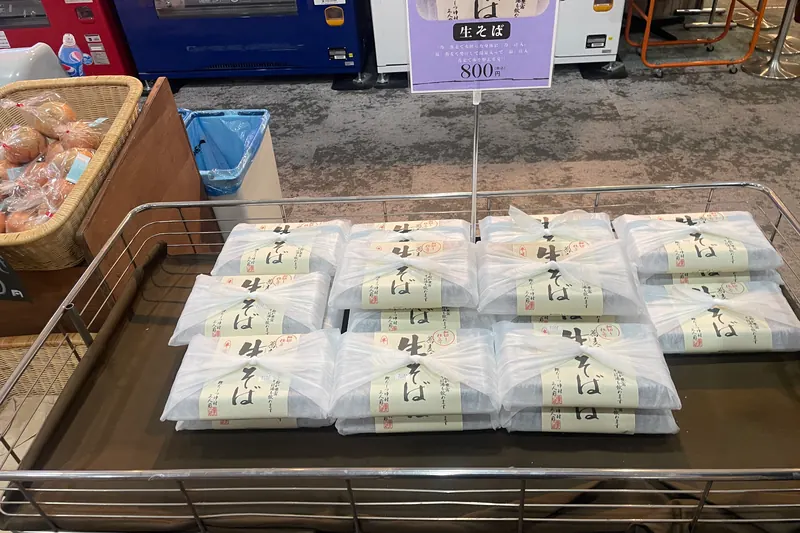
- Fresh soba: 800 yen including tax
- Penny sweets: some tags at 18 yen including tax
- Capsule toys: 300 yen at the machines read
These are single readings from tags and signs on one afternoon, not a price list.
The vegetables sat in wicker baskets with chalkboard tags, among pumpkins and Halloween decorations, and a chalkboard asked buyers to pay at the information counter.
The soba, fresh rather than dried, was stacked in packs on a wire trolley with a handwritten sign.
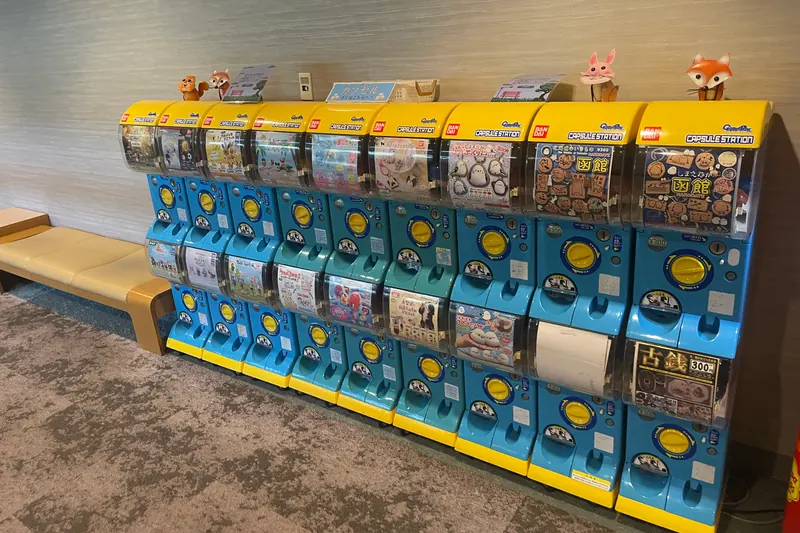
One wall of the hall is given over to capsule-toy machines, two rows of nine. Among those read that day, one sold wooden tags marked with the name Hakodate and another sold old coins.
The children's festival on 28 November 2026
The resort's event page announces a children's festival at the onsen hall on Saturday 28 November 2026, from 10:00 to 16:00.
On the programme
- Penny-sweet scooping: 100 yen a go
- Fill-a-bag potatoes: 200 yen a go
- Mini bingo: 200 yen a card, with 100 cards on sale
- Also on the day: a pottery market
Each event ends when its goods or prizes run out. For travelling with children more widely, see this site's guide to Japan with kids.
Rooms at Greenpia Onuma: hotel, capsules, domes and villas
Greenpia Onuma has five ways to spend the night: rooms in the hotel building, capsule rooms for men beside the baths, three dome tents, log-house villas in four sizes, and the camp sites described in the next section. Check-in is from 15:00 and check-out is by 10:00 for all of them except the camp sites. Nightly prices move with the plan and the date, so this site does not quote them.
Five ways to stay
- Hotel rooms: Japanese rooms, twin and triple rooms, two suites and two barrier-free rooms
- MAX CABIN: capsule rooms for one, men only, attached to the bath hall
- Dome tents: three domes for up to four people, each with a barbecue terrace
- Villas: log houses from 28.81 to 96.32 square metres
- Camp sites: three of them, one in front of the hotel and two behind it
The table sets the room types side by side, with the figures from the resort's Japanese pages. Where a page gives no number, the table says so.
| Type | Sleeps | Size | How many | Notes |
|---|---|---|---|---|
| Japanese room, hotel | 2 to 5 | 39 m² | not stated | 10 tatami mats; guests lay out their own futons |
| Western twin or triple, hotel | 1 to 3 | 36 m² | not stated | beds 126 cm wide |
| Suite, hotel | 2 to 5 | 72 m² | 2 | a twin room joined to an 8-mat Japanese room |
| Barrier-free room, hotel | 1 to 2 | 36 m² | 2 | ask for it when booking |
| MAX CABIN capsule | 1 | not stated | not stated | men only |
| Dome tent | up to 4 | 38 m² | 3 | private barbecue terrace |
| Cabin | 2 to 4 | 28.81 m² | 12 | bunk beds |
| Cottage | 2 to 4 | 53.86 m² | not stated | guests lay out their own futons |
| Junior Suite Villa | up to 8 | 77.36 m² | 2 | living room, Japanese room and wooden-floored room |
| Suite Villa | more than ten | 96.32 m² | 3 | the largest houses |
Rooms in the hotel building
Every room in the hotel looks the same way, towards the volcano. The English stay page says so directly: "All guest rooms in the hotel building have large windows with great views of Mt. Komagatake."
The Japanese room is 10 tatami mats and 39 square metres, for two to five people, with the toilet and the bathroom in separate spaces. Guests lay out their own futons there. The Western rooms hold two or three beds, each 126 centimetres wide, in 36 square metres. The two suites join a twin room to a Japanese room of eight mats, 72 square metres in all. Two more rooms are barrier-free, and the FAQ asks guests who need one to say so when booking.
In every hotel room
- Wi-Fi: free of charge
- Television and air conditioning: in each room
- Toilet: with a bidet seat
- Kettle and tea set: in each room
- Fridge and safe: in each room
- Hair dryer: in each room, with a humidifier to borrow
On the internet connection the English FAQ is specific about where it reaches: "Wi-Fi can be used for free in the hotel lobby and guest rooms within the hotel buildings."
Practical points for hotel guests
- Last check-in: 23:00
- Early check-in or late check-out: 1,100 yen per room per hour
- With dinner booked: arrive by 19:30
- Luggage before check-in: kept at the front desk
- Before check-in: the activity facilities can already be used
- Microwave: in the lift hall on each floor
- Coin laundry: on 1F, three washers and three dryers
- Nursing room: on 2F
- Wheelchairs: four to lend
The coin laundry costs 300 yen for a wash and 100 yen for 60 minutes of drying, with detergent at 100 yen, and the FAQ says people who are not staying may use it too. Bags can also be sent ahead by a delivery service and are held at the front desk; the FAQ asks senders to write the date of the stay and the name on the booking on the delivery slip. This site's luggage guide explains how those services work in Japan.
For families, the FAQ sets out the charges by age. Children aged 3 and over who are not yet at school pay the infant rate, and primary-school pupils pay the primary-school rate. For a child under 3 the FAQ lists three charges, tax included.
For a child under 3
- Bedding: 3,300 yen
- Dinner: 1,980 yen
- Breakfast: 1,100 yen
Children's yukata, the cotton robes worn around a Japanese hotel, come in three sizes and are kept beside the lift on 2F. The hotel has no baby cots, and baby goods are sold at the shop in the 2F lobby.
Rooms next to each other can be requested when the hotel is not full, although a Japanese room and a Western room cannot be side by side; the same floor is possible. The floor itself cannot be chosen, except on plans sold for the top floor. Cancellation charges begin seven days before the stay.
MAX CABIN: capsule rooms for men
MAX CABIN opened in August 2024 as a set of capsule rooms attached to the bath hall. Each capsule sleeps one person, and the English stay page adds a line of its own: "Note: This room is for men only."
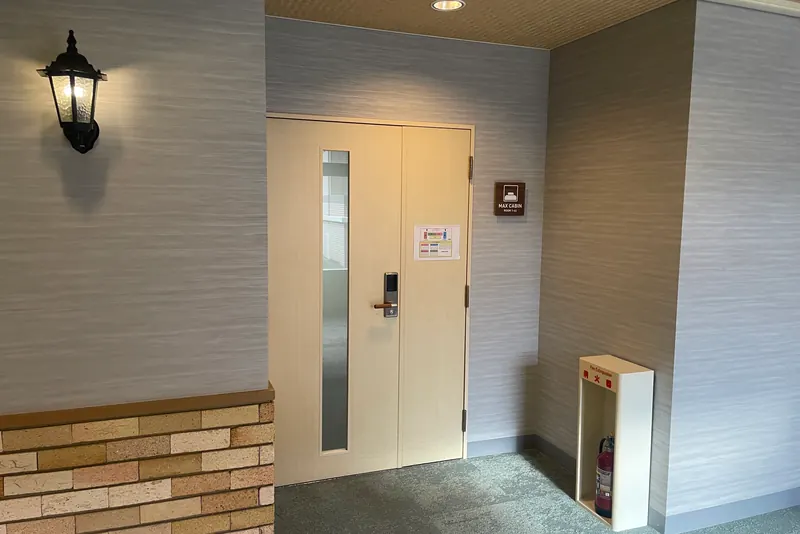
The Japanese page lists a wall-mounted television, a locker for valuables and Wi-Fi in each capsule, and a bath towel, a tenugui, a toothbrush, a hairbrush, a body towel and a razor for each guest. Capsule guests bathe free of charge, and the page says the baths, the sauna, the comic corner and the lounge are theirs to use for the whole stay. Coin lockers for larger bags are limited in number and cost 200 yen per use.
Neither language version gives the size of a capsule, so this site does not state one. The door photographed on 13 October 2026 carries a plaque reading MAX CABIN ROOM 1-44. For what a night in a capsule is like, see this site's capsule hotel guide.
Dome tents
The three dome tents opened in September 2024, and the English stay page sells them on their position: "This dome tent is a superbly located accommodation with a view of Mt. Komagatake." Each dome is a half-sphere of 38 square metres with a high ceiling and large windows, and sleeps up to four. The third and fourth guests sleep on futons.
Inside and outside each dome
- Three styles: a Japanese-style room, a room that mixes Japanese and Western styles, and a Western room
- Terrace: a barbecue terrace with its own grill and sink
- Indoors: smart television, wireless speaker, air conditioning, fridge and oven-microwave
- Air: an air purifier that also humidifies
- Drinks: a tea and coffee set and a thermos pot
- Breakfast: the buffet in the hotel restaurant
- Dinner: a barbecue can be chosen from June to the end of October
Log-house villas
The villas are private log houses in the grounds, in four sizes, and the Japanese villa page dates all of them to August 2024, either renewed or newly opened. Each house has a kitchen, a bath, a toilet with a bidet seat, a smart television, a wireless speaker, air conditioning that both cools and heats, a fridge, a rice cooker, an oven-microwave, bedding, tableware and Wi-Fi. Villa guests bathe at the onsen free of charge.
The smallest house is the Cabin, 28.81 square metres with bunk beds; two cabins form one block, so another party may be staying in the other half. The Cottage, 53.86 square metres, pairs a wooden living room with a Japanese room where guests lay out their own futons. The Junior Suite Villa and the Suite Villa each have a living room, a Japanese room and a wooden-floored room. The resort's pages do not agree on how many people the Suite Villa sleeps, with figures from 13 to 15, so the table above says more than ten; ask the resort when booking for a large group.
The resort does not drive guests between the hotel and the villas, so guests make their own way to the baths and the restaurants.
Staying with a dog
The two language versions of the FAQ disagree about dogs. The Japanese FAQ allows them in a limited set of rooms and at the camp sites, and asks owners for proof of vaccination.
What the Japanese pages say about dogs
- Rooms: some of the cabins, the cottages and the dome tents only
- Dome tents: two of the three room styles are marked as open to dogs
- Camp sites: dogs are accepted in the green season
- At check-in: proof of a rabies vaccination and a combined vaccination given within the past year
The English FAQ says the opposite: "Unfortunately, it is not possible to have pets staying in your room, regardless of the type of room." Where the two versions differ, this guide follows the Japanese pages, which are the ones showing this year's dates. Even so, anyone travelling with a dog should confirm with the resort before booking.
Groups and school trips
Two buildings are set aside for groups. Central Lodge, which the resort offers for training camps and other group stays, has seven rooms of bunk beds, sleeping from 4 to 10 people each and 50 in all, with a meeting room, a projector and screen, a washing machine, a dryer and a shower room. A separate Japanese room of 36 tatami mats, 55.74 square metres, takes up to 15 people and stands in front of the hotel building. Neither has Wi-Fi; the group page sends guests to the hotel lobby for it.
The group rooms in four numbers
- 7bunk-bed rooms in Central Lodge
- 50people in Central Lodge in all
- 36tatami mats in the large Japanese room
- 15people in the large Japanese room
Lodging tax
A notice on the resort's site dated 13 April 2026 says that Hokkaido's lodging tax applies to stays from 1 April 2026 and is charged on top of the room price. The notice itself gives no amount, so this site does not quote one here. Hokkaido's tax is covered in this site's accommodation tax guide.
Camping at Greenpia Onuma
The resort has three camp sites: Site 1 on open ground about 300 metres in front of the hotel, Site 2 about 800 metres behind it in a more natural setting, and Site 3 beside Site 2, an open site where cars and motorbikes may not enter. A pitch with a car starts at 4,000 yen, check-in runs from 13:00 to 18:00, and camp guests can bathe at the onsen hall for 1,000 yen per adult, as often as they like during the stay.
| Site | Where | What it is like | Vehicles | Price from |
|---|---|---|---|---|
| Site 1 | about 300 m in front of the hotel | wide open ground with a view of Mt Komagatake | parked beside the tent | car 4,000 yen; motorbike or bicycle 2,500 yen per person |
| Site 2 | about 800 m behind the hotel | more natural setting, with some powered pitches | parked beside the tent | car 4,000 yen, or 4,500 yen with power; motorbike or bicycle 2,500 yen, or 3,000 yen with power |
| Site 3 | about 700 m behind the hotel, beside Site 2 | open site with no marked pitches | no cars or motorbikes | tent 3,000 yen; solo camper 1,000 yen |
The camp page recommends Site 1 to first-time campers, because the hotel is next door, and Site 2 to people who want more of nature around them. At Sites 1 and 2 the price covers one tent per car. The powered pitches at Site 2 supply up to 7.5 amps, or 750 watts; the page warns that anything above that trips the breaker, and that restoring the power takes a while.
Camp basics
- Check-in: 13:00 to 18:00
- Check-out: 7:00 to 11:00
- Bath price: 1,000 yen for adults, 900 yen for seniors and students, 500 yen for children aged 3 to primary school
- Baths per stay: as many as wanted
- Bathing card: one per person, handed over when the ticket is bought at the onsen hall
- Towels: 330 yen to rent a bath towel and a face towel
- Activity tickets: 10% off for camp guests
- Dogs: accepted at the camp sites in the green season
Camp guests' bathing hours are 13:00 to 21:00 on the day of arrival, with the counter closing at 20:00, and 6:00 to 9:30 the next morning, with the counter closing at 8:30.
Day camping, without staying the night, is taken at Site 1 only. It runs from 11:00 to 21:00 and starts at 2,000 yen for a car and 1,000 yen per person for a motorbike or a bicycle.
Renting gear at the camp sites
- A barbecue tool set costs 4,400 yen: charcoal stove, grill net, iron plate, lighter, charcoal and tongs
- Tables, benches, chairs, hammocks and lanterns are rented too
- Rentals run from 1 May to 31 October
- Reserve by 12:00 on the day before the stay
- Numbers are limited
One event changes the arrangement. When the resort holds its fireworks event in September, Site 1 closes and only Sites 2 and 3 take campers, at an extra charge. The camp page gives no opening and closing dates for the sites themselves, so this site does not quote any. Ask the resort before planning a night under canvas early in spring or late in autumn.
Where to eat at Greenpia Onuma
The resort has three restaurants. Hamanasu, in the hotel, serves dinner and breakfast to guests who booked a stay with meals; Marimo, attached to the onsen hall, is open to anyone at lunch and dinner and closes on Tuesdays; and Morimori opens from 11:00 to 14:30 in the snow season.
| Restaurant | Who it is for | Hours | What it serves |
|---|---|---|---|
| Hamanasu | guests staying with meals | dinner 18:00–20:30; breakfast 7:00–9:00 | kaiseki dinner and buffet breakfast |
| Marimo | anyone, staying or not | 11:30–15:00 and 16:30–20:00; closed on Tuesdays | Japanese, Western and Chinese dishes |
| Morimori | snow-season visitors; groups by reservation in the green season | 11:00–14:30 in the snow season | curry, ramen, soba and udon |
Hamanasu: dinner and breakfast for staying guests
Staying guests on a plan with meals eat at Hamanasu, a dining room with panoramic windows. The English meal page describes the evening: "The dinner served in the hotel is a kaiseki course meal made with various Hokkaido ingredients." Kaiseki is a Japanese dinner of many small dishes brought to the table in sequence.
The Japanese page names the courses. The basic one is a seasonal kaiseki, and the one the resort recommends most is built on beef from Shiraoi and hairy crab from Mori, the town the resort stands in. Children are served a kaiseki of their own. The format changes when the hotel is full, as the English page warns: "Note: Dinner will be buffet-style during peak season." The Japanese page names the year-end and New Year holidays and the summer holidays as those periods, and says the buffet uses Hokkaido ingredients.
Meal times at Hamanasu
- Dinner: 18:00 to 20:30, with last entry at 19:30
- Breakfast: a buffet from 7:00 to 9:00, with last entry at 8:45
- Busy periods: dinner times may shift
- Food allergies: the kitchen adjusts meals for seven items only
- Allergy notice: tell the resort at least one week before the stay
The seven items are egg, milk, wheat, shrimp, crab, buckwheat and peanut. The dinner hours above are those in the Japanese FAQ; the resort's English pages show a longer dinner window, and this guide follows the Japanese pages, as it does wherever the two differ.
Marimo: lunch and dinner for anyone
Marimo is the restaurant attached to the onsen hall, and people who are not staying at the resort may eat there. It was fully renovated in July 2024 and has 50 seats, with a menu of Japanese, Western and Chinese dishes. Lunch runs from 11:30 to 15:00 with last orders at 14:30, and dinner from 16:30 to 20:00 with last orders at 19:30. The restaurant closes every Tuesday, and its page says the hours can change with the season, pointing to the notices on the resort's site.
The dish its page calls the most popular, and the restaurant's speciality, is ankake yakisoba at 1,100 yen: fried noodles under a thick, starchy sauce.
Morimori: curry and noodles in the snow season
Morimori has 60 seats and, in the snow season, opens from 11:00 to 14:30 as a place to eat and to rest. Its page does not say where in the grounds it stands, and it gives the dishes below as examples from the menu.
On the Morimori menu
- Thick-cut pork-cutlet curry: 1,200 yen
- Fried-chicken curry: 1,000 yen
- Miso ramen: 900 yen
- Salt ramen: 900 yen
- Plain soba: 600 yen
- Plain udon: 600 yen
In the green season Morimori changes role. It becomes a restaurant for jingisukan, lamb and vegetables grilled at the table, and takes groups by reservation only.
Summer and autumn activities at Greenpia Onuma: the ticket system
From late April to early November the outdoor activities at Greenpia Onuma are paid for with tickets rather than cash. One ticket costs 350 yen, or 400 yen from 1 July to 31 August, and each ride or rental takes a set number of them. Guests staying the night get 20% off and camp guests 10% off. The 2026 season opened on Saturday 25 April, and its calendar ends on Tuesday 3 November.
The ticket system in four numbers
- 350yen for one ticket outside summer
- 11tickets in a set, for the price of ten
- 20%off for guests staying the night
- 10%off for camp guests
The resort's English facilities page sums the system up in one line: "The activity facilities at Greenpia Onuma are ticket-based, with some exceptions." The English FAQ says where to buy: "Tickets are sold at the Shiki no Mori Ticket Center (next to the hotel)." The Japanese FAQ adds that there is currently nowhere to buy them in advance, and the English one is blunt about tickets left over: "Refunds are not available."
How the tickets work
- Buy tickets, or an unlimited-play pass, at the Shiki no Mori Ticket Center on the day.
- Take them to the reception desk of the activity you want and check in there.
- Use up what you bought, because unused tickets are not refunded.
Opening days and hours
The outdoor facilities do not run every day. The Japanese outdoor page gives the pattern as every Saturday, Sunday and public holiday, plus every day in the summer period from 25 July to 23 August, and it adds that some facilities keep different days.
The 2026 green season
- Opened: Saturday 25 April 2026
- Every day: 25 April to 6 May, and 25 July to 23 August
- Weekends and public holidays only: 9 May to 20 July, and 29 August to 3 November
- Hours: 9:30 to 17:00, reception until 16:30
- 24 October to 3 November: 10:00 to 16:00, reception until 15:30
The opening date is from a notice the resort posted on 9 March 2026, and the hours are from its outdoor page. The spring and autumn pattern is from the calendar on a signboard at the resort, photographed on 13 October 2026.
This site's photographs were taken on Tuesday 13 October 2026, a weekday outside that pattern, so nothing in this section describes a ride from experience.
Ticket prices
The Japanese activity page prints three price lists: a general one, one for guests staying at the resort and one for people using the camp sites. In each, the price in brackets is the summer price, charged from 1 July to 31 August. A ticket costs the same at any age.
| Ticket | General | Guests staying the night | Camp guests |
|---|---|---|---|
| One ticket | 350 yen (400 yen) | 280 yen (320 yen) | 310 yen (360 yen) |
| Set of 11 tickets | 3,500 yen (4,000 yen) | 2,800 yen (3,200 yen) | 3,100 yen (3,600 yen) |
The same page sells an unlimited-play pass for the outdoor facilities, for three hours or for a whole day, priced by age.
Prices for the three-hour pass:
| Age band | General | Guests staying the night | Camp guests |
|---|---|---|---|
| Age 3 to primary school | 3,700 yen (4,000 yen) | 2,960 yen (3,200 yen) | 3,330 yen (3,600 yen) |
| Junior-high students and seniors | 3,900 yen (4,200 yen) | 3,120 yen (3,360 yen) | 3,510 yen (3,780 yen) |
| Adult | 4,200 yen (4,500 yen) | 3,360 yen (3,600 yen) | 3,780 yen (4,050 yen) |
Prices for the one-day pass:
| Age band | General | Guests staying the night | Camp guests |
|---|---|---|---|
| Age 3 to primary school | 4,200 yen (4,500 yen) | 3,360 yen (3,600 yen) | 3,780 yen (4,050 yen) |
| Junior-high students and seniors | 4,700 yen (5,000 yen) | 3,760 yen (4,000 yen) | 4,230 yen (4,500 yen) |
| Adult | 5,200 yen (5,500 yen) | 4,160 yen (4,400 yen) | 4,680 yen (4,950 yen) |
Reading the price lists
- The price in brackets applies from 1 July to 31 August
- A ticket costs the same for every age; only the passes are priced by age
- Seniors are people aged 60 and over
- The set of 11 costs the same as ten single tickets
- Tickets go on sale on the day: the Japanese FAQ lists nowhere to buy them in advance
The English facilities page still lists lower prices, such as 300 yen for a single ticket, and draws its student band more widely, so the prices and age bands here are the Japanese page's.
The Japanese page says the pass and the tickets are for the outdoor play facilities and lists no exceptions. The coin-operated train described below takes coins rather than tickets, so it is worth asking at the ticket centre which rides a pass covers before buying one.
As a guide to the sums, one solo ride on a buggy takes two tickets. That is 700 yen at the general price, 560 yen for a guest staying the night, and 800 yen at the general price in July and August. An adult's three-hour pass, at 4,200 yen, costs the same as twelve single tickets.
What each activity costs in tickets
The outdoor page gives a ticket count for every ride and rental. The table repeats them as that page lists them; the times are how long one go or one rental lasts.
| Activity | Tickets | Notes |
|---|---|---|
| Inflatable play area | 30 minutes 3; 60 minutes 4; 90 minutes 6 | for children of primary-school age and under |
| Sports slider | single 2; double 3, per run | a sled on a track, described as a summer version of bobsleigh |
| Park golf | 2 per person | the 18-hole Shirakaba course, all day, equipment included |
| Buggy | 10 minutes: single 2; double 4 | limits in the box below |
| Electric kick scooter | 10 minutes 2 | riders of 80 kg or less |
| Kick-scooter-style bicycle | 30 minutes 2 | |
| Rental bicycle | 30 minutes 1; 60 minutes 2; 1 day 9 | a tandem takes 2 for 30 minutes |
| Family cycle | 30 minutes 2 | a six-seater and a three-seater, with a front seat for small children |
| Linked cycle | 30 minutes 1 per cycle | cycles that join in a row, suggested for groups |
| Fat bike | 30 minutes 2; 1 hour 3; 2 hours 4; then 1 per extra hour | tyres twice as thick as a mountain bike's; may leave the grounds |
| Electric-assist bicycle | 30 minutes 2; 1 hour 3; 2 hours 4; then 1 per extra hour | may leave the grounds; the page suggests Onuma Park |
| Off-road cycle | 30 minutes 1 | four wheels, easy for small children |
| Pony cycle | 5 minutes 1 | a ride-on pony moved by shifting the rider's weight |
| Wiggle cycle | 15 minutes 1 | moved by swaying the hips |
| Land car | 15 minutes 2; 30 minutes 3; 1 hour 6; 4 hours 11; 8 hours 19 | a golf-cart type that seats four or five |
The inflatable play area holds several inflatables. Children aged 2 and under need no ticket, and children of junior-high age and older and the adults who come in with a child are not charged. Inside it a coin-operated battery train runs on rails, at 200 yen a go. Two things cost nothing in the green season: the athletic course and a giant doughnut-shaped climbing frame.
Limits and lunch breaks
- Buggy: from the fourth year of primary school, 80 kg or less; no sandals or shorts; not run in rain; pauses 13:00 to 13:45
- Buggy for two: only for a child aged 3 to the third year of primary school riding with an adult
- Electric kick scooter: 80 kg or less; pauses 12:00 to 13:00
- Sports slider: pauses 12:15 to 13:00
- Inflatable play area: closes in wind of 7 metres a second or more, and may close in rain
- Land car: an ordinary driving licence is required
The land car is the one activity that asks for a driving licence: the page says an ordinary licence is required to drive it, on a route along the Shukunobe River. It does not say whether a foreign licence or an International Driving Permit counts, so ask at the ticket centre before buying tickets for it. What visitors need in order to drive on Japan's roads is covered in this site's guide to driving in Japan.
For groups and company outings the resort also offers a sports ground, a gymnasium and tennis courts. The signboard photographed on 13 October 2026 priced a tennis court at 2,200 yen an hour.
Drones are not allowed. The English FAQ says: "Due to safety reasons, we are unable to allow use of drones within the area." The Japanese FAQ makes an exception for flights the resort has permitted in advance, such as for media coverage. Japan's wider drone rules are in this site's guide to rules for tourists in Japan.
The indoor pool, karaoke and table tennis
Greenpia Onuma has a heated indoor pool that is open all year, in the Hottopia onsen hall, along with karaoke rooms, table tennis and a game corner. The activity tickets are for the outdoor facilities, so the pool, karaoke and table tennis each have their own price in yen.
The pool in four numbers
- 25metres, the length of the main pool
- 3lanes in the main pool
- 60cm of water in the children's pool
- 3hours on a day visitor's fee
Beside the main pool there are a children's pool, a water slide and a jacuzzi.
Pool hours and prices
Pool hours
- Most of the year: 10:00 to 19:00, reception until 18:00
- 1 July to 31 August: 10:00 to 20:00, reception until 19:00
- Night pool: 19:30 to 21:00, held irregularly
The night pool has no fixed days, so ask the resort whether one is planned for the dates of a trip.
Guests staying at the hotel pay 350 yen for an adult and 250 yen for a child. Prices for day visitors:
| Day visitor | Most of the year | 1 July to 31 August |
|---|---|---|
| Adult | 700 yen | 900 yen |
| Child | 400 yen | 600 yen |
| Senior or student | 600 yen | 800 yen |
A day visitor's fee covers up to three hours. The resort's indoor page defines a child as aged 3 to the sixth year of primary school and a senior as 60 or over.
Renting at the pool
- Swimsuit: 650 yen, in children's sizes of 110 to 160 cm only
- Float toy: 450 yen
- Swim ring: 350 yen
- Goggles: 220 yen
Because the rental swimsuits come in children's sizes only, adults need to bring their own.
Pool rules on the resort's pages
- The water slide is not for children under 6, or for anyone 120 cm or shorter
- Young primary-school children need an adult with them
- A spin-dryer for swimwear stands in front of the pool's changing room
- Group discounts and private hire can be arranged
The pages put the line for an accompanying adult in slightly different places: the pool page at the fourth year of primary school and below, the Japanese FAQ at the third year and below.
The two FAQs also disagree about swimming caps. The Japanese one says a cap is not required, while the English one says: "Both adults and children must wear a cap in the heated pool." This guide follows the Japanese pages, as it does elsewhere, but packing a cap settles the question either way.
Karaoke
Karaoke runs from 10:00 to 21:30, with reception until 21:00, and until 24:00 for guests staying the night. The machines keep score, singing alone is welcome, and preschool children are free.
| Who | Price per person |
|---|---|
| Hotel guests | 300 yen for 1 hour, or 1,000 yen for free time |
| Day visitors | 300 yen for 30 minutes, or 1,500 yen for free time |
A room for up to 20 people costs 2,500 yen for two hours and needs a reservation. Food and drink from the Marimo restaurant and the after-bath lounge can be brought into the rooms, and guests staying the night can settle the bill at check-out.
Table tennis and the game corner
Table tennis and games
- Table tennis: 10:00 to 21:30, reception until 21:00, at the onsen hall's counter
- Per person, per hour: 240 yen for hotel guests, 300 yen for day visitors
- Game corner, weekdays: 15:00 to 21:00
- Game corner, weekends and public holidays: 9:00 to 21:00
The table-tennis corner lends ordinary bats and odd-shaped ones. The game corner's longer hours also apply during the Golden Week, summer and winter holiday periods.
One thing to check before counting on it is bowling. The English facilities page lists a bowling alley, and a line on the Japanese pool page mentions bowling too, but the Japanese indoor page gives no section, hours or price for it.
Dates and prices on this page that will change
Almost every number in this guide belongs to a season. These are the ones most likely to be out of date first, with the day each was read.
Dates that decide a trip
- Ski season: Friday 25 December 2026 to Sunday 7 March 2027, with the opening date marked as planned
- Season-pass discount: 10% in October, 5% in November, then none
- Outdoor activities in 2026: until Tuesday 3 November
- Summer prices: 1 July to 31 August
- Children's festival: Saturday 28 November 2026
- The ski season. The opening date moves with the snow.
- Lift tickets. The prices are those listed on 13 October 2026, with no season label beside them.
- Green-season dates. Dates for 2027 were not on the pages read; the 2026 opening date came in a notice dated 9 March 2026.
- Summer prices. Activity tickets and the pool cost more in the summer period, and the pool stays open an hour longer.
- Events. The children's festival is a single day. The Wednesday sauna sessions are a running event and can change.
- Onsen hours. The morning break and the later opening of the open-air bath on cleaning days are as the hot-spring page gave them on 13 October 2026.
- Lodging tax. The resort's notice says only that the tax applies to stays from 1 April 2026, and gives no amount.
- Restaurant hours. Marimo's hours and closing day, and Morimori's snow-season opening, are the ones on the resort's pages on 13 October 2026.
- This site's photographs. They record one afternoon, 13 October 2026. The displays, the produce on sale and the price tags in them will have changed.
Frequently asked questions
Is Greenpia Onuma in Hakodate?
No. The resort carries Hakodate in its name, but it stands in the town of Mori, about 50 minutes by car from Hakodate and about 10 minutes from Onuma Park.
When does the Greenpia Onuma ski season start?
The resort lists the 2026-27 season as Friday 25 December 2026 to Sunday 7 March 2027, with the opening date marked as planned. The real opening depends on snowfall. The previous season ended on Sunday 8 March 2026.
How much is a lift ticket at Greenpia Onuma?
An adult's one-day lift ticket costs 5,500 yen, or 4,950 yen for guests staying at the resort, as listed on 13 October 2026. Preschool children ride the lifts free.
Does Greenpia Onuma have night skiing?
Yes, on Fridays and Saturdays from 17:00 to 20:45, on lift 1 only. An adult's night ticket costs 2,000 yen, and a season pass covers the night sessions too.
Is Greenpia Onuma good for beginner skiers?
The courses run from beginner to advanced, and the gentlest, Family road, is 1,200 metres long with a steepest gradient of 14 degrees. There is also a free snow escalator, a children's slope and lessons that preschool children can join from the age of 5.
Can day visitors use the onsen at Greenpia Onuma?
Yes. Day visitors can bathe from 6:00 to 9:30 and from 11:00 to 21:00, with last entry at 8:30 and 20:00. The price is 1,000 yen for an adult, 900 yen for a senior or student and 500 yen for a child.
Are tattoos allowed in the onsen at Greenpia Onuma?
None of the resort's pages read for this guide, in Japanese or in English, states a rule on tattoos. Ask the resort before travelling if the answer matters to you.
Is there a shuttle bus to Greenpia Onuma?
Yes, but only for guests staying the night. It leaves Shin-Hakodate-Hokuto Station at 11:00, 12:25, 14:05 and 15:30 and calls at Onuma-Koen Station about 20 minutes later. It is free and has to be booked by 18:00 on the day before. Buses back leave the resort at 10:00, 13:20 and 16:30.
Can you get to Greenpia Onuma without a car?
Yes. Guests staying the night can book the free shuttle. Anyone else can take a JR train to Onuma-Koen Station, about 40 minutes from Hakodate, and then a taxi for about 15 minutes.
Can I bring a dog to Greenpia Onuma?
The resort's two FAQs disagree. The Japanese one says dogs can stay in some cabins, cottages and dome tents, and at the camp sites in the green season, with proof of vaccination. The English one says pets cannot stay in any room. Confirm with the resort before booking.
What is MAX CABIN at Greenpia Onuma?
MAX CABIN is a set of capsule rooms for men only, attached to the bath hall, that opened in August 2024. Each capsule sleeps one person.
Is the pool at Greenpia Onuma open in winter?
Yes. The heated indoor pool is open all year, from 10:00 to 19:00, and until 20:00 from 1 July to 31 August. Outside that summer period a day visitor pays 700 yen per adult for up to three hours.
How much are the activity tickets at Greenpia Onuma?
One ticket costs 350 yen, or 400 yen from 1 July to 31 August, and a set of 11 costs the same as ten. Guests staying the night get 20% off and camp guests 10% off. A solo buggy ride takes two tickets, which is 700 yen at the general price.
Where can people who are not staying eat at Greenpia Onuma?
At the Marimo restaurant, which is open from 11:30 to 15:00 and from 16:30 to 20:00 and closes on Tuesdays, and in the snow season at Morimori, open from 11:00 to 14:30. The Hamanasu dining room is for guests who booked a stay with meals.
Sources
Official and primary sources used for this page. Checked October 14, 2026.
- LiveMax Resort Hakodate Greenpia Onuma: 森と緑に囲まれたホテル&リゾート (in Japanese) — the number of rooms and the size of the grounds
- LiveMax Resort Hakodate Greenpia Onuma: アクセス (in Japanese) — driving routes and times, trains, taxis and parking
- LiveMax Resort Hakodate Greenpia Onuma: 送迎バスの予約 (in Japanese) — the shuttle's timetable and its booking deadline
- LiveMax Resort Hakodate Greenpia Onuma: よくあるご質問 (in Japanese) — the ticket centre, what is nearby, dogs, the pool, drones and other practical answers
- LiveMax Resort Hakodate Greenpia Onuma: 施設案内 (in Japanese) — the entrance hall, the after-bath lounge, the penny-sweet corner and the renewal
Show all 37 sources
- LiveMax Resort Hakodate Greenpia Onuma: スキー場 (in Japanese) — the 2026-27 season, opening hours and night skiing
- LiveMax Resort Hakodate Greenpia Onuma: リフトのご案内 (in Japanese) — lift hours, ticket prices and the season pass
- LiveMax Resort Hakodate Greenpia Onuma: ウィンターアクティビティ (in Japanese) — sledging, the snow scoot and rental discounts
- LiveMax Resort Hakodate Greenpia Onuma: スキースクールのご案内 (in Japanese) — lessons and the age for joining them
- LiveMax Resort Hakodate Greenpia Onuma: スキー場営業終了のご案内, 9 March 2026 (in Japanese) — the end of the 2025-26 ski season and the opening of the outdoor facilities on 25 April 2026
- LiveMax Resort Hakodate Greenpia Onuma: 温泉 (in Japanese) — bath hours, prices for day visitors, cleaning days and rules
- LiveMax Resort Hakodate Greenpia Onuma: 毎週水曜日の熱波師来館イベント! (in Japanese) — the Wednesday sauna sessions and their start times
- LiveMax Resort Hakodate Greenpia Onuma: 水曜日限定!温泉入り放題プラン (in Japanese) — the Wednesday-only onsen plan
- LiveMax Resort Hakodate Greenpia Onuma: 温泉保養館こどもまつり (in Japanese) — the children's festival on 28 November 2026
- LiveMax Resort Hakodate Greenpia Onuma: 宿泊施設 (in Japanese) — the kinds of room and how many there are
- LiveMax Resort Hakodate Greenpia Onuma: ホテル (in Japanese) — rooms in the hotel building
- LiveMax Resort Hakodate Greenpia Onuma: MAX CABIN (in Japanese) — the capsule rooms
- LiveMax Resort Hakodate Greenpia Onuma: グランピング (in Japanese) — the dome tents
- LiveMax Resort Hakodate Greenpia Onuma: ヴィラ (in Japanese) — the log-house villas
- LiveMax Resort Hakodate Greenpia Onuma: キャンプ場 (in Japanese) — the three camp sites, their prices and gear rental
- LiveMax Resort Hakodate Greenpia Onuma: セントラルロッヂ・大部屋 (in Japanese) — rooms for groups and school trips
- LiveMax Resort Hakodate Greenpia Onuma: 宿泊税徴収のご案内, 13 April 2026 (in Japanese) — the lodging tax on stays from 1 April 2026
- LiveMax Resort Hakodate Greenpia Onuma: お食事のご案内 (in Japanese) — dinner and breakfast at Hamanasu
- LiveMax Resort Hakodate Greenpia Onuma: レストランまりも (in Japanese) — Marimo's hours, closing day and menu
- LiveMax Resort Hakodate Greenpia Onuma: レストランもりもり (in Japanese) — Morimori's hours and dishes
- LiveMax Resort Hakodate Greenpia Onuma: アクティビティ (in Japanese) — activity ticket and pass prices, the discounts and the summer period
- LiveMax Resort Hakodate Greenpia Onuma: 屋外遊戯施設 (in Japanese) — opening days, hours and the ticket count for each activity
- LiveMax Resort Hakodate Greenpia Onuma: プール (in Japanese) — pool hours, prices, rentals and rules
- LiveMax Resort Hakodate Greenpia Onuma: 屋内遊戯施設 (in Japanese) — karaoke, table tennis, the game corner and the age bands
- LiVEMAX RESORT HAKODATE Greenpia Onuma: A resort hotel surrounded by forests and greenery in Hakodate, Hokkaido — the size of the grounds in the resort's English wording
- LiVEMAX RESORT HAKODATE Greenpia Onuma: ACCESS — the shuttle and the journey, in English
- LiVEMAX RESORT HAKODATE Greenpia Onuma: FAQ — banks, bathing rules, pets, tickets, refunds, drones and the pool cap, in English
- LiVEMAX RESORT HAKODATE Greenpia Onuma: SKI RESORT — the courses, the lifts and the view from the top, in English
- LiVEMAX RESORT HAKODATE Greenpia Onuma: HOT SPRING — the spring type and the onsen hall, in English
- LiVEMAX RESORT HAKODATE Greenpia Onuma: STAY — hotel rooms, MAX CABIN and the dome tents, in English
- LiVEMAX RESORT HAKODATE Greenpia Onuma: MEAL — dinner at Hamanasu, in English
- LiVEMAX RESORT HAKODATE Greenpia Onuma: FACILITY — the ticket system in English, the older ticket prices and the bowling alley
Related guides
To cite or link to this page: Greenpia Onuma, Hokkaido: the ski slopes, the onsen, rooms, prices and how to get there — Japan Pocket Guide, https://japanpocketguide.com/things-to-do/greenpia-onuma/